

Geologist, Senior Fellow CO2 Coalition, Expert Reviewer IPCC AR6
Apollo Beach, FL
Joined August 2017
- Tweets2K
- Following499
- Followers4.1K
- Likes208




Gregory Wrightstone retweeted

Climate policies have consequences
EU pays 1.9x US prices and 3x China and India
UK has the costliest electricity in the world
iea.org/data-and-statistics/…


The cheap green lie
You are told that solar and wind are cheap
But you need near-100% backup when no sun or wind, paying for two systems
Data for 2025 shows that
cramming in more solar and wind makes electricity overall more and more costly
Sources:
Electricity prices, households and industry, 2025
iea.org/data-and-statistics/…
Solar and wind generation, electricity use and consumption weights
iea.org/data-and-statistics/…
Solar and wind for countries without IEA 2025 data
ember-energy.org/data
Electricity trade partners, plus industry prices for Norway, Albania, Iceland and Kosovo
ec.europa.eu/eurostat/web/en…
US industry price
eia.gov/electricity/annual
Australia, IEA 2021 prices updated with official price indices
abs.gov.au/statistics/econom…
South Africa industry price
eskom.co.za/wp-content/uploa…
Taiwan industry tariff
taipower.com.tw
Egypt industry tariff
egyptera.org/en/TarrifAug202…
Tunisia tariffs (archived copy, the STEG site is unreachable)
web.archive.org/web/20250614…
Azerbaijan industry tariff
regulator.gov.az/en/istehlak…
2025 tariff changes applied to IEA 2024 prices
Pakistan: nepra.org.pk
Thailand: erc.or.th
Ghana: purc.com.gh
Paraguay: ande.gov.py
Kazakhstan: stat.gov.kz/en/industries/ec…
GlobalPetrolPrices 2025 averages for 18 countries, read from archived 2025 pages
globalpetrolprices.com/elect…
web.archive.org
Sri Lanka 2025 tariff changes
pucsl.gov.lk/end-user-tariff…
Indonesia solar and wind estimated from official 2025 capacity
esdm.go.id/id/media-center/a…
Statista 2025 averages for China, Mexico, Brazil, Russia, Singapore, Peru, Argentina and South Africa (data from GlobalPetrolPrices)
statista.com/statistics/1369… (business prices worldwide)
statista.com/statistics/1461… (household prices worldwide)
statista.com/statistics/1173… (Latin America business)
statista.com/statistics/1123… (Latin America households)
statista.com/statistics/1373… (China business)
statista.com/statistics/1372… (Mexico business)
statista.com/statistics/1372… (Mexico households)
statista.com/statistics/1617… (South Africa households)

Gregory Wrightstone retweeted

Can everyone say Great Day?
This is what wind grift looks like in ACNJ.
Wind speed: 13 mph
Electricity generated: 0 kWh
We have created two wonderful ads and hope to embark on a national ad campaign.
myemail.constantcontact.com/…

1
139

Suncor vs Boulder is currently before the Supreme Court. Claims of harm to its citizens are thoroughly rebutted in our recent report on Colorado and Climate Change.
co2coalition.org/publication…


Help me get to #1 bestseller on Amazon... currently #19. amazon.com/dp/1662885857?lv=…

1
102
Anthropic pirated a copy of Gregory Wrightstone’s bestselling book Inconvenient Facts to illegally train its AI Claude chatbot. Wrightstone is now part of the $1.5B Anthropic class action settlement.
apnews.com/article/anthropic…

3
116
Vijay Jayaraj continues to expose how the climate bed-wetters are keeping billions in the developing world in generational poverty.
co2coalition.org/2026/09/17/…

2
106
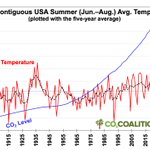
The summer of 2026 was the hottest summer ever recorded in the US?
Summer 2026 was an avg of 73.9 degrees F i. That number was bested in 1936, 1934 and in 1901 Note that CO2 levels during those years were more than 100 ppm lower than today for the 3 previous highs.

The number of the most dangerous tornadoes have been declining for the last 50+ years. Sleep well... there is no climate crisis.

The number of the most dangerous tornadoes have been declining for the last 50+ years. Sleep well... there is no climate crisis.

Gregory Wrightstone retweeted

The collapse can’t come quick enough. 👇

The Trump administration has proposed an amendment to the U.S Fifth National Climate Assessment that acknowledges its emission forecasts (the now infamous RCP8.5) are implausible and must not guide federal policymaking.
This is a welcome restoration of scientific integrity, says executive director Angela Wheeler of the @CO2Coalition.

Gregory Wrightstone retweeted

How Grifters Twist Nepal’s Natural Glacier Avalanche to Blame Fossil Fuels.
Avalanches and earthquakes are relatively common in the Himalaya and recently drove Langtang Lirung’s glacier collapses. For example, on the south-facing side of Langtang Lirung, a 7.8 earthquake caused an avalanche that destroyed the village of Langtang in 2015 (graphic B). On August 26th, 2026 another tragic avalanche happened on its north-facing side. A block of ice and rock, one km wide by 1.5 km long and as much as 200 m thick, fell 1.2 kilometers to the valley floor, causing the earth to shake so severely, it was first believed that an earthquake had triggered the avalanche. That mistaken attribution was used by a grifting washed-up TV weatherman Gloninger to suggest earthquakes did not cause the Himalayan glacier’s instabilities, so it must be climate change. Likewise, socialists on X like @Communist977, @ProudSocialist, socialist @ClaudiaWebbe and radical environmentalists and many more were quick to post about this Nepal tragedy as evidence of failed economies that burn fossil fuels.
However, science provides a far more naturalistic understanding.
Although an earthquake may not have triggered the recent devastating avalanche, earthquakes had certainly set the stage for it. Because plate tectonics are still driving India into Asia and uplifting the Himalaya, earthquake events of magnitude 4 or less, occur frequently across the Himalaya. Often daily somewhere along the range. Moderate earthquakes occur every few years in central Nepal and have produced noticeable shaking in the Langtang valley. Such shaking fractures existing glaciers, and creates large, unstable blocks of glacial ice (seracs) formed by intersecting deep cracks (crevasses) that create instabilities that later lead to a glacier’s collapse.
The continual Himalayan uplift also created differing topographies on south-facing and north-facing slopes. The south side where the 2015 avalanched occurred experiences a progressive mass loss and thinning glaciers, typical of monsoon-influenced warming. The north-side, where the 2026 avalanche happened, consists of extremely steep cliffs with hanging glaciers that are far more vulnerable to destabilization. Langtang’s steep faces and hanging glaciers produce avalanches frequently, ranging from small, regular ice falls to rare, valley-reaching events. In contrast to ignorant grifting alarmists who blame fossil fuel warming for shrinking glaciers and glacier instabilities, the adjacent Karakoram mountain range (graphic A) has experienced very stable and growing glaciers. Global warming can’t drive both changes!
Grifters, with limited scientific understanding, have been quick to argue a warming trend created melt water that lubricates the glacier-ground interface and destabilizes the glaciers. Grifters like Gloninger claim temperatures have warmed 50% faster in this region, as if that is the only evidence needed to blame burning fossil fuels. However, on Langtang Lirung, at the 5200 meter elevation where the rock-ice block first separated to start the 2026 avalanche, the average summer temperature is still below freezing at -6°C to -8°C (21°F to 17°F). During the warmest summer period, mid-day averages reach 2°C to 6°C (36°F to 43°F) but night temperatures stay near -2°C to -5°C (28°F to 23°F). Furthermore, science suggests air temperatures are not affecting the surface ice.
The top few meters of a glacier, rapidly respond to air temperature, sunshine, and seasons. Nonetheless winter cold and summer warmth only penetrate about 10–20 m from the glaciers’ surface. Thus, changes in atmospheric temperature are unlikely to provide “lubricating” melt water in 200-meter thick glaciers. Below the shallow “seasonal layer,” temperature is steady and often close to the local mean annual air temperature, which again averages summer temperature below freezing at -6°C to -8°C (21°F to 17°F). Still studies show the glacier-ground interface is almost always warmer than the ice above it for 3 main reasons: 1) Because ice is such a good insulator, the geothermal heat rising from Earth’s interior accumulates at the glacier’s bottom. 2) frictional heat from ice sliding over rock adds to the temperature. 3) Under thick ice, the melting point is lower due to pressure effects. So even if the surface is –30 °C or colder, the bed of a 2–3 km ice sheet can sit at or very near 0 °C. Global warming is not a factor.
It is true that ice frozen into the rocks and sediments can act like glue that holds the sediments together. There are studies that show a change in surface temperature from -10°C to 0°C can weaken that “ice glue” by 78%. Still, that doesn’t mean, CO2 warmed air temperatures have caused the un-gluing” instability. The science suggests geothermal heat the most likely cause of any temperature changes causing instabilities in the glacier-ground interface

Gregory Wrightstone retweeted

I’ve spent many weeks doing fieldwork in Tibet, sitting above these enormous, deeply incised Himalayan river systems and seeing firsthand just how geologically active this landscape is.
So spare me the climate-change grift every time a natural disaster strikes.
Catastrophic glacial outburst floods are not new. The 1981 Zhangzangbo GLOF released ~20 million m³ of water and debris into Nepal, with estimated peak discharge approaching 16,000 m³/s. The Himalayas experienced enormous GLOFs long before today's atmospheric CO₂ concentrations.
If it happened naturally in the past, we should expect it to happen naturally again in the future—regardless of atmospheric CO₂.
Turning a horrific loss of life into an immediate climate-change narrative without demonstrating that CO₂ caused this particular event isn't attribution. It's opportunism.
And the people exploiting tragedy to do it are grifters.

From Angela Wheeler, ED of CO2 Coalition:
co2coalition.org/2026/08/06/…

115
Gregory Wrightstone retweeted

🚨 BRITAIN HAS FINALLY FOUND A WAY TO EXPLAIN NET ZERO...
MAKE IT A COMEDY.
The team at Artificial Idiots have produced one of the funniest political sketches I've seen in a long time.
The "solar-powered submarine" alone is worth watching.
Brilliant satire. Brilliant writing.
Enjoy. 🤣👇 @AiIdiots


