

FACTS: The Golden Age of Boxing c1900-1940. AUTHOR: Catherine Johnson. BOOK: Then The World Moved On: The Brutal Truth Behind the Baer-Campbell Fight.
Joined July 2022
- Tweets4.4K
- Following307
- Followers779
- Likes264K





Pinned Tweet
Once upon a time #OTD in 1930, a future heavyweight champ purposefully beat to death his opponent. Then he bragged about it. He lied and changed his story about what happened. He lied about his support of the dead man's family. He used that death as a public relations tactic for pity and support and to intimidate his opponents. So three years of solid research and 1400 solid primary sources later, I wrote a book about it. If you want to know the uncomfortable truths after a century of lies, check it out: a.co/d/gq4Zad1
MYTHS DEBUNKED
- with primary sources too, what a concept.
#OTD in 1909, Stanley Ketchel fought Jack Johnson in what has long been framed as a fix, a fake, or a mere exhibition. It was none of those things. Those lies came from just one man: George Little, Johnson's disgruntled ex-manager. Little was adept at self-promotion but blinded by self-delusion, casting himself as a mastermind behind the champion's success. He was driven by greed and spite: his true goal was simply to squeeze more money from Johnson and diminish his athletic legacy as the cherry on top.
Without financial paper trails, betting anomalies, or any corroboration from promoters or opposing camps, Little made claims that the Kaufman, Ketchel, and Jeffries fights were all fixed. But these claims remain nothing more than the unverified, sketchy grumblings of a bitter ex-employee.
Little stated that on the evening of October 15, 1909, Ketchel and Johnson practiced the choreography for their fight by piling rugs and pillows on the parlor floor of the house belonging to Willis Britt, Ketchel's manager. However, both training camps were swarmed by sports writers, photographers, and boxing enthusiasts who accounted for the fighters' whereabouts hour by hour. Knowing both men's penchant for partying into the early hours, reporters had even staged automobiles outside the camps to track their every movement. Logistically, the idea that Johnson and Ketchel secretly commuted along steep, unlit early roads of primitive sand and dirt—navigating the miles between Johnson's camp at Ocean Beach, Ketchel's camp down in Colma, and Britt's house out in the Fillmore district for a midnight rehearsal—was laughable to the locals.
To understand the absurdity of these claims, it helps to look at the timeline of when Little actually began spinning his tall tales. It was during Johnson's preparations for the 1910 Jeffries fight that the champion finally tossed Little overboard, suddenly having police escort his ex-manager from his Ocean Beach training camp. Johnson claimed Little tried to persuade him to throw the fight to Jeffries; Little countered that Johnson tried to persuade him to help orchestrate the throw. The reality was clear: Little had not only been kicked out of the champion's lucrative inner circle, but Johnson had cut him loose right before he was about to collect his largest windfall ever.
A week after Johnson defeated Jeffries, Little began to wildly spout off to the press. Sports writers at the time gave his claims zero credence. The press labeled him a desperate man trying to be seen as Johnson's puppeteer, determined to force a cut of the fat Jeffries purse denied him. As one contemporary report noted, "He is vindictive and is trying to even up old scores with Johnson." As Little's fixed-fight stories escalated in sensationalism, he repeatedly claimed, "I was not invited but I later went in," to describe several super-secret meetings where these nefarious plans were supposedly hatched—an implausible statement at best.
Turning back to the Johnson-Ketchel fight itself, some modern critics claim Ketchel's famous 12th-round knockout punch actually missed. Referee Jack Welsh vehemently contradicted this, confirming the punch landed squarely. Welsh repeatedly stated that Johnson simply got careless, Ketchel saw his moment, and swung. Several reporters later noted a large lump behind Johnson's ear, which Jack confirmed was the direct result of Ketchel's blow. Did Johnson carry Ketchel to make the fight films profitable? He admitted he did so. But Ketchel's final blow-against an opponent who out-weighed him fully fifty pounds-was real.
There were absolutely no contemporary claims that the fight was intended to be an exhibition. While Ketchel originally pushed for a grueling 45-round bout, Johnson stood firm. The articles of agreement were explicitly drawn up and billed for a competitive 20-round fight, and that is exactly how reporters covered the event.
Later comments mocking Ketchel for supposedly putting on high-heeled boots to appear taller next to the champion ignore a basic fact of his personality: Ketchel always wore high heels. Standing just under 5'10", he was deeply insecure about his height and wore them constantly; reports from his training camps even note that he wore them while running his daily eight to ten miles.
Similarly, though Ketchel looked bulky and tall in the contract-signing photo next to Johnson, those heels were among his regular wardrobe. While it is suspected he put on several layers of winter clothing, he may have overdone it to appear closer to Johnson's size by donning his heavy automobile car coat. These massive greatcoats—made of thick wool, leather, or dense animal furs like bear and raccoon—were standard gear at the high speeds Ketchel clocked, to shield him from freezing winds in an era of open, windshield-less vehicles.
Finally, claims that Ketchel and Johnson went out together after the fight to shoot craps and party the night away are completely false. San Francisco papers remarked that while friends tried to get Ketchel to go dancing at a local resort, he hid from sight for several days until a dentist could repair the teeth Johnson punched away to the gumline. Those reporters also tracked Johnson as he immediately hopped into a car and headed to the Black section of town to celebrate his victory.
George Little continued for several more years after this debacle to threaten suits and hint at scandalous stories about Johnson in an attempt to get more money from him, but he never won a court case of any kind against Johnson. In fact, every legal attempt Little later launched against the champion either collapsed before a verdict or was abandoned by him entirely.
Stanley Ketchel himself best closed the book on George Little's fiction with one simple, definitive query: "Does he suppose that I would have taken the punishment I did in that battle if it had not been on the level?"


Paul Berlenbach, known as the "Astoria Assassin," suffered an attack of scarlet fever as a child that left him both deaf and dumb. He solved the problem himself by climbing a telegraph pole and getting a shock from a loose cable that almost killed him. His speech returned, and shortly afterwards his hearing did too. Prior to taking up boxing professionally he was also an Olympic wrestler.
He fought out of New York from 1923-1931. He was a converted southpaw with a wicked left hook and one of the most brutal body punchers ever. He boasted a record of 41-8-3 (35 KOs) and won the Light Heavyweight Championship of the World from Mike McTigue in 1925 and defended his title five times before a loss in a 1926 rematch to Jack Delaney.
Berlenbach fought Battling Siki, Mickey Walker, W.L. "Young" Stribling, Jack Delaney, Mike McTigue, Jimmy Slattery, Billy Conley and Johnny Risko.
Berlenbach is consistently ranked in the Top 10 for All-Time Greatest Light Heavyweights.

"A sort of stillness fell upon my heart. At last this thing that brought men from the ends of the earth to witness was going to happen.
The two men, the black and the copper-colored, in their single bright garments, came from their corners...the black man smiled, the copper-colored man chewed gum with a slow, regular movement of his big straight mouth.
They watched each other with glances that seemed to bind them together like taut wire. The eyes determined everything-when to attack, when to seem to attack, when to guard, when to parry. It was a game these men were playing. I saw before the first three minutes had passed, a game as intricate, calling for as much skill as chess; a game in which the opponents conceded each other not a hair's breadth, in which every movement and expenditure of skill and strength must count; a game of superb strength and fitness matched against superb strength and fitness.
It was wonderful-so wonderful that that vast bowlful of humanity breathed in unison, watched as with one pair of eyes, spoke as with one voice. And it was quiet. The contest seemed so close, swinging first slightly to one and then the other, that there was no occasion for demonstration, but only for the tense watching of the two so pitted against each other in this absorbing game."
A bit of the legendary Helen Dare's coverage of the Johnson-Jeffries fight.
Source: San Francisco Chronicle - Tue, Jul 05, 1910 ·Page 25

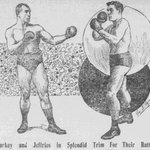
In 1935, Jim Jeffries recalled the time almost 5,000 bleacher seats collapsed and the mob rioted in San Francisco while he and Sailor Tom Sharkey fought on through the tumult.
"On the night of May 6, 1898 we packed the old Mechanics' Pavilion with the biggest mob that had ever attended a bout in the U. S. A. And it was a mob too.
Listen, that first night I fought Sailor Tom Sharkey was a brawl from start to finish. Tom and I had to fight our way into the ring, we battled twenty rounds inside the old ropes, and we had to fight our way out again.
Jim Coffroth promoted more business on that fight than the Pavilion was built to handle (seat capacity was +11,000 but Coffroth allowed fans to sit two to a seat), and he'd rigged up a lot of temporary bleachers and seats. One section (of 500+ seats) crashed while Tom and I were waiting in the dressing rooms. Just by a miracle, nobody was killed, but the mob stampeded out of the wreck and down in to the reserved sections.
It took Tom and me fifteen minutes to buck through to the ring. Alex Greggains, the referee, hustled us out almost before we got the gloves on; he jabbered the instructions at us and gave the call for the gong. Outside the ring they quit rioting then, because Tom and I put on a worse riot inside it.
Tom Sharkey was on top of me from the second the gong rang, and he stayed there from then on. We stood head to head, toe to toe, for twenty rounds and slugged at each other with everything in the book. I drove him back, time and again, just by the weight of the punches I threw to his belly, but I never stopped him, never knocked him down, never seemed to hurt him. You know what Sharkey was like-there was only one of him-stocky, with a chest like a beer keg, not enough neck to hoist his chin out.
He was quick as a cat. He was a punishing puncher. He swarmed in and threw gloves, and the only way you could get him off you was to knock him off. He was good and rough too. Along in the seventh that night-with the mob jammed right up against the ring, yelling its head off-I grabbed Tom by both shoulders, shook him up and threw him into the ropes. The next time we got in close, I yelled at him: "You wanna play rough, I'll play rough too!"
I think it was the first time in his life Tom Sharkey had ever met a man as strong as he was. He quit roughing me for a little while. In the tenth, another bleacher section (of 2000+ seats) went down. I heard the crash. I heard the yells and groans, and I knew the mob was rioting again. But I was down in the ring slugging the Sailor and being slugged-and I didn't find out what had happened until the fight was over. Tom didn't give me time to find out.
Greggains held up my hand at the end of Round 20. I think it was right-I think I won it. Tom thought a draw was the worst he could have got, but he didn't yell. All he asked for was another chance. He told the world he'd wreck me next time he got me in the ring.
We battled our way out through the mob (2000+ more seats had fallen). People say Tom hated my guts after that fight, but that wasn't true. He thought he could lick me; he wanted a chance to fight me again. He wanted another chance to paste hell out of me, but he didn't hate me. Tom Sharkey was a fighting man.
Twenty-five years later I talked to Sharkey about that fight. "Tom," I asked him, "did you see the balcony crash that night?" "I was too busy," he said. Then he gave me that stubborn Irish grin of his. "Did you?" he asked. "I wouldn't have had time to see the whole building fall down," I told him.
After that Sharkey fight, Billy Delaney started out to get Bob Fitzsimmons for me. He figured I was ready. So did I. But it was a year and one month before we finally got the shot."
Source: Saturday Evening Post - July 6, 1935


Last month I posted a newspaper photo of Jack Johnson behind a donkey cart. Here's a super crisp image from the original glass plate negative. The photo was taken in front of the home he bought for his mother, Tiny, in May, 1910. It was Jack's last week in Chicago before he boarded a train for California. He trained at San Francisco's Ocean Beach, for his bout against James J. Jeffries in "The Fight of the Century," when the fight was still scheduled to be fought in nearby Richmond, CA.

When this photo was taken in late 1907, the legendary lightweight boxer Battling Nelson was primarily recovering from his brutal, historic 42-round loss the year before to Joe Gans for Gan's world title. He had lost the world 'white' lightweight title that summer on points in a grueling 20-rounder to his bitter rival, Jimmy Britt. But Nelson carefully positioned himself for a comeback. In 1908 he earned a draw against Abe Attell and a draw against Jimmy Britt, before he finally knocked out, and then defended his world title in a rematch, against a Joe Gans stricken with tuberculosis. But he wouldn't hold onto it for long. A young and hungry Ad Wolgast took Nelson's title in round 40 of a 45-round 'fight to the finish' in early 1910.

When this 1907 photo of 18-year-old lightweight Packey McFarland was taken, he boasted an official record of 36–0–0. When he retired in 1915, his official record was 70–0–5. Unofficially, (with newspaper decisions) his record was 38–1–0 up this point, and his final career record (with newspaper decisions) was 106–1–6.
When he retired at just 26 years old, he not only became a self-made millionaire with lucrative banking, oil, and real estate investments, he also served as a military boxing instructor during World War I, and sat on the Illinois Athletic Commission.


One of the first images taken of Primo Carnera after his entry into the US fight scene in January 1930.

Champion Gene Tunney looks out at 105,000 fans who awaited the sound of the gong for his rematch with Jack Dempsey at Soldier Field in Chicago on 22 Sept, 1927.

After a day of training in 1927 for the rematch with Gene Tunney to win back his title, Jack Dempsey is instructed by John M. Kuhn on how to play a tuba, as he sits on the porch at Pop Soper’s Ranch, Ojai, California.

Few white sportswriters in 1910 dared to admit the immense psychological courage required of Jack Johnson to fight the world's Greatest White Hope. Yet, exactly one month before he fought James J. Jeffries in the "Fight of the Century," E.W. Cochrane did just that in an op-ed for the Kansas City Journal. Here's part of his shockingly prescient piece, which appeared in the Journal on Jun 05, 1910.
"Should Jack Johnson go into the ring next month and defend his title as champion heavyweight by defeating Jeffries, he will prove to the entire world that he is as game a man as ever stepped into a prize ring, black or white. They claim negro fighters are not game, but Johnson will be game if he beats Jeffries.
Think of the nerve it takes for a negro to get into a ring, before 25,000 or more white men and beat a white man into submission. Jeffries is the pugilistic idol of the white race. He is the one man on whom the white people depend to bring the title back to them. If he fails there is not a chance to get it away from the blacks for years to come, unless some wonder springs into prominence very soon, which is not likely. When Johnson steps into the ring he will not receive much of an ovation, while Jeffries will. It is a tough job for a referee to act before those fans and give satisfaction, but for a negro to beat a white man before white fans will be a game act.
Johnson beat Fitzsimmons in Philadelphia and after the battle he trembled like a leaf for fear the white men in the audience would mob him. He would not leave the ring until everyone was out of the house. Johnson was hit over the head with a bottle when he beat one man in Philadelphia and since then has never had the nerve to walk through a crowd after beating a white man. When Johnson knocked out Ketchel he was afraid he would be mobbed and he might have been had not the white people on the coast wanted to save him for Jeff.
But this is the whites' last chance to take the title from him. Think of the way those fans will feel toward Johnson if he wins. I would not be surprised to see the crowd cut the ropes, swarm on to the platform and mob the negro. He will have police protection, but what will police protection amount to with an angry mob of several thousand men to oppose. It is also a ten to one shot the police will feel like the rest of the white men at the ring side.
It would not surprise me to see the fans swarm into the ring and prevent Johnson knocking out Jeffries if they think there is a possibility of such a thing taking place, or if they see that Jeffries is sure to lose. In that event there could be no decision of the referee. Is it possible for a negro to keep from fearing these things?"

Like something only seen in old western movies, the interior of this building in Montrose, Colorado, known as the "Carriage Works," once looked down upon a hungry unknown teenager with aspirations, not only to fill his belly and help support his large family, but perhaps to be a prizefighter worth remembering.
Fighting then under the name, “Kid Blackie,” he would later become one of the most iconic boxers in history, known as the "Manassa Mauler," Jack Dempsey.
When Jack first arrived in Montrose, he took a job housesitting for some family friends on vacation, Mr. and Mrs. Hanes. When the Hanes returned home, they discovered their home had been transformed into a filthy, sweat-soaked gym. Jack had hung their featherbed from the ceiling as a makeshift punching bag. He used Mrs. Hanes' linens to wipe the grime from his sweaty face.
Once Jack caught his breath from a mad dash out of the house, he befriended two prominent area boxers. Fred Wood, known as The Fighting Blacksmith, and Charley Diehl, the son of Bill Diehl, who owned the Carriage Works. It was Charley Diehl who gave Jack his first boxing gloves.
Jack received his early boxing training in a back room of the building from 1909-1912. He used bags of sawdust and sides of beef to practice his punches. He hardened the skin on his hands with horse urine. He learned to use beef brine to toughen his face against cuts and bruises. He raced teams of horses along the dusty roads of town to improve his speed. Two of Dempsey’s early professional fights took place in Montrose in 1915.
William F. Diehl had constructed his "Carriage Works" in 1895 for wagon and farm equipment fabrication and repair. He was later a dealer in Studebaker wagons, which he marketed in Montrose and nearby towns, earning him the nickname “Studebaker Bill.”
The Carriage Works is the last known false-front, wood-frame building in Montrose, a style which eventually gave way to buildings of brick and stone. In 2002, the Carriage Works was donated to the Museum of the Mountain West. It was dismantled and moved 3.5 miles east, where its reusable parts were reassembled. Members of Montrose High School’s Future Farmers of America club raised the side walls like an old-fashioned barn raising.
You can visit the museums' carefully reconstructed building where Kid Blackie got his start, as well as see a town of restored residential and commercial buildings from the same era at: 68169 Miami Road, Montrose CO - Site Number 5MN.2725
Seen here is a photo of Kid Blackie in 1912-13, taken by Bill Lehr of Victor, Colorado, part of the Fred M. Mazzulla Collection, and a contemporary image of the reconstructed Carriage Works.
Sources: historycolorado.org / highcountryspotlight.com


In one of the most bizarre and controversial title bouts in boxing history, on July 4, 1912, over 11,000 fans packed the stands of Jack Doyle's Vernon Arena just outside of Los Angeles under a blazing midday sun. "Mexican" Joe Rivers and World Lightweight Champion Ad Wolgast had battled for twelve grueling rounds. By the 13th, both men were thoroughly exhausted and bloodied. The fight had turned into an absolute war. While many onlookers felt Rivers had won most of the early rounds, Wolgast later fiercely disputed this, confidently claiming that he had Rivers completely licked and was dominating the pace.
As they clashed near the ropes, at the exact same fraction of a second, both fighters unleashed finishing blows. Wolgast slammed a punch directly into Rivers' midsection—which Rivers’ camp swore was a vicious low blow—while Rivers simultaneously landed a devastating right-left combination flush to Wolgast's jaw. Both men collapsed into each other. Because boxing rings back then used only two rows of ropes, they nearly tumbled out through the lower gap and into the crowd. As the fighters teetered on the edge of the ring apron, cornermen, nearby officials, and Wolgast's manager Tom Jones (who later managed Jess Willard) lunged forward to hold up the fighters and keep them from falling all the way out of the ring.
Instead of counting both men out, referee Jack Welch hoisted a semi-conscious Wolgast up off the floor with one arm. While physically supporting the champion, Welch used his other hand to count out a paralyzed Joe Rivers. Welch reached the count of ten and declared Wolgast the winner by knockout. He turned to shout at the rabid crowd that his actions were completely fair and stood as the final verdict. Furious, Joe Rivers' manager, Joe Levy, jumped through the ropes and physically confronted Welch. As an angry mob of fans rushed the ring in protest, Welch slipped through the ropes and fled the arena. Joe Rivers stood up and walked around seemingly recovered, while Wolgast had to be carried from the ring by his handlers.
Reporters the next day called the decision a disgrace to America's Independence Day. They openly insinuated that Welch had long been on Ad Wolgast’s team payroll. The press argued Welch had deliberately ignored the rules throughout the entire match by letting Wolgast use illegal tactics. Furthermore, the timekeeper, Al Holder, insisted the round's closing bell actually rang when Welch was only at the count of four. The fight should have officially gone to the next round, but Welch completely ignored the bell.
Jack Welch vehemently denied Wolgast had thrown a low blow, claiming it was a perfectly legal shot to the stomach that caused Rivers to collapse. However, three doctors who later examined Rivers declared that the severe bruising around his groin clearly indicated a low blow. Welch then argued that because Wolgast had started to rise from the canvas before the fatal ten-count, he had merely assisted a fighter who was already actively recovering on his own.
Wolgast didn't get to enjoy his stolen championship belt for very long. Just a few months later, on November 28, 1912, he defended his title against Willie Ritchie. Wolgast resorted to his dirty tactics again and hit Ritchie with two blatant, vicious low blows in the 16th round. But this time, referee James Griffin didn't play along. Griffin immediately disqualified Wolgast on the spot, stripped him of his title, and awarded the championship to Ritchie.


On a whim, in early 2025 a fella in Iowa brought a painting he'd paid $20 for at a garage sale, to the Antiques Roadshow for appraisal. His 20-spot turned out to be this original painting by Robert Riggs called "The Fall Guy," done for a 1951 Saturday Evening Post article by sports journalist W.C. Heinz titled "The Fixed Fight."
In the story, an underdog fighter accepts a bribe from mobsters to deliberately throw a high-profile fight. Instead of taking a dive, the boxer knocks out his opponent to win the bout. Gamblers and fans, who had bet big on a sure thing, caused a riot after the match.
The fella in Iowa's Robert Riggs painting was appraised for $70,000-90,000.

Rare image of a young and unmarked Battling Nelson. He began his pro career at around 14 or 15 years old so this first image is possibly a promotional card from about 1896-1897. Based out of Hegewisch, a working-class, heavily industrial neighborhood on the far southeast side of Chicago, Nelson fought his earliest bouts in Chicago railyards, local athletic clubs, and small smokey local clubs. He wore no mouthguard, no rigid groin protection, and fought with 5 ounce horsehair-padded gloves. By the second image, taken in 1911 when Nelson was 29 years old, he had fought over 1000 hard rounds.


The title says it all .... champion Jack Johnson was a notorious speed freak behind the wheel of his racing cars. This photo was taken during Jack's last week in Chicago before he boarded a train for California to continue training for defense of his title against James J. Jeffries in "The Fight of the Century," when the bout was still scheduled to be fought in the Golden State.

'I was a quiet sort of boy, but sometimes the kids we used to play with would start fights with my sisters. l would take their part. I didn't know how to fight, then, and lots of times I got whipped. Then sometimes I won - sometimes. One time I remember I was getting whipped by a kid who was bigger than me. I got desperate and swung a hard right with all my might, and knocked the kid out. I was so surprised that l ran all the way home.' - Joe Louis
h/t @LoneliestSport
