

FACTS: The Golden Age of Boxing c1900-1940. AUTHOR: Catherine Johnson. BOOK: Then The World Moved On: The Brutal Truth Behind the Baer-Campbell Fight.
Joined July 2022
- Tweets4.4K
- Following307
- Followers779
- Likes264K




Golden Age Boxing History retweeted
Need a last minute Christmas or Hannukah gift idea for the boxing history lovers among your family & friends? Available here at a.co/d/gq4Zad1 or worldwide wherever books are sold.


Golden Age Boxing History retweeted

Tony Canzoneri wins a 10-round unanimous decision over Jimmy McLarnin, on May 8, 1936, at Madison Square Garden.
(McLarnin is in the trunks with the white band around the waist.)
This bout was proclaimed by eventual IBHOF Inductee Ted Carroll (pictured) as the greatest fight that he ever witnessed during his 50-year career. (Source: The Ring magazine, April 1973).
From boxrec once again:
Theodore (Ted) Carroll (1904-1973) is considered one of the greatest American artists of the 20th Century, notably as a master boxing cartoonist. His drawings and prose appeared on almost a monthly basis in The Ring, virtually from the magazine’s inception until his death -- almost 50 years. He became the sole cartoonist for The Ring in 1935. An African-American himself, his series on the history of black boxers for The Ring was a product of his meticulous research.
Born July 6, 1904 in New York to Jesse and Elizabeth, Carroll was raised in Greenwich Village and the Greenwich Settlement. He was graduated from the High School of Commerce in New York, and applied for entry into the Art Students League. He was turned down.
Carroll was also an accomplished athlete, excelling in basketball. He did some basketball coaching and is credited with starting Frank McGuire on his way to a successful coaching career. Carroll entered the United States Army and was discharged four years later as a First Lieutenant.
Carroll worked for the Brooklyn Daily Times from 1928-1933, and the Brooklyn Daily Eagle 1933-1937.
"He was rich in knowledge of the old writers, a strong admirer of Dr. Samuel Johnson and Boswell, of Goldsmith, Dickens, Faulkner and Wolfe.... Carroll picked Ray Robinson as the greatest boxer, pound for pound. He saw Willie Pep as the most clever. He picked Joe DiMaggio as the No. 1 ballplayer. His football favorite was Ken Strong, of NYU and the New York Giants. His basketball heroes were Bob Pettit and Bob Cousy. His favorite fight manager was Jimmy Bronson." The greatest fight he ever saw was Tony Canzoneri vs. Jimmy McLarnin (1st meeting).
Known for his ubiquitous bow-ties, Carroll never married, spending his last years in a small apartment on Edgecomb Street, Harlem, New York. In the last year of his career Carroll created paintings of horse racing, which were displayed at New York’s Aqueduct Track.
"I miss the guy terribly," said Harry Markson, of Madison Square Garden. "He was a rare man, a great artist."
"If my career, such as it is, can help make this a better country for all, it will have been well spent." Ted Carroll.
Some of you (Members of 20thCB:IM&M on Facebook/Meta) may recall the artwork of his that I had posted previously entitled "The Great Featherweights". I have many of his drawings in the archives so you'll see them on here as well.


Golden Age Boxing History retweeted
@boxerjoegrim rightly comments that not enough is written about the great Bob Fitzsimmons, the man who effectively pioneered the body shot, popularized the phrase “the bigger they are, the harder they fall,” and became the first boxer to hold world titles at three weights.
Robert "Bob" Fitzsimmons, later known in boxing circles as 'Ruby Robert' and 'the Freckled Wonder', was born at Helston, Cornwall, England, on 26 May 1863. He was the youngest of 12 children of James Fitzsimmons, an Irish policeman, and his wife, Jane Strongman, a Cornish native, who with their five youngest children emigrated to New Zealand on the sailing ship 'Adamant' in 1873 to settle in Timaru.
James Fitzsimmons set up a blacksmith's forge in Timaru. After completing his education at Timaru Main School, Bob joined his father and his brother Jarrett to learn the trade. His work at the forge developed the powerful arms and shoulders which made him such a devastating puncher when he took up boxing. His upper body formed a marked contrast to his spindly legs.
In 1880 the famous British pugilist Jem Mace visited New Zealand and organized a boxing tournament in Timaru. Fitzsimmons entered and won the tournament, knocking out four opponents in one night. He won the tournament again the following year and turned professional, fighting with marked success in Australia from 1882 to 1890. He then sailed for San Francisco, arriving on 10 May 1890. After winning three bouts he was matched with Jack Dempsey, 'the Nonpareil', for the world middleweight championship in New Orleans on 14 January 1891. Fitzsimmons caused an upset by knocking the champion out in the 13th round.
Fitzsimmons found difficulty in making the middleweight limit and began fighting as a heavyweight. (The light-heavyweight class was not introduced until 1903.) However, he reduced his weight in 1894 to defend his title against Dan Creedon, a New Zealander from Invercargill. Creedon had campaigned with considerable success in Australia and the United States, but Fitzsimmons knocked him out in the second round.
On 17 March 1897 Fitzsimmons, by now an American citizen, became heavyweight champion of the world when he knocked out James J. Corbett in 14 rounds at Carson City, Nevada. At 167 lbs. Fitzsimmons conceded 16 pounds to Corbett's 178 lbs. and he remains the lightest boxer to hold the world heavyweight title.
Fitzsimmons lost his title on his first defense on 9 June 1899 when James J. Jeffries, 215 lbs. and 12 years younger, knocked him out in 11 rounds at Coney Island. Three years later Fitzsimmons failed to regain the championship when Jeffries stopped him in eight rounds at San Francisco.
On 25 November 1903 Fitzsimmons took the light-heavyweight championship of the world from George Gardner, winning on points over 20 rounds at San Francisco. He thus became the first boxer to hold world titles at three weights. He lost his light-heavyweight crown to 'Philadelphia Jack O'Brien' in 1905, but continued to fight intermittently until 1914. His record stands at 62 bouts: he won 40, lost 9 and drew 13.


Golden Age Boxing History retweeted

If you're a subscriber, please spread the word!
If you haven't yet done so, please subscribe by clicking the link below ⬇️
youtube.com/@the286project
#arts #culture #politics #sport #podcast #subscribe

Golden Age Boxing History retweeted

#OTD in @PoliceGazette 1882: The first high-quality professional portrait of John L Sullivan in the Gazette shows a determined young fighter.

Golden Age Boxing History retweeted
Highlights of "the most beautiful fighting machine" that was Joe Louis, who #OTD 24 Sep, 1935, annihilated Max Baer before a crowd of over 90,000 at Yankee Stadium. The slow-mo's are amazing and announcer Clem McCarthy is incredible.
Fun facts: Baer's hands were repeatedly x-rayed in the weeks leading up to this fight. His hands were declared fit. They were fit before/after Braddock too. Louis' handlers asked that Baer and his team be watched closely by the commission for illegal stimulant use, after Baer admitted before a crowd of 300, and his trainer later confirmed, that Baer often fought doped up, including the title fight vs Carnera. Dempsey wrote an opinion piece after the Louis fight, that Baer was washed up and should quit. Baer admitted a year later, “I was on my way downhill against Carnera and worse against Braddock and Louis. Much worse.” More fun facts on a multitude of Baer myths are at: a.co/d/gq4Zad1
Golden Age Boxing History retweeted
Ron Howard got it right, and didn't go far enough, in the portrayal of Max Baer in "Cinderella Man." Give a listen to a chat of the facts, with boxing historian Steve Hunt, as we discuss the movie, and my new book on the truth behind the Baer-Campbell fight.

@BoxingGoldenAge joins me on the latest episode to discuss, who was the real Max Baer? Lovable clown or mean spirited killer? Available on all the major podcast platforms. #boxing
open.spotify.com/episode/34x…
Golden Age Boxing History retweeted

Blonde bombshell and Hollywood star Jean Harlow has a big smile for a very big world champion, Primo Carnera, aka "The Ambling Alp," circa 1933. That year "The Vast Venetian" defeated, among others, Jack Sharkey and Paulino Uzcudun. #Heavyweight #History #Boxing #Legends

Golden Age Boxing History retweeted
Still not sold yet on purchase of my book “Then the World Moved On: The Brutal Truth Behind the Max Baer-Frankie Campbell Fight” …?? Here’s the 4-page Prologue, which is a brutal synopsis of exactly what you can expect to find between the pages. On Amazon Worldwide at: a.co/d/gq4Zad1


Golden Age Boxing History retweeted
CONTEST TIME !! Winner gets one signed paperback. RULES: Just repost this book trailer. DEADLINE: 04 Sept, 2024 at Midnight GMT. NOTE: No limit on human retweet. Random name picker to select the winner. Thanks !!
Golden Age Boxing History retweeted
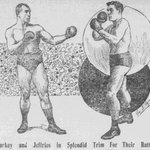
Old rivals Tom Sharkey, aka "Sailor Tom," & James Jeffries, aka "The Boilermaker," lay a wreath at the grave of John L. Sullivan in 1926. "The Boston Strongboy," 1st ever king of the big men under Queensberry Rules, died in 1918. #Heavyweight #History #Boxing #Legends


Golden Age Boxing History retweeted

Legendary World Heavyweight Champion Joe Louis was born in LaFayette, Alabama, #OnThisDay in 1914.


Golden Age Boxing History retweeted
Max Baer not only knew exactly what punch knocked Frankie Campbell unconscious, he was allowed over 20 free shots at his head and jaw. He literally followed the body down throwing hands. As Frankie lay on the canvas, Max fought the referee to go back and hammer him some more.


Golden Age Boxing History retweeted

Incredible photo taken before the Jeffries-Johnson world title bout in 1910.
Legends of the sport pictured include John L Sullivan, Bob Fitzsimmons, Tommy Burns and Stanley Ketchell - not to mention wrestling pioneer Frank Gotch.

Golden Age Boxing History retweeted
Former HW champ Jack Johnson testing his strength against two horses at age 42.
He also said he raced a kangaroo… wish we had photos.

Golden Age Boxing History retweeted
Max Baer punched Frankie Campbell OVER 20 TIMES while a paid off referee chosen by a boxing commissioner who profited off of Baer's fights stood by. This is not the 1st ringside reporter to reference an entire minute ticked by as Baer beat to death a man he knew was unconscious.


