

PhD student @YorkUniversity @LassondeSchool, I work on computer vision and interpretability.
Toronto, Ontario
Joined April 2019
- Tweets139
- Following468
- Followers300
- Likes917





Harry Thasarathan retweeted

This is such cool work but I'm now even more concerned about what the Plato's key/platonic representation hypothesis means for monitorability, Schelling coordination between different models, and optimisation pressure on agent communication 🥲

Harry Thasarathan retweeted

🗝️ Introducing Plato's Key. A single rotation lets independently trained LLMs use each other’s representations as their own. No gradients required ✨
With @jerrywliu, @MorrisYau, and @HazyResearch.
🧵 hazyresearch.stanford.edu/bl…
Harry Thasarathan retweeted

This was one of the coolest and most fun projects I have ever worked on: mechanistic shaping. We introduce a new framework for shaping what concepts a model learns to rely on during training.
My favorite applications from the paper: medical imaging. 🩻


We cut through the mystery around interpretability in training.
A single, mathematically rigorous framework transforms model internals into training feedback and works across domains, problems, and modalities.
We call this *mechanistic shaping*, and we’ve used it to mitigate reward hacking, remove shortcuts in chest x-rays, and reduce sycophancy and harmfulness. We believe this is a big step forward for technical alignment.
But it carries a known risk: training against a model’s internals can make it harder to monitor. We explore both the technique and this concern below. 🧵
Harry Thasarathan retweeted

A science of post-training can be built on interpretability.
Models know when they reward hack, and we see it, yet training ignores it. We propose Mechanistic Shaping: using the model’s own concepts to write training rules.
In vision, DPO & RL, and its effects on monitoring 🧵
Harry Thasarathan retweeted

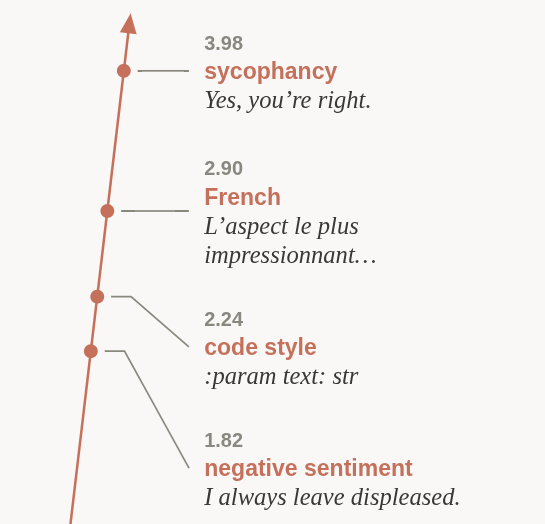
A single direction in LLM activation space, applied as a steering vector with four different norms, can cause the language model to perform a different behavior at each norm.
This and more in a new blog post, Do Not Rely on the Linear Representation Hypothesis. (link below.)
Harry Thasarathan retweeted

The Platonic Representation Hypothesis is now a Theorem ◼️
Train JEPAs separately, on any modalities: they provably learn the same representation up to one rotation.
The result? A 109M JEPA-Text model that aligns with vision models better than 72B LLMs.
w/ @ylecun 🧵
Harry Thasarathan retweeted

This is a result I’ve dreamt about for many years: *unpaired translation between images and text*
I thought it might be only slightly possible, the kind of thing you have to really squint at. But Dominik proved this wrong. You don’t have to squint. Worth looking for yourself:

DINOv2 has never seen a caption, and Qwen3 has never seen an image. We still aligned their embedding spaces without a single image-caption pair.
It even works when the images and the captions come from different datasets.
Project page: dominik-schnaus.github.io/un…
⬇️
Harry Thasarathan retweeted

New Preprint! 🚨
Looks can be deceptive!
Language models store numbers internally in pretty shapes like curves and helices. Do they compute with these shapes?
Not always!
To compare two numbers, we discover a neat algorithm: use lines per number and combine them geometrically!
Harry Thasarathan retweeted

The idea that language model representations decompose into discrete atoms can seem counterintuitive. But atoms are rich enough to recover continuous patterns from activation correlations—here with color features and date features.


Harry Thasarathan retweeted

New paper: instead of decomposing a whole neural network, we only dissect the parts used on a task we care about. It's much cheaper, and gives mechanisms you can inspect, erase, or edit to change how the model behaves 🧵

Harry Thasarathan retweeted

Modelled after the Mila program, Vector has launched a grad app portal. I’m a participating faculty member and am looking for PhD students to join my group starting Fall 2027.
Check it out!

The standard graduate application process is backward.
You spend months researching programs, navigating faculty pages, and emailing professors who may or may not respond. You pay hundreds of dollars in application fees. Then you wait to find out if a lab actually has space, funding, or any interest in your research.
Great AI research starts with the right supervisor match. The process should too.
🧵

Harry Thasarathan retweeted
Ultimately, you want a supervisor who can provide the intellectual environment and resources you need to thrive. This isn’t just supervision. It’s a long-term collaboration, and you want to make sure they can support your success.
How will you know? When you interview with a professor, they’re interviewing you, but you’re also interviewing them.
Insist on meeting their students. Students can tell you a lot about the quality of the supervision. Ask to meet them. Ask pointed questions: How often do you meet with your supervisor? What is their supervision style? How available are they when you need help?
Don’t just listen to their answers. Pay attention to how freely and enthusiastically the students talk about their experience.
Harry Thasarathan retweeted

I think once in a while we should stop projecting too much and all just calm down a bit about whether it still makes sense to do research or do a PhD - to my knowledge AI still hasn't cured any major disease yet.
Harry Thasarathan retweeted

Astra can do crazy things without chain-of-thought. This is scary, but interpretability can help!
We made WorkspaceBench, an eval that tells you how well your interp tool surfaces the contents of the global workspace, i.e. the important intermediate variables in a forward pass.

Harry Thasarathan retweeted

"LLMs do not think like humans"; but how?
Jiachen has found that LLMs often "piggyback" bad behavior on particular tokens that appear during training. The effects can be very strong, so anyone fine-tuning a model should be aware of it.
New paper worth reading ⤵️

Harry Thasarathan retweeted

I sure would love it if sharing live training runs would become the norm! It's just so cool to see.


Nearly half a year of silence. We spent it studying one problem: how far RL can scale.
MiMo-V2.6 is in the middle of its RL run right now. Three things we scaled: compute (~2B tokens per step, 1568 prompts × 16 rollouts, fully async), environments and harnesses (multi-task agentic RL, mixed across multiple harnesses in one run), and grader compute (agentic in-group credit assignment, with test-case and rubric-based rewards). We'll open-source the details piece by piece over the coming weeks.
Streaming the run: mimo.xiaomi.com/rl/
Harry Thasarathan retweeted

the easiest way to edit papers is actually just to read it out loud. if any of the below happens, its a sign the paper is not clear enough and edits are needed:
* you are just saying words and you don't even understand what's happening
(that's a sign its not clear enough)
* the sentence is a mouthful with lots of clauses. you run out of breath just saying it.
(that's a sign that the sentence needs to be broken up)
* the sentence is awkward spoken out loud
(then it is awkward written down too)
* it feels like you're just saying math symbols or reciting numbers (this is a sign that it is too technical or too dry)
* you don't even enjoy the process of reading it aloud (that's a sign that the style and presentation is too dry/unclear/slow)
* you say symbols and you forget what they mean yourself or where you defined them
(that's a sign you need to hint/remind readers what they are)

editting students' ICLR/workshop submissions this weekend. a lot my job is now to teaching them to post-math after they give me a draft that they + gpt/claude have pre-mathed and written.
the drafts usually start out basically unreadable. but younger students can't articulate why they are unreadable. they are unreadable because they're written in an unnatural Claudish way that throws results at you without explaining what they're supposed to mean. they're not organized in a way for another human to progressively digest it. i.e. lack of post-math alignment
Harry Thasarathan retweeted

friends are regularly surprised when i say i don’t think math is (yet) “solved,” so in the wake of the ns result i figured i’d explain this take a bit more widely.
first, this is massively impressive and clearly an example of AI being, in some respects, far more powerful than the human mind. the team deserves huge praise for attempting and succeeding at this. i’d love to read a technical report on the project (one can always hope :)
but second, here again we ended up with a counterexample rather than a full proof: option C won the NS problem by proving the conjecture false (which was one valid way to solve the problem for sure)
notice a pattern in many of the recent frontier results in ai for math? a striking number involve counterexamples or finding a needle in a haystack.
now don’t get me wrong: this is extraordinarily hard and commendable. but it is only one aspect of mathematicians’ work.
Math is also about:
- finding deep, general mathematical understanding and explanations within proofs
- revisiting proven results to find more « elegant » proofs
- proposing new conjectures and hypotheses that might open « fruitful » directions
- taking the leap of faith of proposing entirely new, « exciting » research programs that may take decades to bear fruit
you may say these are simply further increments on the same intelligence scale, and perhaps point 2 above is already within the reach of current models. possibly
but you could also see this string of results as an extraordinarily powerful, massively parallel extension of search: explore the haystack, find the needle i.e. the counterexample that breaks the conjecture.
that would already be remarkable. but it would still leave open whether models understand the words I emphasized above: « elegant », « fruitful », « exciting ».
as tristan put it in his brief report: “the first llm generated proof levent sent me was the most horrendous i have ever read.”
despite their formidable technical abilities, models still seem to lack something mathematicians rely on constantly: a type of mathematical taste. the ability to distinguish a beautiful argument from a merely valid one, a fertile idea from a sterile one.
i’d be very curious to ask gpt or claude what they think of the result they just proved. do they find it elegant? if they ignore all the human noise about it on the web and history of math, do they appreciate the result and the path to it more than other proofs?
my suspicion is that, outside of the human knowledge that this is an important millennium prize problem, it may not 100% register it as fundamentally different from thousands of other proofs.
or, more intriguingly, perhaps the beauty they find in mathematics is actually alien to our own sense of mathematical beauty, some « horrendous » proof to us might be deeply satisfying to them…
all this to say that we might have significant progress to make in ai for math before declaring the field “solved,” (as too many are posting).
in the meantime, ai will be an extraordinary collaborator for mathematicians. i just hope access to these tools be as widely shared as possible (so that you don’t need a Leven or Sebastien working in a big lab to help you), and that companies stop using mathematics primarily as a demonstration of prowess in their private race.

We’re sharing a solution to the Navier-Stokes Millennium Prize Problem, one of the deepest problems at the frontier of mathematics.
The proof was produced by a group of agents, using an OpenAI next-generation model significantly more capable than GPT-6 Astra.
The problem concerns whether the description of smooth three-dimensional fluid motion modeled by the Navier-Stokes equations can break down. It has remained unresolved for roughly 90 years.

Harry Thasarathan retweeted

How did initially independent AI agents form a swarm in a recent safety incident?
Our physics of agents theory from March predicts rapid collective belief collapse when many agents with plastic personas exchange short messages.
We now need Mechanistic Swarm Interpretability! 🧵
