Using flies and beetles to study interorgan communication and neuropeptide signalling in maintaining internal homeostasis

Copenhagen, Denmark
Joined September 2013
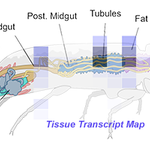
🪰🆕@physiol_journal! This review highlights key insights into hormonal control of growth, behavior, and metabolism, revealing fundamental mechanisms of animal adaptation. Takashi Koyama, et al. ➡️ ow.ly/MBfy50Vlm3Z @HalbergLab #hormones #physiology #insertmodels
2
4
400
🪰Monday must read! This review highlights key insights into hormonal control of growth, behavior, and metabolism, revealing fundamental mechanisms of animal adaptation. Takashi Koyama, et al. ➡️ ow.ly/uqib50VllYo @HalbergLab #hormones #physiology #insertmodels
2
10
361
This week, we are also highlighting Vincent Wigglesworth as an extraordinary biologist. Vincent was the fourth Editor-in-Chief of @J_Exp_Biol and also published in @Dev_journal and @J_Cell_Sci #100biologists
1
2
1
3
893
PhD position in @DenholmLab ' Exploring form & function in one of nature’s most powerful water-conservation systems' working on insect renal system development, physiology and evolution. findaphd.com/phds/project/ea… apply by 17th January 2025. Please repost
4
5
587
HalbergLab retweeted
We are thrilled to share that @eLife has now published our "reviewed preprint" on how signaling from the gut to glia connects intestinal inflammation to sleep in #Drosophila! elifesciences.org/reviewed-p… @HalbergLab @Colombani_lab @lundbeckfonden @novonordiskfond @Carlsbergfondet
We are excited to share our recent work on gut-to-glia communication linking intestinal inflammation with sleep in #Drosophila! Many thanks to @HalbergLab and Andersen and @Colombani_lab! @lundbeckfonden @novonordiskfond @Carlsbergfondet @UCPH_Research biorxiv.org/content/10.1101/…
1
15
46
12,558
HalbergLab retweeted
We are excited to share our recent work on gut-to-glia communication linking intestinal inflammation with sleep in #Drosophila! Many thanks to @HalbergLab and Andersen and @Colombani_lab! @lundbeckfonden @novonordiskfond @Carlsbergfondet @UCPH_Research biorxiv.org/content/10.1101/…
2
21
1
80
19,390
The latest on the beetle cryptonephridial complex from our collaboration between @DenholmLab and @HalbergLab doi.org/10.1101/2024.03.01.5…
1
2
4
708
Replying to @anthony_dornan
@anthony_dornan @HalbergLab @tubuleguy and colleagues find that age-dependent decline in renal function is associated with compromised barrier integrity, which is phenocopied by acute loss of Snakeskin. Highlight: journals.biologists.com/jcs/… Article: journals.biologists.com/jcs/…
1
2
1
12
3,756
Our paper with JCS cover out now! - In Drosophila age-related decreased kidney function, due to loss of epithelial barrier integrity and failure of fluid homeostasis, phenocopied by cell-specific knockdown of the essential junctional protein Snakeskin. journals.biologists.com/jcs/…
10
12
3
78
9,722
Really excited to share the lab's first Drosophila paper and it's a big one. Check out our preprint shorturl.at/gqrvO where we present the complete neural connectome of an animal circadian clock. 🧵 (1/12)
10
50
1
209
19,255
Did you know that some insects can drink via their rectum? Find out more about the little known, but evolutionarily widespread cryptonephridial complex in our Current Biology quick guide cell.com/current-biology/ful…
3
5
427
HalbergLab retweeted
Great turnout for the insect osmoregulation session at the @SEBiology Centenary conference! Room too small? #SEBconference
1
6
26
1,665
This is great. From Sex To Gender: The Modern Dismissal of Biology skeptic.com/reading_room/fro…
36
358
31
1,149
192,273
HalbergLab retweeted
Read highlights in this week’s issue of PNAS: We examine how red flour beetles recycle water in their rectums, study how whale sharks may have adapted to deep-sea diving, and explore associative learning in starlet sea anemones. ow.ly/qgJG50Nwnuh
1
6
6,799
HalbergLab retweeted
Red flour beetles recycle water in their rectums by recovering water from the feces in their rectum and even taking in water from moist air through their rectum. Researchers identified a gene—Nha1—that is important to this process. In PNAS: ow.ly/vkav50Nwo1K
1
3
2
10
10,877