
Healthcare economics and policy. Occasionally pharmacy and digital health
Washington, DC
Joined September 2013
- Tweets406
- Following858
- Followers469
- Likes9K




Joe Smith retweeted
A quick thought experiment: if Canada (or any other country) replaced its health payer system with BCBS, and continued to fund the payer with the same taxes, but called the taxes “premiums,” would that mean the country’s taxpayers immediately experienced a huge tax cut? Of course not. But in the US, we consider our taxes to be lower for this very reason.
Congress has enacted laws that overpay the healthcare industry by $2T/year. We could stop overpaying and give $2T/year back to taxpayers (conservative solution) or to the poor (liberal solution). But we don't.
Are you conservative or liberal? Doesn't matter - Congress represents the healthcare industry, not you
1
93
Joe Smith retweeted

Bigger picture: Health insurance premiums (both employer and employee contributions) have vastly outpaced inflation for decades. These are constant wage cuts, and everyone out there is getting hammered, silently behind the scenes. statnews.com/2026/07/07/smal…

What is an income tax?
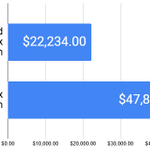
Technically, the typical American family pays as little as $3,506 in "federal income taxes."
Practically, the typical American family has $48,398 taken from their earnings and redistributed.
Why the difference?
- $26,993 in health premiums (both the $6,850 employee share and $20,143 employer share are foregone wages). Economically, functions just like a quasi-mandatory tax
- $15,140 in FICA (both the $7,570 employee share and the $7,570 employer share are foregone wages)
- $2,759 in state/local income taxes

1
1
110
A quick thought experiment: if Canada (or any other country) replaced its health payer system with BCBS, and continued to fund the payer with the same taxes, but called the taxes “premiums,” would that mean the country’s taxpayers immediately experienced a huge tax cut? Of course not. But in the US, we consider our taxes to be lower for this very reason.
“But taxes are compulsory, and participating in health coverage isn’t,” you might object. But because of the regulatory framework created for healthcare, healthcare premiums are practically compulsory:
1) If an employee declines health coverage, they don’t receive the full premium paid to them in cash - they only receive the employee share.
2) If the employee chooses to receive the $6,850 as cash, both the employee and the employer will be taxed on the payment. (The employee will have to pay state income taxes, federal income taxes, and payroll taxes; the employer will have to pay payroll taxes.) So that leaves the employee with roughly $4,500.
3) The US healthcare system is engineered towards third-party payment, so it’s challenging to purchase health services without participating in the system.
24
Joe Smith retweeted

Which is why the Senate signaling it refuses to even modestly reform Medicaid is offensive.

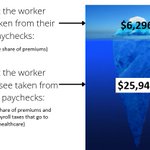
$2,100 is a ton of money. But the typical family has more than $30,000 taken from their paychecks in healthcare-related taxes & premiums.
Tariffs are important, but artificially inflated healthcare prices are always, always the most important economic issue for the middle class

The real waste/bureaucracy at CMS isn't internal. Back of the envelope, I'd guess the headcount at Medicare Advantage plans and MCOs to be north of 300,000.
These superfluous middlemen waste taxpayer money, complicate beneficiaries' lives, and cause headaches for providers.


Notes for the quick back-of-the-envelope estimate:
peri.umass.edu/wp-content/up… estimated 834k payer-side headcount in 2017. Their best option was to grab some obvious BLS categories and estimate that 40% were in healthcare, so there's already uncertainty around that number.
With healthcare employment as a % of total employment basically flat (healthsystemtracker.org/char…) and total employment growing 9% since 2017 (fred.stlouisfed.org/series/P…), I'd guess the 834,000 has grown to 910,000 in 2025.
Adding the 71,995,410 Medicaid beneficiaries in MCOs in 2022 (kff.org/other/state-indicato…) to the 32,800,000 Medicare beneficiaries in MA in 2024 (kff.org/medicare/issue-brief…) gets 104,795,410 lives covered by MA/MCOs.
Divide that by 300M covered Americans (kff.org/other/state-indicato…) gets 34.9% of covered Americans in MA/MCOs.
Assuming payer headcount is proportional to lives covered (not a great assumption!), that implies a headcount of 317,506 at MA/MCOs.
Quick sanity checks using individual companies make that estimate seem low:
Molina is almost exclusively focused on Medicaid and has ~18,000 employees (money.usnews.com/careers/com…). They have 6% of the MCO market (kff.org/medicaid/issue-brief…), implying an even 300,000 headcount FOR MCOs ALONE.
Devoted is exclusively focused on Medicare, has 1,700 employees per LinkedIn, covers 227,141 lives (devoted.com/resources/devote….), implying 245,486 employee headcount FOR MEDICARE ADVANTAGE ALONE. (Devoted is small - not the best example to use for this analysis).
1
126
The biggest waste/redundancy in HHS? Using 1,264 redundant contractors to pay doctors and hospitals:
982 Medicare Advantage plans
282 Medicaid managed care organizations
Eliminate MA and MCOs.

RFK Jr. says Elon Musk & DOGE are now inside the Department of HHS, exposing & eliminating massive fraud.
"We've identified extraordinary waste in my department and HHS. The expenditures, and the budget of HHS during the Biden administration went up by 38%, the employees went up by 17%, and healthcare went down. We have 40 comms departments. We have 40 procurement departments. We have 40 IT departments, and we have 40 procurement HR, none of them talking to each other. We are, with Elon's help, eliminating the redundancies. We are streamlining our department."
Notes:
This bureaucracy isn't just an exhausting administrative hassle for providers and a drain on taxpayers (see MedPAC analyses), it's also a nightmare for beneficiaries to navigate.
By my count, the full scope of "federal government programs/plans to pay providers" is 1,980:
-Medicare Part A
- Medicare Part B
- All 982 Part C (Medicare Advantage) plans
- All 464 Medicare Part D plans
- All 56 Medicaid agencies (yes, these are fed/state)
- All 282 Medicaid MCOs
- All 180 Federal Employee Health Benefits plans
- All 11 Tricare plans
- The Indian Health Service
- The Bureau of Primary Health Care
- The healthcare portions of the Veterans Administration
I'm probably missing something. And the 1,980 doesn't count the numerous state/local government health plans for state/local employees.
I didn't include the 464 PDPs in the original tweet because there isn't an existing FFS analog, but thematically, they belong there.
Legislative action would be needed to eliminate these redundant payers -- RFK/DOGE couldn't just "decide" to do this.
Refences:
cms.gov/data-research/statis…
kff.org/medicare/issue-brief…
kff.org/medicaid/state-indic…
opm.gov/healthcare-insurance…
tricare.mil/Plans/HealthPlan…
dol.gov/sites/dolgov/files/E…
I pulled this data a couple months ago; it might be a little outdated.
1
97
Notes:
This assumes a family of four making median family income ($100,800) with a $4,000 CTC and a $6,296 employee share premium / $19,276 employer share premium (KFF average).
I first calculate what total federal income taxes would be if premiums were taxable ($2.43T + $202B = $2.63T). I then calculate the federal income taxes that would have been paid by this family assuming their employer gives them the entire value of the premium as taxable income ($7,484), take that as the percentage of the whole $2.63T, and apply that percentage to total ESI ($1.286T).
Using the same approach, the premium (employee share and employer share) for a typical median-income individual worker (as opposed to a family) would be $3,383. This is pretty close to the family's premium because the CTC favors the family.
Yes, a lot of analyses like this were tossed around during M4A debates, and this isn't really anything new. But it's worth revisiting from time to time.
Details are in "Step 7b" of the "2024 analysis (revised estimates - WIP)" tab here: docs.google.com/spreadsheets…
4
345

Notes:
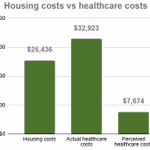
For housing costs, I'm just grabbing the mean household housing costs from BLS: bls.gov/news.release/cesan.n…. This is the number most frequently referenced in "where do Americans spend their money" articles like visualcapitalist.com/average…. Could use median mortgage payment or median rent instead.
For healthcare costs, I'm summing KFF ESI survey data ($6k employee share and $19k employer share) + estimated portion of taxes spent on healthcare ($6k) + OOP costs ($1k).
The housing figure is based on "household," while the healthcare figure is based on "family" - obviously not ideal.
See breakdown of healthcare costs here: docs.google.com/spreadsheets….
406
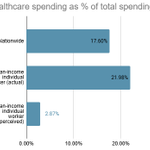
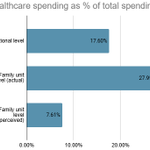
Health as a % of GDP is 18%, 2x most nations.
But since burden falls disproportionately on middle class, it's 28% for median family -- really extreme.
But since most $$ are hidden away in employer share of premiums, people underestimate their own costs to be 8%.

1
1
144
