

Independent archaeology and ancient history covering discoveries, research, and lost civilizations.
Joined August 2011
- Tweets40.9K
- Following3.2K
- Followers85.5K
- Likes112K



Pinned Tweet
The text on this cliff is funnier than it looks. Carved twenty metres up the rock of Van, it runs in three columns, Old Persian, Elamite and Babylonian, 27 lines each, all saying the same thing.
Here is what it says:
“A great god is Ahuramazda, the greatest of gods, who created this earth, who created that sky, who created man, who created happiness for man, who made Xerxes king, one king for all, one ruler for all.
I am Xerxes, the great king, the king of kings, king of all kinds of peoples, king of this earth great and wide, the son of king Darius, the Achaemenid.
King Xerxes says: King Darius, my father, by the grace of Ahuramazda built much that was good, and he gave orders to dig this niche out, but because he did not make an inscription, I ordered this inscription to be made.”
An imperial monument whose real subject is an empty panel his father left behind.
Look again at the disc and crescent carved above the figures. That pairing is Punic, the sign of Baal Hammon, and it kept being cut into stone in North Africa for centuries after Carthage was destroyed, by then under the Roman name Saturn.
Around 1,500 stelae of this family have been catalogued, running from the fifth century BC to the fourth century AD. Roman frames, older symbols.
Pavlopetri, the 5,000 Year Old Greek Town the Sea Swallowed
Pavlopetri, Greece. A planned Bronze Age town with streets, courtyards and tombs, now resting 3 to 4 metres under the sea.
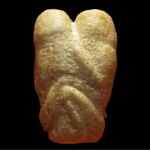
The Ain Sakhri Lovers, an 11,000-Year-Old Couple Carved in Stone
11,000 years ago, a Natufian carver in the Judean Desert took a calcite cobble about the size of a hand and picked away its surface until two lovers appeared.
They sit face to face. One figure’s arms hold the other’s shoulders, knees bent up beneath. Both faces are left blank, and turning the stone changes what its curves suggest.
The Ain Sakhri Lovers, now in the British Museum, are widely called the oldest known sculpture of a couple making love. A Bedouin found it in a gorge near Bethlehem, and in 1933 the prehistorians Henri Breuil and René Neuville recognised it in a small museum there.

The sarcophagus in this water used to stand on dry land beside a working port.
From around 200 BC the bay silted up and İztuzu beach closed the mouth, leaving Kaunos about eight kilometres inland and killing the trade it lived on.
The marshes that replaced the harbour also gave the city a reputation for fever. What does a port do when the sea leaves?
Between 57,000 and 27,000 years ago, hunter-gatherers in the Southern Caucasus lived in small, scattered groups, yet they were never isolated.
Obsidian tools from Ararat-1 Cave in Armenia show stone carried and resharpened across 40 to 200 kilometers, with shared toolmaking traditions linking whole regions.
The shift from the Middle to the Upper Paleolithic looks gradual, with different cultures coexisting for thousands of years. Connection may have mattered as much as adaptation.

Twelve thousand years ago, at the point where the Batman river joins the Tigris, people built round stone houses and buried their dead beneath the floors they walked on.
Around two thousand graves have come out of Körtik Tepe, more than any other site of its age in Western Asia, and almost every one held something made with care.
This is what people were doing before farming, before pottery, before writing.
What everyone photographs at Perrhe is the necropolis, which the ministry calls the largest in the region, with family vaults cut for three to eight bodies and underground chambers reached by steps.
The living city stayed almost untouched until recently. Excavators have only lately begun working the settlement area itself. Why do you think the dead so often survive better than the living?
The oldest swords ever found came out of this mound. Nine of them, cast from an arsenic-copper alloy around 3300 BC, three inlaid with silver, stacked together with lance tips inside a mudbrick palace at Arslantepe near Malatya.
They predate the next oldest swords known anywhere by roughly a thousand years, and they were sitting in the building where the accounts were kept.
These tombs are usually described as plain rock-cut chambers, and they were not.
Dowel holes and channels for cast metal show that three of the five once carried separately carved columns and pediments across their fronts, all of it now gone.
The sequence here also runs backwards from the rest of Anatolia, where Greek facades replaced local forms rather than the other way round. What else do we call austere simply because the decoration fell off?
Ancient Content retweeted
New on Ancient Content: “The Room With No Door”
A sealed tomb under a man-made mountain at Gordion, and the king inside it is not the one everyone thinks.
Limyra was built on a lake that had just dried out. Cores drilled through the Lycian city show lake and lagoon sediments underneath the middle and eastern districts, silting up in the mid first millennium BC, which is exactly when people started building here.
Centuries later the water came back, rising through karst springs from the mountain to the north while the whole plain sank. The city is lying in its own lake bed again.
Around 1750 BC a Babylonian schoolboy named Iddin-Sin sent his mother Zinu a letter.
The other young gentlemen’s clothes get better every year, he writes, while she makes his worse. Wool is consumed in their house like bread.
The son of his father’s underling is walking around in two new garments while she worries about his single one. Then the last line.
She gave birth to him, the other boy’s mother only adopted hers, and yet that mother loves her son while his does not love him.

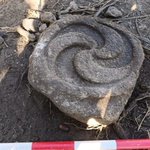
A Stone With Two Faces Found in Galicia: Triskelion on One Side, Petroglyph on the Other
Archaeologists at the Castro do Pico da Bandeira in Salcidos, A Guarda (Galicia, Spain) have found a granite stone with a finely carved triskelion on one face and a rougher petroglyph on the other.
It lay inside a large circular house occupied between the 1st century BC and the 1st century AD, among fragments of Roman amphorae. The triskelion stayed almost fresh because that face fell toward the ground. Archaeologist Benito Vilas says no other stone in Galicia is known to carry both symbols on opposite sides.
Were they carved together, or did the petroglyph come first and the stone get reused later? For now the answer is open, and more than half of the house is still unexcavated.


The Sahara’s Antennae Tomb at Lawash el Telli Finally Has a Date
On a gravel plain at Lawash el Telli in northern Western Sahara, a stone tomb stretches 54.5 meters (179 feet) across the desert. Two rows of slabs, called antennae, run east from a central mound like the arms of a V that never closes.
Archaeologists have now excavated it and dated the burial to between 4,100 and 4,400 years ago, around the time the Akkadian Empire rose in Mesopotamia. A young adult lay on the bare ground beneath the stones with four ostrich eggshell beads. The bones held too little collagen for standard dating, so the team dated the mineral part of the bone instead.
These are the first radiocarbon dates ever obtained for an antennae tumulus in the Atlantic Sahara. Why communities that once buried their dead underground began raising stone monuments pointing east remains unanswered.

ALT Aerial view of the excavated monument (tumulus, antennae and satellite stone mound)
New on Ancient Content: “The Room With No Door”
A sealed tomb under a man-made mountain at Gordion, and the king inside it is not the one everyone thinks.
This ram has moved twice in three thousand years. It was carved around 1356 BC for the avenue leading to Amenhotep III’s temple at Soleb in Nubia, one of twelve rams flanked by falcons and lions.
About six hundred years later a later king had it shipped north to Gebel Barkal. In 1844 Lepsius chose it as the best of the rams still standing there and sent it on to Berlin, where it stands today.

Troy’s first musical instrument has been found. A 2,800-year-old bone flute from the Archaic Period, the only instrument in 160+ years of excavations at Troy. Alongside it, a 4,500-year-old human-shaped idol head from the Troy II city gate.

The Assyrians left their own description of what these figures were for. One king writes that creatures like this turn back anyone arriving with bad intent, guard the steps and keep the king’s path secure.
Sargon II simply says he set animals of white stone at his gates. The threshold was designed to be a test.
What do you think a visitor felt first at a gate like that?
The face was eaten. Insects worked through the wood of this Old Kingdom head from Dendera for four thousand years and left the surface you see.
What they could not touch was the eyes, made of copper, hippopotamus ivory and dark stone, which is why a ruined face still looks straight back at you.
The head is about 15 cm high and is now in the Penn Museum.
