

Independent archaeology and ancient history covering discoveries, research, and lost civilizations.
Joined August 2011
- Tweets40.9K
- Following3.2K
- Followers85.5K
- Likes112K




Ancient Content retweeted
New on Ancient Content: “The Room With No Door”
A sealed tomb under a man-made mountain at Gordion, and the king inside it is not the one everyone thinks.
Ancient Content retweeted
In August 2004, Georgi Kitov opened a burial mound east of Shipka, in the Valley of the Thracian Kings, and lifted a solid gold mask off the face of a dead man. 672 grams, 23.5 carat, life-size, eyelids closed.
It carries the name of King Teres I, founder of the Odrysian kingdom. The pottery in the same grave argues against him.
Teres died around 445 BC. The Athenian vessel buried beside the mask dates to 430 to 420 BC, a generation too late. The royal attribution rested on a resemblance to portraits struck on coins.
The museum holding it now describes the burial as that of a prominent Thracian aristocrat. Not a king. The most famous face in Bulgarian archaeology may belong to a man whose name we never had.
Ancient Content retweeted
Greek alphabet. Etruscan language. Aegean island. Nobody can explain it
This gravestone came out of a field on Lemnos in 1885. It carries 198 letters in the Greek alphabet, and the language is not Greek. It has never been deciphered.
One phrase can be read, and only because it resembles Etruscan, from across the sea in Italy. Aviš sialχviš. Sixty years old. That is what survives of him. Not his name, not what he did. His age.
In the Odyssey, Homer sends Hephaistos to Lemnos to join the wild-speaking Sintians. Greeks used that phrase for people whose speech did not sound like language to them.
Twenty-seven centuries later, we are still standing in front of this stone in exactly that position. We can hear it and we cannot understand it.

ALT This gravestone came out of a field on Lemnos in 1885. It carries 198 letters in the Greek alphabet, and the language is not Greek. It has never been deciphered.
Ancient Content retweeted
Sunlight strikes the face of Ramesses II inside the Grand Egyptian Museum twice a year, echoing Abu Simbel.
That effect was not designed by ancient architects. It was not even in the museum's plans. An engineer proposed it in October 2019, after the statue was already standing in the atrium, and a team was assembled to make the building do it.
The oldest-looking thing in the room is the newest.
Ancient Content retweeted
A small seated figure, 5.1 cm tall, handed in as a surface find during the autumn 2012 season at Göbekli Tepe, picked up on the north-western hilltop of the mound. It was published five years later, in 2017, by Oliver Dietrich and the late Klaus Schmidt.
At Göbekli Tepe, when an animal appears on a human figure, it is usually attacking. Birds and four-legged predators gripping heads in their claws, possibly carrying them off. Archaeologists connect that imagery to a cult of the dead.
This one is doing none of that. It sits crouched on the man's left shoulder, calm, no claws, and he is not reacting. Half the figurine is under a thick mineral crust, so whether a second animal sat on the other shoulder cannot be settled.
Each of the great enclosures at the site is dominated by a single animal. Boars in C. Snakes in A. Foxes in B. Birds and insects in D. One reading of this figure is that the animal on the shoulder says which group the man belonged to. A badge, eleven thousand years before heraldry.
If that is right, these were separate peoples meeting at one place. What would bring them there?

ALT A small seated figure, 5.1 cm tall, handed in as a surface find during the autumn 2012 season at Göbekli Tepe, picked up on the north-western hilltop of the mound. It was published five years later, in 2017, by Oliver Dietrich and the late Klaus Schmidt.
Ancient Content retweeted
The Huashan cliff paintings in southern China are up to 2,500 years old. At one site, the paint layer was 97 to 99% human blood, with proteins linked to women in late pregnancy or breastfeeding, possibly connecting to the fertility imagery above.

Ancient Content retweeted
What these ancient people themselves chose to name their culture remains unknown, but the name we commonly use, Olmec, from Olman, an Aztec word for "place of rubber", was actually given to the Gulf Coast region of Mexico by a people who arrived well over two millennia after its creators.
What these artists themselves called their works is gone from history. They and their art are a silent monument from a far distant time to a human ingenuity as marvelous and creative in its own way as any elsewhere. This work, a hollow fired ceramic human effigy made between about 1200 and 800 BC, stands at the apex of the earliest portraiture tradition in the Americas.
Here, on this sliver of the American continent, someone was moulding a recognisable, individual human face out of fired clay at a time when New Kingdom Egypt was at its zenith.
Ancient Content retweeted
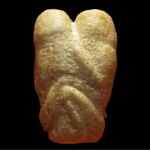
A limestone figure from Sayburç in Türkiye has fine lines cut across its mouth, like stitches. Ribs sharp on the chest, shell in the eye sockets. It was found lying in a village courtyard, in the middle of a cluster of human burials.
Ancient Content retweeted
Most ancient art is studied as a record of people who are gone. Wandjina painting is a living obligation held by named families in the Kimberley right now, governed by their own law, with rules about who may paint, who may look, and when.
It is the oldest continuous sacred painting tradition on earth, and it has current custodians.
Ancient Content retweeted
Looking down the Khara-Hora shaft in Zayukovo, the precision of those aligned stone blocks feels far too deliberate. Geology dictates that cooling volcanic rock can naturally snap into razor straight lines, yet the stark geometry remains deeply unsettling.
Maybe ancient locals simply stumbled upon nature acting like a master builder.
Ancient Content retweeted
The official story claims heavy stones and a vanished wooden superstructure powered an olive press here in Hierapolis. When you examine the exactness of the fluid channels cut deep into solid rock, the agricultural explanation feels incomplete. The foundation suggests a level of mechanical engineering we rarely credit to that era.
Ancient Content retweeted
A massive 2,200-pound block of flawlessly smooth nephrite sits entirely out of place among the rough limestone rubble of the Great Temple of Hattusa in Türkiye.
Standard explanations wave it away as a local religious object or a mythological gift from an Egyptian Pharaoh, but the mirror-like polish on this single green stone fundamentally clashes with the accepted bronze toolkits of the 13th-century BC Hittites.
The block rests completely exposed to the elements, offering absolutely zero mechanical context for how it was surfaced or why it commands the center of a Bronze Age ruin.
Ancient Content retweeted
A Hittite document records the routine. Every morning the mayor had to make sure a lord of Hatti or a commanding officer inspected the seals on the city gates before they were opened. The bolt holes are still visible in the stone. Three thousand two hundred years later the gate stands open with nobody left to check it.
Ancient Content retweeted
The largest Olmec head weighs somewhere around forty tonnes and stands 3.4 metres tall.
It also never left home. Archaeologists found it near the basalt source in the Tuxtla Mountains, unfinished, and it is the only one of the seventeen whose eyes are carved closed.
Whoever started it either could not move it or stopped caring. The heads that did make the journey are far lighter, most between six and twenty six tonnes.
Ancient Content retweeted
People look at the razor-sharp angles of the Cumbemayo aqueduct in Peru and ask why a simple water channel needed such extreme precision. The answer is that it was never simple. It was sacred.
Carved into volcanic rock near Cajamarca around 1500 BC, making it roughly 3,500 years old, Cumbemayo diverts water clear across the continental divide with obsessive right angles and zigzag cuts.
Here is the detail that solves the mystery. The region gets enough rain to farm without any aqueduct at all. This channel was not an agricultural necessity. Alongside it sit an altar, a sacrifice table, stepped stones, and a cliff carved into a giant human head.
Cumbemayo was a water temple. The Cajamarca people worshipped water as the source of life, and shaping its path with perfect geometry was the prayer.
It looks over-engineered only if you assume the goal was efficiency. The goal was reverence, and reverence has no upper limit.
Ancient Content retweeted
Bronze Age superpowers signed their biggest treaties in precious metal. Almost all of it is gone. One tablet survived.
We know the famous Egypt-Hittite peace treaty after Kadesh was engraved on silver tablets. The silver is lost, melted or looted millennia ago, and the text survives only in clay copies.
Then in 1986, at the ruins of the Hittite capital Hattusa, excavators found this. A complete bronze treaty, chains still attached, recording King Tudhaliya IV's guarantee of the kingdom of Tarhuntassa to his cousin Kurunta around 1235 BC.
It is the only Hittite metal tablet ever discovered, and one of just three Hittite diplomatic documents believed to be true originals rather than copies.
An entire class of documents, the metal originals of ancient diplomacy, survives in exactly one specimen. This is it.

Ancient Content retweeted
People ask whether the Ziggurat of Ur was a temple to the gods or a tool to condition a population toward obedience. The honest answer is that the question has a false floor. It was engineered to be both, in the same bricks, with no contradiction.
Here is the key fact most people miss. Nobody worshipped inside the ziggurat. It was a solid mass, a colossal platform with no chambers. The actual shrine of Nanna, the moon god, sat on the summit, and only priests ever climbed to it.
So the building's whole purpose was elevation. It lifted the god's house above every roof, every wall, every human being in Ur, and made that hierarchy impossible to unsee from anywhere in the city.
That is worship and social order fused into one silhouette. Sumerians did not separate the two. The tower that honored heaven also announced exactly who spoke for it.
The god lived on top. Everyone else lived looking up.