Award-winning Creative Agency, we work w/ startups, entrepreneurs, and fast-growth companies to tell their story and introduce their brand to the world.
Detroit, MI
Joined November 2008
- Tweets4.1K
- Following4.3K
- Followers1.2K
- Likes4.4K


the honos group 〽️ retweeted

Anthropic just published a chart that visualizes what I've been saying for a year now.
- A chatbot doesn't move the needle.
- Point solution AI doesn't move the needle.
- If you want to WIN in AI, you HAVE to go deep.
Look at all the use cases on the bottom left of the chart: "slide decks", "ad hoc data analysis", "competitive analysis"… All of them required individuals to change their habits but offered almost no value.
Compare that to the top right: "document review", "frontline support agents", "coding agents"… All of them required re-engineering the processes.
So what does it take to get from the bottom left to the top right?
- Map the current process meticulously, including exceptions (what's in the SOP and what's in the system logs are often very different)
- Agree with the business on what KPI the new process will measure (time, revenue minus token cost, or risk), just one
- Re-engineer the process to reduce the number of steps, say from 15 to 5, four of which will be done by AI
- Build AI agents that interact with the systems you already have (SAP, Salesforce, ServiceNow, etc.), no new systems to learn
- Get a C-suite sponsor for the project. If you don't have someone at that level, you won't be able to eliminate steps, merge teams, or change KPIs, which will force you to automate the existing process (good luck with that)
- Have the people who will be running the new process own the AI agents, be responsible for handling exceptions, and improve them over time
And that last point is how you deal with Ethan's second point. People are going to fight changes that are being done to them, but they're going to participate in changes they're taking ownership of.
This is what we do at Varick. If you'd like to work with us, visit the website below:

Two big points from this new Anthropic paper:
1) The most AI value comes from changing the organization
2) There is wide worker resistance to AI adoption (partially due to point 1)
Changes that expand what workers do & share AI gains with them could help anthropic.com/research/worki…

the honos group 〽️ retweeted

The 17 most common AI asks we're getting from mid-market companies right now (in no particular order):
1. AI Enablement - Workshops, hackathons, and a recorded training library built around their own tech so the whole team becomes AI native.
2. AI Audit / ROI Blueprint - Interview every department, map the processes, rank automation opportunities by projected ROI, and get a phased build plan before spending money on development.
3. Context Layer - SOPs, pricing, client history, and past decisions in one place that every AI tool and agent pulls from.
4. Company-Wide AI Rollout - Company Enterprise AI accounts, connected to their drive, CRM, and SOPs, so staff stop putting client data into personal accounts.
5. AI Policy and Governance - Acceptable-use rules, an approved tool list, data handling, and a review process for every agent and connector before it goes live.
6. Private AI - Open-source or private models running in their own cloud, or on their own hardware, for regulated data that can't go through a public tool.
7. Custom Software Over SaaS - Replacing overlapping subscriptions with one custom app built on their own data. CRMs and internal admin tools go first.
8. Client Portals - One login where clients see project status, files, invoices, and reports instead of emailing the team for updates.
9. Quoting and Estimating - Getting pricing knowledge out of the owner's head so drawings and specs turn into accurate quotes the same day.
10. Voice and Chat Agents - Inbound calls, texts, and forms answered in seconds, qualified, and booked, handling 60-70% of inbound volume without a human.
11. Ops Agents - Agents working inside email, Slack, and the CRM that triage requests, chase updates, and keep records current.
12. Back-Office Finance - Invoices read and matched automatically, weekly reconciliations off the team's plate, and unbilled work flagged before month-end.
13. Client Onboarding - Signed contract to kickoff with intake, documents, and account setup running without anyone chasing paperwork.
14. Automated Reporting - Dashboards and weekly reports pulled from the CRM, ERP, and accounting system with zero manual input.
15. Data Cleanup - Scattered spreadsheets, inboxes, and legacy systems pulled into one clean, queryable place, since bad data is where most AI projects stall.
16. AI ROI and Observability Tracking - Baselines before the build and a live dashboard after, so leadership can prove what the AI spend returned.
17. AI Search Visibility - Getting the company cited when buyers ask LLMs.


the honos group 〽️ retweeted

JUST IN: OpenAI announces it will pay AI experts up to $8,000/month to help local small businesses adopt artificial intelligence through its new "OpenWorks" program.
the honos group 〽️ retweeted
This is exactly how a second brain should work.
Every relevant source ends up in one place your agents can find later. Beautiful thing about this build is that it compounds in value over time!
Here's how we built ours:
1. The whole thing is 2 private GitHub repos of plain markdown files. We have one company brain then I have my personal brain.
2. We labeled each folder by function so agents always know where a new note belongs.
3. We have one AGENTS. md file that every agent reads first. We put our ingest rules in there too (where summaries go, how to name them, what to link, etc.)
4. At the end of each week our agents run a "knowledge base audit" skill that compares the week’s work to both brains and suggests edits.
I like woody's ingest step and we’ll probably add it on top of our build. Drop a source in a folder, say "ingest this" and let the agent file it.
Plain markdown means any agent can read it so we’re not tied to any one harness.

Elon Musk reposted my second brain setup last week. It runs on Claude Code and an Obsidian vault.
A thread, an article, a PDF, a podcast transcript. Drop one into a folder, say "ingest this", and Claude writes a summary page, walks the vault, finds every related note and links them.
The whole setup, start to finish:
→ install Obsidian, make a vault
→ open the vault in Claude Code
→ ask it to build you a personal wiki with a CLAUDE.md in the root
→ drop a source into /raw and say "ingest this"
→ Claude writes the summary, updates every related note, adds the backlinks
→ once a week say "lint the wiki", it fixes dead links, outdated facts and orphan pages
Every question I ask it now points at my own pages.
Bookmark this and set it up the next time you lose a tab you meant to read.
Full CLAUDE.md template is in the article below ↓

the honos group 〽️ retweeted

A toothpaste company has quietly killed the entire market research industry and nobody is talking about it.
Colgate published a paper showing you can predict real purchase intent by simply asking LLMs to roleplay customers.
And this is beyond insane.
If you ask an AI, "Rate this product from 1 to 5," it gives safe, middle-of-the-road garbage.
So researchers invented a method called Semantic Similarity Rating (SSR).
Instead of asking the AI for a number, they asked it to roleplay.
They gave the LLM a demographic profile. They showed it a product concept. And they asked it to write down its raw, unfiltered thoughts.
Then, they used a semantic model to translate those written thoughts into a numerical score.
The results are staggering.
Tested against 57 real personal care product surveys and 9,300 human responses, the synthetic consumers hit 90% of human test-retest reliability.
They perfectly mirrored how different age brackets and income levels react to price changes.
And they provided detailed, qualitative feedback that was deeper and more critical than what actual humans wrote.
This destroys the economics of traditional market research.
You don't need to wait a month to see if a product will sell.
You can simulate 1,000 hyper-targeted customer interviews overnight.
You can A/B test pricing across every demographic instantly.


the honos group 〽️ retweeted

Tech Stocks in Bear Market Territory:
1. AppLovin, $APP: -65%
2. CoreWeave, $CRWV: -57%
3. Coinbase, $COIN: -56%
4. Western Digital, $WDC: -52%
5. Oracle, $ORCL: -50%
6. Arm Holdings, $ARM: -49%
7. Circle, $CRCL: -44%
8. Sandisk, $SNDK: -42%
9. Robinhood, $HOOD: -40%
10. Seagate, $STX: -39%
11. ServiceNow, $NOW: -37%
12. Super Micro Computer, $SMCI: -35%
13. Intel, $INTC: -35%
14. Adobe, $ADBE: -34%
15. Broadcom, $AVGO: -31%
16. Marvell Technology, $MRVL: -30%
17. Alphabet, $GOOGL: -28%
18. IBM, $IBM: -25%
19. Micron, $MU: -24%
20. Meta, $META: -22%
We are in a "stealth" bear market.
Read our analysis below.


the honos group 〽️ retweeted

Every single Grok Bot tip from Elon Musk & the SpaceXSI team (bookmark):


the honos group 〽️ retweeted
The most dangerous Grok Bot prompt on the internet.
Use this to launch a REAL solo business with Bots.
Just tag your @bot to steal this:


the honos group 〽️ retweeted

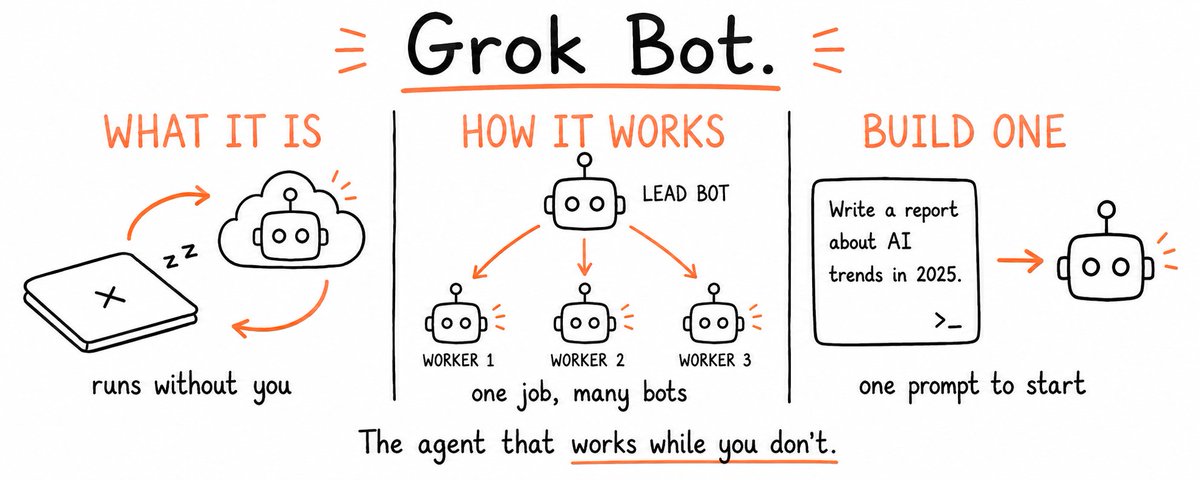
You have no f*cking idea what Grok Bot can do nowadays.
I put every feature that actually matters in 1 place, with what to use it for.
save this before it gets buried in your feed.


the honos group 〽️ retweeted

I LAUNCHED A GROK BOT TERMINAL OVERNIGHT, GAVE IT $44.82 AND STOPPED ASKING AI WHAT IT WOULD DO. BY MORNING IT HAD $11,643.21 AND SIX AGENTS LOGGING EVERY TRADE
I spent a year asking agents what they'd trade and watching the chat scroll. Last weekend I built the thing that actually trades, in Grok Bot, with no code I touched by hand.
The six agents share one screen, each one job:
> scanner reads new token pairs and volume spikes
> rug check filters suspicious tokens before anything executes
> sizer sets position from account equity, not a fixed ticket
> executor opens and closes with slippage tracking
> logger writes the reason behind every trade
> equity curve updates on every close
I went to bed on $44.82 and left the laptop open on the dashboard. By morning the balance read $11,643.21. Every trade on the activity feed had a reason next to it and a line in the log.
That's the shift I didn't see coming. Not that an agent made money overnight. That I stopped being the one asking "would you long this?" and started being the one reading the log of what already happened.
Starting balance: $44.82
Current balance: $11,643.21
Grok Bot built the terminal, the agent architecture and the dashboard. I described what I wanted and the thing went live.
The full build is in the article below ↓
The whole build is in the post below ↓
Comment " Grok_Bot "
2️⃣ Like and Repost
3️⃣ Follow me @Nexa_Tech_Ai
I'll DM you the complete setup.
the honos group 〽️ retweeted

I spent 48 hours in SF hanging out with billionaires, data labs and AI founders and execs running $1B to $100B companies.
My observations:
1. Sooo MANY stories of data brokers making like $2M a WEEK selling company data to labs. I can't tell if it's the beginning or a bubble, and I kept wondering which niches are left. Digging into it actively.
2. At dinner, someone asked the table, "If a new model drops next month, does your company get better or worse?" HALF the table went quiet! I think that's the best question to ask about any AI startup right now.
3. The bar people talk about now is hitting $1B in revenue in 12 months (I guess that's the new unicorn?). What I didn't hear much about is retention. AI revenue can come in fast and leave fast, and I think we're going to see a lot of stories of AI companies with huge revenue and terrible retention.
4. It's pretty clear we're living through the reinvention of the computer. The model is the CPU, the harness is the operating system, and skills and plugins are the apps. Thinking about it that way makes it easier to see where the whitespace is.
5. We're maybe 12 months from an agent that can watch you work for a week and then do your job without any instructions. The screen recording plus agent memory plus local model combination makes this possible right now.
6. Agent harnesses feel like the new GPT wrappers, in a good way, especially vertical ones. The best teams I talked to treat the model as swappable. One founder walked me through routing different models to different jobs: one for taste and visuals, a cheaper one for the everyday stuff, another for text.
They use prompts they can move across models over fine-tuning, and A/B test the output on what users actually do with it: do they edit it, export it, share it? A vertical harness is basically four things: the connectors for that industry's data, evals written by people who know the work, rules for what the agent can and can't touch, and a clean screen for a human to review. The model is maybe 20% of it.
7. There's a lot of reverse engineering going on/cloning going on more than I've ever seen. People are decompiling software and rebuilding it with agents, and someone showed a suite of like 10 apps that are worth $5B+ each all that he cloned open source. Me and everyone are still thinking through what it means when software gets this easy to copy.
8. My guess is the value moves to data. If the software can be rebuilt quickly, what's worth paying for in a legacy SaaS company is the years of customer data and workflows inside it. Some SaaS companies are secretly data companies.
Gets me thinking about how do you truly value data for this saas companies? Like if we were buying these dying saas companies at 2x ARR before (as example), maybe there is a better metric. Idk, just thinking out loud here.
9. It feels like a good chunk of legacy software won't make it to the agentic era, especially anything built around people clicking through a lot of screens.
10. Every company I talked to wants to pipe its internal data into one place and expose it to agents through MCP. Then they look at the data and realize it's a mess: five versions of the same customer, old Slack channels, PDFs nobody can search. Cleaning that up feels like a big consulting opportunity!
11. A lot of founders are building the basic building blocks for agents: APIs, data layers and tools. Some of the companies I saw barely have a UI because the main user is an agent. I really believe the startups that build primitives to this agentic era will do extremely well. Building blocks is the best way to think about it.
12. Labs can get plenty of training data, but it's harder to get real examples of agents failing inside companies. Whoever has those logs has something valuable.
13. Someone running a big consumer company told me the next fight is over memory. The model that remembers the most about you wins, and the smartest model matters less than people think.
14. Physical AI came up a lot. Astra I think was the first model that got people into AI can actually do CAD, and I think a lot of people are thinking what does vibe manufacturing really look like. The line I keep thinking about came from a robotics founder: the hardest problems in AI are deployment problems now, not research problems. Their robots work on their own, call a human when they get stuck, and every one of those calls becomes training data.
15. Cybersecurity companies are having a moment and are actually cool companies to build now, especially the ones that clean up after a breach. Every agent with access to your systems is a new door into your company, and a lot of those doors were left open.
16. Some startups are worth more dead than alive now. A shutdown company with 5 years of Slack, email and code can get paid for licensing all of it. I wouldn't be surprised if founders start factoring that into when they shut down.
17. People are starting to talk about monetizing the agent web. It feels really early, but when the most popular user of the internet is an agent, what startups should you be building?
18. I think agent insurance is coming. Once an agent makes an expensive mistake, insurers will want audits before they cover anyone.
19. Several people said the hire they want most is someone with taste who can write evals. The models are getting good at generating ideas, so the hard part is judging which ones are good.
20. New trend I observed: startup raises VC, uses venture dollars to become a creator, startup fails, founder falls back on being a full-time creator and incubates other products bootstrapped.
21. Getting SIGNIFICANT distribution is HARD right now. Founders are sponsoring buses, buying billboards like crazy and throwing parties with famous DJs to get noticed. Kinda feels dotcom era in that sense.
Attention is what's scarce! The growth guy going viral sharing his UGC strategy from Wispr Flow is a good example. It's the sauce everyone wants, and I truly believe there are probably only 50 people on the planet who know how to scale these types of businesses efficiently in this era.
Always good to get that dose of SF. I felt sooo lucky to have such an incredible trip during such an incredible time in building businesses. Surreal in so many ways.
Happy to be home and locked in.
Until next time!


the honos group 〽️ retweeted

Photoshop costs $60 a month. Someone just put a free version on the internet, and the weirdest part is who it was built for.
Each of these apps ships with a control port that lets an AI agent open files, edit layers, and export finished work with no human at the keyboard. That one detail tells you what this project really is.
ArtCraft, the team behind it, makes AI image tools. Their problem is that a model can generate a picture in seconds and then everything stalls, because the finishing work (masking, color grading, layout, export specs) happens inside Adobe software designed for a person holding a mouse. Adobe sells seats. An agent can't sit in one.
So they pointed Claude Opus 5.5 at the problem and rebuilt the production layer itself. Seven clean-room apps in Rust, pushed to GitHub over two days. Headless command line, JSON batch control, agent hooks in all of them. The Photoshop clone is already past 6,600 stars.
I'll be honest about where it stands. Only two of the seven have even reached early alpha, and the project's own docs put the Photoshop clone around a quarter of the way to real professional use. Nobody is canceling Creative Cloud this month.
But Adobe spent 36 years building Photoshop. The surface of all seven flagship apps got rebuilt in about a week, by a tool that takes instructions from another tool.
Adobe built the best creative software for human hands. This is the first production suite that doesn't need hands at all.

AI is now being used to recreate Adobe’s software, a developer has released seven free, open-source apps as clean-room alternatives to Adobe’s main tools:
- PhotoCraft → Photoshop
- VectorCraft → Illustrator
- FilmCraft → Premiere Pro
- LightCraft → Lightroom
- EffectCraft → After Effects
- DesignCraft → InDesign
- PrintCraft → Acrobat Pro
Built in Rust with help from Claude Opus 5.5, they run on Windows, Linux, and macOS under MIT/Apache licenses without using Adobe’s source code.

the honos group 〽️ retweeted

Sometimes I can just sense that my fleet of agents aren't operating as effectively as I want them to.
That's when I tell my chief engineer, Ahad, to do an analysis of all my conversations and clean up whatever could be causing my frustration with my agents.
I did that this morning, and here's his response.

the honos group 〽️ retweeted

Your AI isn't bad at design. It has just never seen good design.
I've tested 100+ vibe coding resources this year. These are the 40 I actually kept, grouped by what you're stuck on.
Bookmark this 🔖
1. 👑 scrolltide.co
Why it's different from everything below:
- Every one is a complete prompt, not a snippet you wire up yourself
- 3 steps: copy the prompt, paste it into your AI, launch it live
- 300+ award-winning prompts, all in one place
- Full source code to download and edit
- Works with Claude Code, Cursor or v0
Built for founders and freelancers who want award-level sites without a design team or a week of tweaking. If you only open one link in this post, make it this one.
2. designmd.ai - design systems as markdown your agent can read
3. vibeprompts.dev - ready-made prompts for dashboards and landing pages
4. minimal.gallery - curated high-end sites
5. kage.design - real UI inspiration mapped to prompts
6. styles.refero.design - 2,000+ real product styles with typography
7. component.gallery - 2,600+ examples of how top design systems solve the same element
8. godly.website - curated collection of beautiful websites
9. awwwards.com - the best of web design, recognized and ranked
10. landing.love - showcase of the best animation websites
11. land-book.com - curated landing pages
12. mobbin.com - mobile design patterns
13. hoverstat.es - experimental web design projects
14. navbar.gallery - navigation patterns
15. footer.design - footer layouts
16. cta.gallery - conversion-tested forms, popups and buttons
17. supahero.io - curated hero sections
18. pricingpages.design - the best pricing page examples
19. 21st.dev - community component marketplace that plugs into agents via MCP
20. ui.shadcn.com - still the gold standard
21. ui.aceternity.com - 200+ animated React and Tailwind components
22. magicui.design - 150+ animated components and effects
23. motion-primitives.com - advanced interactions
24. uiverse.io - open-source UI elements
25. smoothui.dev - animated components built on Motion and GSAP
26. shadcnblocks.com - 2,000+ pre-built section blocks for shadcn/ui
27. kinetics.colorion.co - 150+ motion effects with React code and prompts
28. microkit.co - micro-interactions
29. glass.samasante.com - glass refraction components
30. animejs.com - lightweight animation engine
31. threejs.org - the most popular web 3D library
32. shadertoy.com - the standard online shader editor and community
33. thebookofshaders.com - free interactive intro to fragment shaders
34. threejs-journey.com - full Three.js course with shader chapters
35. kitbitz.art - 2,000+ hand-drawn illustrations
36. 3dicons.co - 3D icons
37. claude.com/product/claude-co… - command-line AI coding agent
38. cursor.com - AI-first code editor
39. v0.dev - Vercel's prompt-to-component tool
40. lovable.dev - AI app builder in the browser
Which one should I add next?
the honos group 〽️ retweeted

Uber publicó cómo armó su infraestructura de MCP y hay varias ideas muy buenas acá.
imaginate una empresa con miles de servicios internos y muchos equipos conectando agentes a esos sistemas por su cuenta.
cuando eso empieza a crecer, terminás con tooling fragmentado, infra duplicada, distintas formas de exponer tools y poca consistencia en seguridad, discovery y operación.
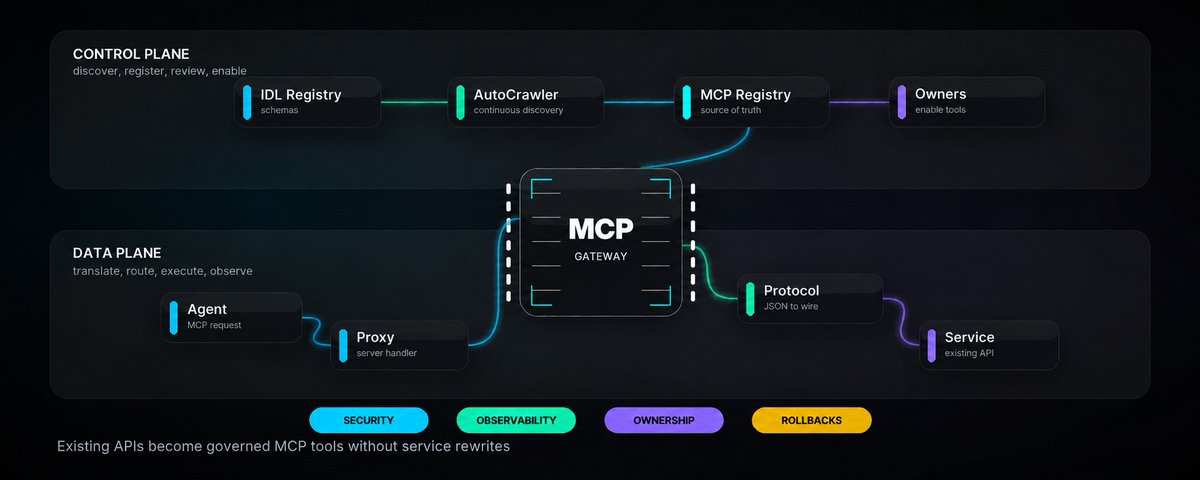
por eso Uber hizo un MCP Gateway: una capa central entre los agentes y sus servicios internos.
el agente habla MCP y el gateway se encarga de routing, permisos, ejecución y de traducir las llamadas a HTTP, gRPC o TChannel según corresponda.
como Uber ya tenía miles de APIs internas, también hicieron AutoCrawler: recorre sus definiciones, detecta métodos y schemas y genera MCP tools automáticamente. incluso usan un LLM para mejorar las descripciones.
hoy tienen +800 MCP servers y +5000 tools. y ahí aparece otro problema: no podés cargar todas esas definiciones en el contexto del modelo.
para eso crearon Omni MCP. en vez de pasarle miles de tools al agente, este va descubriendo qué server necesita, qué tools tiene disponibles, carga el schema de la correcta y recién ahí ejecuta.
me parece un muy buen ejemplo de cómo cambia la arquitectura cuando los agentes pasan de usar unas pocas tools a trabajar con miles.
terminás necesitando algo muy parecido a un API Gateway para agentes.


the honos group 〽️ retweeted

43 places to find B2B buyers, already ranked for you:
1. Inc. 5000 (fastest growing US companies)
2. Deloitte Fast 500 (tech, by revenue growth)
3. Forbes Cloud 100 (private cloud companies)
4. Clutch 1000 (B2B agencies)
5. MSP 501 (managed service providers)
6. CRN Solution Provider 500 (IT resellers)
7. MSSP Alert Top 250 (security MSPs)
8. Am Law 200 (law firms by revenue)
9. Accounting Today Top 100 (CPA firms)
10. Vault Consulting 50 (consultancies)
11. NLJ 500 (biggest firms by lawyer count)
12. Barron's Top 100 RIA Firms (wealth managers)
13. PEI 300 (private equity firms)
14. SIA Largest Staffing Firms (US, $100M+)
15. ENR Top 400 (general contractors)
16. Builder 100 (home builders)
17. BD+C Giants 400 (design and build firms)
18. ENR Top 600 (specialty contractors)
19. Architectural Record Top 300 (architects)
20. Qualified Remodeler Top 500 (remodelers)
21. ENR Top 500 (design firms)
22. Roofing Contractor Top 100 (roofers)
23. Lawn & Landscape Top 100 (landscapers)
24. PCT Top 100 (pest control)
25. SDM 100 (alarm and security dealers)
26. Solar Power World Top Contractors (solar)
27. IndustryWeek US 500 (public manufacturers)
28. Food Processing Top 100 (food makers)
29. Medtech Big 100 (medical device companies)
30. Industrial Distribution Big 50 (distributors)
31. Transport Topics Top 100 (for-hire carriers)
32. CCJ Top 250 (trucking fleets)
33. FreightTech 100 (freight software)
34. Transport Topics Top 100 Logistics (3PLs)
35. Automotive News Top 150 (dealer groups)
36. NRF Top 100 (retailers)
37. Restaurant Business Top 500 (chains)
38. Franchise Times Top 400 (franchise systems)
39. NMHC 50 (apartment owners and managers)
40. Washington Technology Top 100 (fed contractors)
41. NPT 100 (largest nonprofits)
42. FT 1000 (Europe, by growth)
43. Sunday Times 100 (UK, by growth)
Every company on these has a rank it's proud of.
Search the list name on LinkedIn and you'll find the person who posted about making it.
That's who you message, and the rank is your first line.
the honos group 〽️ retweeted

i couldn't sleep after reading this
Sam Altman just explained how he uses his own AI agent, and it feels illegal:
he leaves it one long voice note as he's drifting off. by morning the thing is built, and it already "did the next seven steps"
his agent is called Dotty. it sorts the morning fires and only pings him when something is urgent. in his words, it gave him "space for creativity or to just hang out with my kids"
that's literally what openai dots does now. the launch post hit 13.7 million views three days ago. each dot gets its own computer in the cloud, plugs into 4,000+ apps, and you message it inside chatgpt, slack or teams. your laptop stays shut
getting the same morning out of your own dot takes five moves, and the first one matters most:
→ give it one job and keep the chain short. in openai's own safety tests, handing a dot 10 tasks in a row instead of 5 more than doubled the slip-ups
→ write the brief as four answers: what must get done, which sources it reads, what deserves your attention, what it must not do yet
→ skip scheduling the follow-ups. it can "decide when to pause and wake up to continue work", so give it the goal and let it pick its own hours
→ ask for a handful of versions. Altman leaves Dotty notes on how a feature should work and gets several builds back to pick from
→ write repeat jobs like a calendar invite: "every friday at 17:00, post the summary in the team channel. only what's in the summary. ask me first before posting anywhere else"
dots are live on chatgpt pro and business premium, and your first dot comes included in the plan
it learns from your feedback over time. six months from now, the people who started this week will have a dot that knows how they work, and everyone else starts from zero
full playbook in my article below. bookmark this before tonight's voice note