

Respect what others value, it goes both ways. The world needs to stop shouting & start listening. No one is above another
Joined December 2012
- Tweets1.3K
- Following181
- Followers77
- Likes11.4K




Keeping PIP The Ignored Side - @DailyMail @TheSun @GMB @BBCPolitics @itvnews @UKLabour @andyburnham @labourlewis @UNHumanRights @thetimes @FinancialTimes @Conservatives @Telegraph
Keeping PIP & UC will cost DWP £3.4 billion a year. However, once you count wider GDP growth, job retention, and avoided NHS and homelessness bills, keeping the safety net while funding support delivers a net positive return to the UK economy.
Keeping PIP means disabled young people can actually afford the specialized transport, sensory aids, or support needed to stay in those new jobs—protecting the +£1bn to +£2.4bn in new tax and economic output rather than seeing them drop back out of work.
GDP Multiplier (+£2bn to +£5bn+): Retaining £3.6 billion in PIP and UC payments keeps that money circulating immediately in local supermarkets, utilities, and high streets. Even using the OBR’s conservative 0.6 multiplier, keeping that money in claimants' pockets preserves ~£2.16 billion a year in GDP (and up to £5.4 billion using higher low-income multipliers).
Avoided Crisis Costs (+£1bn to £3bn+): Keeping the financial safety net prevents the cost-shunting of eviction, temporary council housing (£15k–£30k per person), food bank reliance, and acute NHS mental health admissions. (For comparison, TUC economic modelling of a targeted youth jobs guarantee without benefit cuts estimated a return of £2.69 for every £1 spent in combined tax, productivity, and public service savings).
Keeping PIP and the UC health element intact while funding targeted employment support produces a net positive return to the UK economy of roughly +£3.5 billion to +£7.5 billion per year compared to cutting those benefits.
Even if you strip out gross wages so you aren't double-counting GDP and look strictly at public-sector and local demand value, the net gain is still +£3.5 billion to +£7.0 billion a year.
16
D retweeted

Quick Google suggests disability law is being tested ECHR must have something to say #SEND

When you are pushing thousands of young disabled people 16-24, with mental health issues, ADHD & Autisim (lifelong neurodevelopmental differences rather than illnesses to be "cured" or "treated) into poverty & suicidal thoughts & suicide, you now say 100k anually - EU citizens can come & take those same jobs you want them to apply for. So in effect you as per the Milburn report will expect them to live on £338 Per Month & because of this, & the report which says if they can't engage or find employment you will reduce this amount. The transfer of this age group was EU to UK 130K to 180k annually UK TO EU roughly 85k. Why do you hate our disabled youth & non disabled youth so much. This will not help our unemployed & disabled community at all, as it has never been more able to move to the EU than come here.
@andyburnham @UKLabour
15

D retweeted

The Parliamentary Work and Pensions Committee has launched an inquiry into the Milburn report on young people and unemployment
committees.parliament.uk/com…
Submit your evidence by 16th December committees.parliament.uk/sub…
#MilburnReview #Disability #PIP #NEET

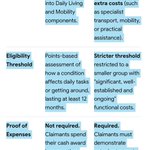
PIP Claimants Who Cannot Prove "Demonstrable" Out-of-Pocket Costs: Because the replacement Additional Cost Allowance is narrower than PIP and designed to pay out to fewer people, tens of thousands of young people—particularly those with autism, ADHD, or severe mental illness whose support needs involve supervision, prompting, or cognitive assistance rather than buying physical equipment—risk losing their disability payment altogether.
Moving hundreds of thousands of young people with neurodevelopmental or mental health conditions out of protected disability categories and onto a conditional Youth Allowance puts them at risk of 100% benefit sanctions if communication barriers, executive dysfunction, or health crises prevent them from meeting their Participation Plan requirements. Our son would be one of them . It is sickening its like you are punishing him for living. For being Autistic, with severe learning delays and language disorder. Who everyday has a least one toilet accident, who doesn't understand going to toilet & the sensation. Who needs help with washing. dressing, eating doesn't understand danger .
A scheme which doesn't guarantee anything after a max of 6 months & saves £200 million in 10 years. £20 million per year. Labour deliberately, negatively and 100% are creating living unobtainable for the disabled, let alone equality in life.
@TomHayesBmouth
55
D retweeted

I've been skimming through the Milburn Review, and I genuinely struggle to comprehend the sheer SHORT-SIGHTEDNESS of what's being proposed.
And, of course, @Helen_Whately, below, is already salivating at the prospect of slashing sickness benefits, like some sadistic accountant who sees human suffering as an opportunity to balance the books.
But let's look at what's actually being proposed...
We're talking about fundamentally restructuring the welfare system for under-25s, stripping disabled young people of vital financial support, while simultaneously handing taxpayers' money to private employers to incentivise recruitment.
And here's the staggering part.
Employers receiving the government's £3,000 Youth Jobs Grant are NOT required to retain employees for any minimum period.
They're not even required to demonstrate they've created an additional job!
This is one enormous WEALTH TRANSFER.
Taking financial security away from some of the most vulnerable people in society, while funnelling public money towards private employers without sufficient guarantees of sustainable employment.
So what exactly are WE being asked to fund?
Genuine pathways out of poverty? Or a revolving door of subsidised employment, with vulnerable young people potentially dumped straight back into unemployment and financial insecurity?
And those who genuinely can't work? Are we simply prepared to push them further into poverty from the outset?
WHERE THE FUCK IS THE ACCOUNTABILITY?
What happens when the subsidies end?
How many of these young people will still be employed in 12 months? Two years? Five years?
We're talking about the future of an entire generation, yet still confusing short-term corporate initiatives with the fundamental economic transformation that's desperately needed.
And perhaps most absurdly, why should a disabled 24-year-old receive fundamentally different financial protection from a disabled 26-year-old?
Does their disability suddenly become more expensive at 25? Does their rent change? Their food bills? Their need for dignity and independence?
OF COURSE IT FUCKING DOESN'T!
Yet we're contemplating a system that transfers financial security away from vulnerable young people, while directing public money towards employers without adequate guarantees of lasting employment.
This is the fundamental problem with treating welfare primarily as a COST to be reduced, rather than social protection that allows people to live with dignity.
Where's the long-term vision?
Where's the investment in genuinely sustainable employment, education, healthcare, infrastructure and an economy that creates opportunities for EVERYONE?
Where's the commitment to protecting those who simply cannot work?
Instead, we're in danger of weaponising poverty as an incentive to force people into employment, while rewarding businesses for offering opportunities that will most likely disappear as soon as the financial incentives do.
A functioning welfare state protects people from poverty.
A functioning economy provides meaningful opportunities.
WE NEED BOTH.
Otherwise, we're not fixing the crisis. We're simply recycling it, at an enormous human cost.
And politicians celebrating the prospect of cutting support for vulnerable people should seriously question what the hell they've come into politics to achieve.
#MilburnReview
@ZackPolanski @TheGreenParty @andyburnham @UKLabour


D retweeted

The manufacturing of consent for another round of welfare cuts is well under way. And frankly, the whole thing is becoming depressingly familiar.
Before Parliament has even seen Alan Milburn’s final report, we’re being treated to a steady drumbeat of media interviews, briefings and commentary telling us that painful choices are unavoidable. That radical reform is necessary. That anyone raising objections simply doesn’t understand the scale of the problem.
It’s all quite telling. Because increasingly, I don’t think Labour MPs are the real audience for this exercise.
The real audience is outside Parliament: the media commentariat, think tanks and, through their relentless promotion of these proposals as economic ‘common sense’, a currently sceptical public.
The objective, it seems, is to turn scepticism into grudging acceptance, then point to that acceptance as evidence that the reforms are politically viable, perhaps even desirable.
It’s a familiar process of manufacturing consent. A pincer movement: persuade the public there’s no alternative, then tell Labour MPs the public demands it.
And at the heart of it lies a particularly pernicious political trick.
Present people with a false choice, then insist they choose.
Either we cut financial support for some of the most vulnerable people in society, or we face economic ruin. Either we accept the reforms, or we condemn another generation to a lifetime on benefits.
Heads I win, tails you lose.
As any first-year debating student knows, once you’ve conceded your opponent’s premise, much of the argument is already lost.
But why should we accept the premise?
For fellow Star Trek fans, this is our government’s Kobayashi Maru moment. The seemingly impossible, no-win scenario. Kirk’s solution was famously to reprogramme the computer. He refused to accept that the rules of the simulation were the only rules possible.
And that’s precisely what we need to do with our political economy.
Andy Burnham has already identified the operating system that’s been running Britain for the past 40 years. It’s called neoliberalism. And he’s promised to end it.
An economic model that has progressively hollowed out our democracy, stripped communities of economic power, privatised public wealth, weakened organised labour and handed ever greater control over our collective future to financial markets and corporations.
A model that disciplines workers through insecurity, while insulating capital from the consequences of its own failures.
Indeed, what we’re living with now barely resembles the free-market capitalism its advocates once promised. It’s closer to corporate socialism: public money underwriting private risk, public services guaranteeing private returns, and the taxpayer picking up the bill when things go wrong.
Socialism for the powerful. Market discipline for everyone else.
And all the while, the same political and economic establishment tells us what is and isn’t possible. What we can and cannot afford. Which choices are ‘responsible’ and which are supposedly beyond the pale.
That’s the real significance of manufacturing consent. It’s not just about selling unpopular policies. It’s about narrowing the boundaries of political imagination until the public, and eventually Parliament itself, forgets that alternatives exist.
So what does reprogramming the system actually mean?
It means replacing an extractive economy with a productive one.
It means taxing accumulated wealth more fairly, restoring collective bargaining, taking back democratic control of essential infrastructure, and investing in the industries, services and communities that generate genuine prosperity.
It means rewriting fiscal rules that constrain long-term public investment, and ensuring institutions such as the Treasury, the OBR and the Bank of England serve democratically determined economic objectives rather than treating the preferences of financial markets as the final word.
It means being prepared to confront concentrated economic power, whether that sits in the bond markets, water companies, property monopolies or tech corporations.
And it means recognising that economic policy is not simply about distributing whatever crumbs are left after capital has taken its share. It’s about deciding how wealth is created, who controls it and who benefits.
Keynes famously observed that “anything we can actually do we can afford”.
That doesn’t mean resources are infinite. It means the real constraints on an economy are its productive capacity, people, skills and resources, not the fictional idea that a sovereign government operates like a household with a fixed pot of money.
Which brings us back to welfare.
Before asking how much we can cut from the social security bill, shouldn’t we first be asking why so many people need financial support in the first place?
Why do millions of people work yet still need Universal Credit to get by? Why are housing costs swallowing wages? Why are so many people waiting for medical treatment? Why are insecure employment, poor housing and ill health so deeply embedded in our economic model?
Some 3.1 million Universal Credit recipients were already in work in April this year.
That’s not evidence of a country overwhelmed by people unwilling to work. It’s evidence of an economy in which work itself too often fails to provide security.
Of course, Milburn is right about one thing. Too many young people are being failed. We urgently need better mental health services, apprenticeships, training, employment support and good jobs. And he’s right that this requires serious upfront investment.
But here’s the contradiction.
If poverty, poor health and lack of opportunity are keeping young people out of work, how does making some of them poorer solve the problem?
PIP isn’t an unemployment benefit. It helps disabled people meet the additional costs of living, including costs that can enable them to work.
Taking that support away and promising better opportunities later isn’t necessarily a route out of poverty. It risks creating another barrier to escaping it.
And that’s why this debate has to be about much more than the merits of one report.
There is sufficient wealth in this country to provide a decent social security system. What we lack is an economic model that distributes that wealth fairly, invests productively and gives working people genuine power over their lives.
Rising welfare expenditure is not simply the cause of our economic difficulties. Much of it is a symptom of an economy that isn’t working as it should.
Until we’re prepared to tackle that underlying failure, taking money away from people already struggling is neither economically convincing nor morally defensible.
A Labour government should not be taking a penny from people who need support while leaving the structures that generate poverty, insecurity and inequality largely intact.
This feels uncomfortably like the unfinished business of the Starmer government: the same old economic assumptions, dressed up in the language of unavoidable choices.
Andy Burnham has promised something different. An end to neoliberalism. A more democratic economy. A state that shapes markets rather than simply submitting to them.
Well, this is the test.
Because you cannot promise to change the economic operating system while continuing to accept its most damaging assumptions.
We don’t have to choose between supporting vulnerable people and building a stronger economy. Done properly, the former is part of achieving the latter.
The real choice is between continuing to manage the consequences of a broken economy, or finally having the courage to change the economy itself.
And that is the choice Labour should be offering the country.

D retweeted

Lisa Nandy has said that the social media ban for under-16s is just the starting point.
She praised Keir Starmer and Liz Kendall for beginning the process of increasing online censorship, and welcomed Andy Burnham’s decision to accelerate it.
At Labour Party conference, Nandy said the ban was “a staging post to what must be a very interventionist state, policing and regulating the online space so that people are safe”.
We should recognise that this is no longer just about protecting children online. It is about giving the state greater control over what we can and cannot say online.
We are living in Orwell’s 1984.
#StrictlyComeDancing @BBC why is Emma feeling the need to shout all the time? Is her mike not working? She's great on Delivering babies. Josh Widdicombe stop with the fake laugh. You all made the cut. Johannes is great, professional & letting the show contestants be the main feature as well as the judges.
1
5
4,444
D retweeted

Live stream of my run for Tina’s hospital here on YouTube…
youtube.com/live/K44RPa-wg-c…
Follow along. Share it. Book mark. We are 25km into the 120km 🙏


D retweeted
This time tomorrow I’ll start trying to run 3 marathons in 24 hours.
It’s all to build a hospital for street dogs.
If you would like to support me you can sponsor me here…
happydoggo.com/tinas-hospita…


And finally Labour are the party who can't wait to bring in full Digital ID, Central Bank backed by the Government, restrictions on free speech & promotion of approved news channels. Restrictions on travel with higher costs on airlines. All to make you more dependant on the state
1
33
D retweeted

Bea & Elsie are still waiting for UK 🇬🇧 homes. 🏡
They are currently based in kennels in Ellesmere, Shropshire.
Please see our main page for more details...
Please share them for #forgottensoulshour 🙏🥰

D retweeted
Day 1 of applying to become education secretary every day until @educationgovuk respond!
D retweeted
Bea & Elsie are still waiting for UK 🇬🇧 homes. 🏡
They are currently based in kennels in Ellesmere, Shropshire.
Please see our main page for more details...
Please share them for #rehomehour 🙏🥰
