

Exterminate/EXTERMINATE!!!!!
Skaro
Joined June 2023
- Tweets5.8K
- Following853
- Followers435
- Likes54.5K




On the topic of the prequels, Palpatine was such a good villain that even the most jaded xillenial that has replaced their capacity for critical thinking with Redlettermedia clips has nothing negative to say about his character & Ian McDiarmid's performance.


Prequel haters in the replies calling Anakin a "school shooter," like he wasn't motivated by intense anger & grief over losing the ones he loves, like he was just watching Martha Speaks porn on his phone on his way to the Sand People camp/Jedi Temple with the 501st.

Niggas be like "Hayden Christenson sounded like some awkward angsty teenager in AOTC," as if that wasn't the fucking character he was playing.


"I'm comfortable painting my nails," mfers when I paint mine with the blood & gunk from their eyes after I jammed my thumbs into them.


HowlingDalek retweeted

This is so disingenuous because there isn't some vast spectrum of individuality amongst "queers", but the opposite, extremely rigid archetypes you do everything you can to mold yourselves into, clone armies of liliths with the exact same personality.


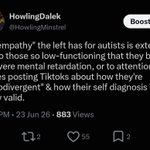
The actual goal of mainstream "autistic support" is infantilization. If you actually want to be taken seriously without trooning out, these same sippy cup supporters will go full knives out to demoralize, demean, & silence you for trying to speak out against social harms.


The point of the sequel is that devil worshipers will inflict pain & suffering on vulnerable people under the guise of altruism & care for them in order to gain power, only to be manipulated in turn & used as a tool for greater forces of evil (as well as also going to hell).


Deland Tyerell: "Erm, podracing is le hecking dangerous because my dad crashed into a stalagmite, we should like ban it."
Neva Kee's body rotting in a Tusken Raider camp:


Autumn weather's absolutely perfect, no bugs, nice cool breeze, lovely scenery with the leaves changing color. Give it about 2 months when its actually cold & gloomy & muddy when there's no snow on the ground.
🤖 Made with AI


Since you seem unfamiliar with Ian Danskin's The Alt-Right Playbook, allow me to explain what it actually is and why I brought it up.
It's a series of video essays by Innuendo Studios examining how reactionary political arguments can manipulate public discourse. It isn't a literal instruction manual or a magical way to win arguments. It's an analytical framework for recognizing rhetorical strategies that prioritize controlling a conversation over establishing whether a claim is true.
Several episodes are particularly relevant to this exchange.
1. Never Play Defense
The basic principle is to keep your opponent explaining and defending themselves while avoiding scrutiny of your own claims.
Instead of answering evidence with counterevidence, respond with ridicule, insults, accusations, or another provocative statement.
The opponent then spends time defending their intelligence, credibility, or sources rather than examining the original disagreement.
The result? You've successfully redirected their attention without demonstrating that they were wrong.
In our exchange, the original subject concerned executive power and constitutional limitations. Responses like "No lol" and reaction GIFs provide no constitutional analysis whatsoever.
2. Control the Conversation
Danskin examines the importance of determining what a political discussion is actually about.
If someone presents an argument supported by constitutional principles, you can challenge the evidence, question the reasoning, or offer another interpretation.
Alternatively, you can change the subject to whether the person deserves to be taken seriously.
Once the conversation becomes about someone's intelligence, political identity, or preferred sources, the original argument has effectively been displaced.
This matters because controlling the subject of a debate can create the appearance of winning without actually addressing the disputed proposition.
3. The Card Says Moops
This episode explores a particular form of argumentative opportunism: treating facts and claims as pieces in a game rather than commitments to a consistent position.
The objective becomes finding whatever statement will frustrate or embarrass an opponent at that moment.
An argument can be adopted, abandoned, or contradicted whenever doing so seems rhetorically advantageous.
The important distinction is between someone genuinely defending a belief and someone using an argument merely because it provides a convenient way to score points.
I'm not claiming that every sarcastic response demonstrates this tactic. The question is whether the person maintains a coherent position when challenged.
4. Why Don't You Respond to Criticism?
This episode examines how vague accusations can resemble meaningful criticism without presenting anything specific to answer.
Statements suggesting someone is ignorant, delusional, brainwashed, or incapable of reasoning can create the impression that their position has been discredited.
But unless the speaker identifies an actual factual error, unsupported premise, or invalid inference, there is no substantive criticism to evaluate.
A sneering response isn't a logical refutation.
5. You Go High, We Go Low
Danskin also examines how political discussions can operate under unequal expectations.
One participant is expected to remain meticulous, provide sources, and follow norms of civil debate, while another relies on provocation, insults, or deliberate disruption.
If the first participant responds emotionally, the second can point to that reaction as evidence of irrationality.
If the first participant ignores the provocation, the second can claim victory through silence.
The broader lesson isn't that civility is bad. It's that civility alone cannot guarantee productive discussion when participants have different objectives.
Now, back to this actual conversation.
We were discussing constitutional limits on executive power, the separation of powers, and whether
Reminds me of that Dr Who episode where the vampires were repelled by a psychic barrier created by strong faith. A russian officer with a USSR pin who believed in communism enough was just as effective as a priest. Dumb idea, but its funny to imagine this guy driving them back.


Channard wasn't quite in over his head as Frank was, he's shown to enjoy inflicting pain & mutilation, but had cold feet about being on the receiving end. The Leviathan only gives him what he wants after he's "enlightened," & even then at the cost of his free will.


