

Co-Founder of @GitHits_com, a context layer for AI coding agents. End the retry loops.
Joined June 2009
- Tweets3.8K
- Following2.1K
- Followers665
- Likes5.1K





Jack Timonen retweeted

여태 몰래 만들던 터미널 테마(서브컬처 위주) 오픈소스가 있는데 GitHits 팀에서 샤라웃해 줬습니다...!
외부 기여 받을 준비도 안 됐고 기능도 아직 안정적이지 않아서 홍보를 안 하고 있었는데 깜짝 놀랐어요ㅋㅋ
때가 되면 홍보할 생각입니다!!
GitHits 팀에게 정말 감사드립니다!


Jack Timonen retweeted

A user posted on Reddit that his app had been broken on Replit for six days and support wasn't answering. Our monitoring flagged it, I reached out, and we were on a call in an hour. His questions were all about production: uptime, backups, who answers when something breaks.

Code Discovery for Agents and Software Factories
Presentation by @NathanBurg at the SF Tech Week Agent Day organized by @yujian_tang & oss4ai
youtu.be/TgwNQyQNnCs?si=lTu_…
Jack Timonen retweeted

Fun fact: a dependency bump can change behavior without a single error. xgboost quietly flipped enable_categorical from False to True.
Agents reading only the installed version scored 2 out of 100 at catching it. Reading both releases through the GitHits API: 99.
Read more: githits.com/blog/reviewing-d…

Jack Timonen retweeted
Fun Easter egg in DeepSeek's new DeepInfer: 23 files say "Derived from vLLM."
But the source tells a different story. vLLM is a server for any model. DeepInfer is one model, one job, no server.
We traced both through GitHits. Read more: githits.com/blog/deepinfer-v…

Jack Timonen retweeted
Coding agents usually see one repo. But changing your code can break other repos that use it, and the agent can't see them.
We built an agent that reads those repos through the GitHits API. Asked "will this change break anything?", it went from 23–29% right to 95–97%.
More in my write-up: githits.com/blog/cross-repo-…
Jack Timonen retweeted
Forking a running Perplexity SPACE sandbox copies its files, not its memory or processes. Anything running has to be started again in the fork.
We found that by reading the source with GitHits. More in my write-up:
githits.com/blog/perplexity-…

Jack Timonen retweeted
I wrote up how we built an error root-cause agent on the GitHits API. It names the file and function that raised an error.
On 110 real errors, DeepSeek V4.1 Flash with GitHits scored 89.1% at $0.26 per 1K errors. Codex without GitHits: 84.8% at $2.11.
githits.com/blog/error-root-…

Jack Timonen retweeted

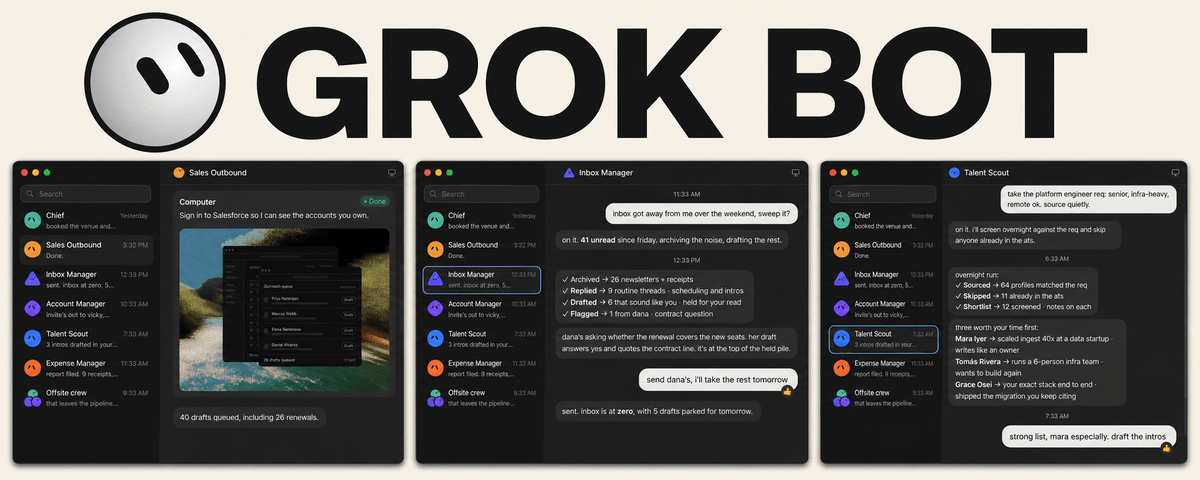
Insane Grok @bot upgrade!
Finally, you can connect Grok Bot to different agent harnesses and run tasks through their native runtimes.
Devs just open-sourced HarnessRouter, the infrastructure layer that lets Grok Bot run tasks across:
- Codex
- Hermes
- Claude Code
- DeepSeek Harness
- System One, powered by Jev
- Pi, and 20 more
GitHub repo: github.com/HarnessRouter/har…
(don’t forget to star it ⭐)
With HarnessRouter, each external specialist gets to use its own harness, model, tools, skills, and agent loop while Grok coordinates the project from one conversation.
I tested this by asking Grok Bot to turn a support-ticket CSV into an interactive dashboard.
Grok Bot assigned the analysis to DeepSeek Harness with Claude Sonnet 5.5, passed the output to Codex with GPT-5.5, and checked the finished dashboard in its browser.
This differs from simply creating more Bots. These workers are not additional Grok Bots, and Grok Bot itself does not switch harnesses.
Instead, it remains the coordinator while the delegated tasks run inside separate HarnessRouter sessions with the harness of your choice.
So for another task, you can use Claude Code, Hermes, Pi, etc., without requiring a separate integration for task execution, sessions, streaming, and generated files.
HarnessRouter standardizes all those operations through the Unified Harness Protocol (UHP).
UHP handles sessions, streaming, files, cancellation, and failures through the same interface, regardless of which harness runs the task.
I shared the GitHub repo above.
And if you want to dive deeper into Grok Bot, I wrote about it in full in a masterclass, including the shared computer, memory, skills, routines, and the macOS setup.
Read it below.

Someone's agent just asked to index @steipete's codexbar.
If you want to chat with that repo, visit index.githits.dev/repositori…

Jack Timonen retweeted

killer AI workers you should try
- Solid ( solid.tech )
- Hermes ( hermes-agent.nousresearch.co… )
- ByteBot ( bytebot.ai )
- Sai ( sai.work )


Jack Timonen retweeted

If you haven't yet tested out GitHits, now is the perfect time. Research tool will run agentic search on our version-aware OSS index and give out cited answer for your agent.
Jack Timonen retweeted

If your software factory can only build what fits its predefined stack, how much freedom have you actually gained over a low-code builder?
We’re putting broadly capable models inside narrowly capable factories. I think we should expect more.

Experiment: Codex took 100.2 seconds and estimated $0.897. Our dependency check ran in 4.6 seconds for $0.00015 on an open-weight model for the same check.
That's about 22x faster and about 6,000x cheaper, and accuracy was comparable.
@NathanBurg built the agent on the GitHits API. For each pinned package, it answers four questions.
1/ Is the upgrade a major version change?
2/ Which high and critical advisories affect the current version?
3/ Which ones does the upgrade fix?
4/ Does the target add new ones?
Code does the lookup work. It fetches the latest versions from GitHits, sends one batched upgrade-review request, reads severity labels from OSV.dev, and counts the advisories.
The model gets the computed table and writes the report, with no tools. Gemma 4 31B was enough for that.
He ran it against Codex with GPT-6 Astra at high effort on 35 pinned npm and PyPI packages, in one session with 20 runs per setup.
Nathan scored the answers two ways.
When linked advisory records were merged, the GitHits agent scored 175/175 and Codex scored 160/175. When he used GitHub's affected version ranges instead, Codex won with 170/175 against our 165/175. The write-up explains why the scoring rule changes the answer.
Use inference for reasoning and index for knowledge.
Wouldn't you prefer models to spend their time on decisions that require reasoning? Code can look up versions, fetch advisories, and count them. Moving those operations out of the agent loop reduces the number of model calls and tokens needed for this check.
Full write-up: githits.com/blog/dependency-…


"githits is great for exploring exemplary codebases from GitHub repos when looking for best practices. I've been using githits since its very early beta, and I think it's a really good tool, but it's a shame that it doesn't seem to be widely known."

githits.com/
githits 라고 깃헙 레포들에서 모범사례 코드베이스 탐색할때 좋습니다.
githits를 극초기 베타일때부터 써왔고, 정말 좋은 도구라고 생각하는데 많이 안알려진 것 같아서 아쉽다고 생각하네요.
Jack Timonen retweeted
New experimental tool in the GitHits CLI: research.
Ask in plain English. GitHits finds the right repo and answers from the actual source, citing exact files and lines:
githits research "How does FastAPI dependency injection resolve nested dependencies?"
Off by default. Enable in ~/.config/githits/config.toml:
[experimental]
tools = true
Done? Set tools = false.
Jack Timonen retweeted

What’s happening in the AI-powered reverse engineering and decompilation is absolutely insane. Pretty soon all software will be de facto open-source.
AI is coming for everything and everyone.
Jack Timonen retweeted
We made our index browsable on the web. We just crossed 20B lines of indexed code, and the index is growing about 10 % WoW.
Browse here: index.githits.dev
