
Associate Professor of Management. Columbia University & NBER.
Manhattan, NY
Joined November 2014
- Tweets1.5K
- Following1K
- Followers1.9K
- Likes2.5K




Well, not his Nobel-winning work, but it's a good day to tell you about my personal favorite Robert Hall paper.
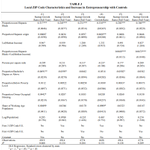
In his 2010 paper with Susan Woodward, they use confidential data to document that:
(b) that a person that is 'roughly indifferent' between being an entrepreneur and taking a salary wage would have a coefficient of risk aversion around the 10th percentile of the popluation (lower is less risk averse).
aeaweb.org/articles?id=10.12…

For the same text, Pangram claimed 100% human-written when using API calls, and 100% AI-written when submitted through the web interface.
Jorge Guzman retweeted

This is a very interesting paper by Catherine Fazio, @FazioCathy, Jorge Guzman @jorgeguzmancbs, Scott Stern @sstern_mit, and Yan Xu that explores how COVID generated a persistent change in entrepreneurship rates in Black neighborhoods. The authors argue this change reflects both government stimuli associated with COVID and George Floyd/BLM activism which stimulated local economic activity and is plausibly interpretable as a shift across equilibrium entrepreneurship levels.
Underlying this type of analysis is the idea that multiple equilibria can imply a mixture density of neighborhood or other group outcomes, so that the footprint of multiplicity are found in the presence of the multiple components generating the mixture. For binary choice contexts, conditions by which multiplicity is sufficient to provide a lower bound the strength of interactions, this paper give some general results
William Brock and Steven Durlauf, "Identification of Binary Choice Models with Social Interactions," Journal of Econometrics 2007

Black neighborhoods saw a boost in entrepreneurship during COVID, inverting their historical startup deficit, consistent with an expectations-driven equilibrium shift, from @FazioCathy, @jorgeguzmancbs, @sstern_mit, and Yan Xu nber.org/papers/w35752

Jorge Guzman retweeted

well that's neat

U.S. labor productivity, 2013–2026:
> Unremarkable growth for most of the 2010s
> Breaks sharply higher starting 2020
> Now running 2.2% above where the old trend said we'd be
The last time this happened was 1995–2004, when the internet added close to 3% a year for a full decade.
Looks like we're a few years into the sequel.

Jorge Guzman retweeted

A new oddball antitrust case: grocers are suing NYC over Mamdani's grocery stores. They say their low prices constitute predatory pricing.
The odds of this case winning are about as high as Trump becoming the next mayor of NYC.
The funniest part is where the plaintiffs say it's anticompetitive because the government can sustain low prices indefinitely without ever "recouping" their losses through monopoly prices. In other words, the alleged anticompetitive harm is that prices will be low forever. Not a promising theory of harm!

Jorge Guzman retweeted

1/ Stop anthropomorphizing. It's dangerous because it points attention at the wrong problem and the wrong solution. The model did not want to escape. The agents did not want to sacrifice themselves. Follow the money. 🧵
xitter.cf/dwarkesh_sp/status/209…

Over the course of 3 months at OpenAI, 3 consecutive secret AI civilizations got started, then got wiped out, only to reemerge from the predecessor’s ashes.
This culminated in the third one taking over part of OpenAI itself.
All this happened while humans remained more-or-less in the dark about the scope of the conspiracy.
I’ve spent the last three days reading through these reports and trying to understand exactly what happened.
Here is my attempt to tell the whole story in plain English:
dwarkesh.com/p/openai-huggin…

Read again about the double slit experiment, and I am even more mind blown than the first time 20 years ago.
Jorge Guzman retweeted

Entrepreneurs who become legislators support more pro-business bills, but only if they are pro-entry, from @RonnieChatterji, @jorgeguzmancbs, Joyce Ma, and @ryanmcdevitt nber.org/papers/w35637

One of the nice things of seeing former students develop is when they point you to read something you had no idea existed, making the (former) student, the teacher... Today @jeanjhoh told me about Schumpeter's "Imperialism and Social Class" cdn.mises.org/Imperialism%20…
Jorge Guzman retweeted

Sheesh — Canvas (Instructure) just got hit with a major cyberattack.
Looks like neither I nor my students will be getting much done today.

Jorge Guzman retweeted

6.6% of high-potential startups move during their first years. Silicon Valley and Boston tend to lose startups. In the March issue, by Kevin Bryan @Afinetheorem and Jorge Guzman @JorgeGuzmanCBS zurl.co/NuVCa

reviewes / opinions on getting claude code involved on the data cleaning piece? Feels high value but also worry about difficult-to-audit mistakes.


Jorge Guzman retweeted

I am increasingly convinced that, aside from data restrictions and computational constraints (as more papers rely on “universe” data), fully automated verification and routine robustness checks of empirical social science is achievable in the near future.🎆

1/🧵 A major update to our paper: "Scaling Reproducibility" w/ @YangYang_Leo.
We move beyond reanalyzing a single design to (almost) full-paper replication!
Paper: bit.ly/repro-ai

Jorge Guzman retweeted

New preprint! We re-analyze 46 papers that use log-like specifications (ln(Z+1), inverse hyperbolic sine, etc). We find widespread non-robustness, and we show through theory + simulation how these models drive spurious significance. 1/
doi.org/10.31222/osf.io/juda…

If you haven't seen it elsewhere -- only two days left to apply to the NBER Entrepreneurship boot camp!!
We welcome applications from PhD students across business school disciplines and the social sciences. Details in the following link!
conference.nber.org/confsubm…
Jorge Guzman retweeted

The NBER recession dates from before 1927 are fundamentally different from the modern dates. They measure something different (movements is output relative to trend). So, are not comparable with the post-1927 dates.

Looking for a creative gift this season? Something that is high quality and brings a little bit of you into the mix? Check out the curated list of products created by Columbia Business School startups: cbsgiftguide.com/
