

all in on memecoins // prediction markets // ex Bet365
Joined September 2008
- Tweets254K
- Following449
- Followers49.8K
- Likes5.4K


Joying.eth retweeted

Handed Grok Bot $200 and a death sentence overnight
My one rule: survive or shut down. One prompt. 6 agents.
1. Scout swept 11,400 pools across four launchpads
2. Filter killed 99.2% of them. 94 survived the gates
3. Analyst scored each one from 0 to 1. Below 0.6, gone
4. Executor capped my entries at 10% of the stack
5. Risk held -8% stops and trailed every winner past +15%
6. Logger filed 112 kill reasons while I slept
41 trades by sunrise. 29 green, 12 red. Best hit: +$760 on SGRAVY. Worst loss all night: -$3.50.
I woke up to $2,811.31. A clean 14.06x on my $200 stack in 8 hours 12 minutes.
The desk starts in execution mode. Going live means handing your wallet key to the agent.
Bookmark this


Built a fictional rig. Twelve timelines gone, one slider left.
One equation. Every part, every gauge, every label I wired reads from it.
1. Machine: hex chassis, 6 legs, 18 joints, built in real units to the servo.
2. Model: pure functions of one input. Legs, panels and floor all compute from one solver.
3. Panels: joint torque, foot height, per-leg load, solver time. Nothing typed in.
4. Buttons: wave, ripple and tripod gaits, direction pad, speed and stride.
5. Window: floor draws the solver live. Lines to planted feet, markers for landings.
6. Tour: cursor runs the page alone. Any click takes over. 25 s of quiet gives it back.
I tore down the landing gear. Rack pushes 201 mm, turns a 32-tooth pinion half a turn.
128 mm pitch circle. Legs swing 180 degrees into the airframe.
Jansen's Strandbeest runs the same rule. 11 link lengths, every joint from one crank.
One input, whole machine ↓


BEYOND F*CKING COOKED, MY BOTS SAT OUT A 508% CANDLE WHILE I SLEPT AND STILL TURNED MY $100 INTO $4,236
I would have bought that candle.
my bots didn't.
every morning QUANT pulls six macro inputs and publishes one dial. 0 to 1
under 0.50, stand down. 0.50, half size. 0.75, three quarters. 1.00, full send
my size rule clamps every ticket at 6% of the bank times the dial, caps it at 2% of the pool
3:35am my crawler found CATBOT. up 508% in 80 minutes
Jev read the dial. 0.75. too weak for today. skip
I would have gone in.
4:10am the creator pulled the money. -99.6%
I'd be holding dust.
the same night, five fills on HIRE:
1. 2:50pm in at $248K, out at $1.76M, +$416
2. 9:45pm floor $198K, sold $757K, +$1,197
3. 1:55am bought the top, -$138
4. 7:55am back in $368K to $765K, +$1,237
5. 11:05am sold $1.09M before the slide, +$1,304
volume ratio drops under 0.20, my risk seat closes everything in 60 seconds
equity drops 4%, every seat flattens for the day
my $100 turned into $4,236. the fills add to $4,016
the exit is not mine to touch
the dial reading drops and every seat goes dark in one frame

COOKED WHAT A $6 BOT PRINTS ON POLYMARKET
288 Bitcoin markets open every day. Five minutes each. One builder wired a Grok Bot team to sit inside them and grind.
1. Window opens. Scout reads Chainlink BTC/USD. Prices each side's real chance.
2. Two minutes left. The losing side sells for 20-40 cents. The bot buys it. Hits 44%.
3. One side pulls far ahead. It grabs the leader near 50 cents. Never above 70 cents.
4. Seven windows out of ten get skipped. $14 a bet, up to $170 on the strongest calls.
5. Morning. Risk reviews every trade. Three red days in a row and everything pauses.
The builder's running total: +$10,774 across 6,692 trades.
Worst day: -$31.
Before real money, every paper version bled for a week. Fees ate the edge.
Runs on a $6 server. Straight to Polymarket. Grok Bot routines are too slow for two-minute windows, so Builder wrote a standalone terminal.
Fees, slippage and latency still erase the edge even when direction is right.
BEYOND F*CKING COOKED, SAVIP'S DESK SAT OUT A 508% CANDLE ON ONE DIAL READING AND STILL TURNED $100 INTO $4,236 OVERNIGHT
the restraint:
every morning QUANT pulls six macro inputs and publishes one dial. 0 to 1
under 0.50, stand down. 0.50, half size. 0.75, three quarters. 1.00, full send
the size rule clamps every ticket at 6% of the bank times the dial, caps it at 2% of the pool
the temptation:
3:35am the crawler found CATBOT. up 508% in 80 minutes
Jev read the dial. 0.75. still a go on paper, but Jev judged it too weak for the day. skip
4:10am the creator pulled the money. -99.6%
the same night, five fills on HIRE:
→ 2:50pm in at $248K, out at $1.76M, +$416
→ 9:45pm floor $198K, sold $757K, +$1,197
→ 1:55am bought the top, -$138
→ 7:55am back in $368K to $765K, +$1,237
→ 11:05am sold $1.09M before the slide, +$1,304
volume ratio drops under 0.20, the risk seat closes everything in 60 seconds. equity drops 4%, every seat flattens for the day
savip's desk turned $100 into $4,236. the fills add to $4,016
one skipped candle carried the whole night
save this. the terminal below shows the full dial and rule stack
YOUR OLD CHART IS THE PROBLEM
Every second of dxFeed order-flow depth tells a different story than the candle:
> 0:00. DOM ladder loads. Resting buys and sells stacked by level.
> 0:02. Price drops. Fat red bubble prints on the fall. Sellers hammering bids.
> 0:04. Red bubbles trail lower. Ladder bars stretch at every row. Sell walls piling up.
> 0:05. Watch this one. Green bubbles punch through the red at the lows. Buyers absorbing sells at the same price. A long bar locks in the DOM. Massive resting order at one level.
> 0:07. Cluster at the new low. Red and green tangled on the level line. Size vs. size.
The candle said "down."
The bubbles showed who hit bids, who absorbed, and where the walls sat waiting.
bookmark this.
It is becoming f*cking dangerous: when Anthropic disclosed this, they didn't even realize they were opening a Pandora's box
1. Connect QuantGPT to Grok Bot over MCP to pull historical equity data, insider transactions, and macro feeds instantly
2. Set up the 8-seat trading desk where every seat has one strict job (Quant, Scan, Judge, Size, Fills, Risk, Chief, Cloud)
3. Run the morning Risk Dial using 6 macro inputs (liquidity, volatility, credit, BTC, SOL, QQQ) to decide today's size
4. Use Jev for structured verdicts and FOMO for automated memecoin pool scanning and execution
5. Deploy QuantGPT Cloud to manage the 3x Nasdaq trend sleeve on Alpaca with automatic risk stops
6. Enforce strict account kill switches that flatten positions if drawdowns exceed 4%
7. Let the Chief of staff run daily pre-flight checks and compile end-of-day reports with zero fabrication
The whole setup process takes around 20 minutes
Turn Grok Bot into your ultimate autonomous trading desk, equipped with live data terminals, multi-sleeve risk dials, and automated broker execution
Find the step-by-step instructions in the article below
AMN, ONE RULE MADE 6 BOTS SIT OUT A 6.8X AND SAVIP'S FIVE DESKS STILL TURNED $17,600 INTO $50,440 IN ONE F*CKING NIGHT
Grok Bot runs five desks. one bot team per coin, each desk starts with a fifth of the bank
10% of a desk holds its coin all night. the other 90% trades only what passes six rules
2.87x in one night. the night before, the same bots only doubled $8,506
the six rules:
1. no pool under $40K
2. no coin with dead volume
3. no buying a chart that's already vertical
4. no coin where sells beat buys 2 to 1
5. 2 losses in a row and the bot is out
6. a post on X is research, never the trigger
the price of rule 3: the Robinhood desk sold KIMCHIBULL at $1.68M, up 122%. then it ran to $11.37M without them. 6 bots watched a 6.8x walk
21 green trades, 10 red. worst loss -5.6%. Kimchi -45% and BACKERS -46% overnight, both desks still ended green
the rules do not save a desk from a pulled pool or a model that misreads the chart
would you hold every rule in place knowing one of them just let a 6.8x walk?
the terminal below shows every desk, every rule, and the one trade they all watched leave ↓
NO F*CKING WAY, SAVIP'S GROK BOTS WENT ALL CASH AT 5AM, A TRUMP MEME COIN CRASHED 78% BY SUNRISE, $1,873 LEFT IS NOW $8,977
Grok Bot on one desk. three nights, $100 became $61,873. savip pulled $60,000 to the bank and left the bots $1,873.
the coin: VeilTrump, 1-day-old Trump meme coin, $866K at 1pm.
the night:
→ 3:20pm bought the dip at $714K, sold at $1.71M, +$2,400
→ 10:30pm passed on a coin up 218% in 40 minutes. pool emptied by 11:30pm
→ 5:00am sold at $1.10M, all cash
→ 6:30am the coin fell from $1.03M to $230K in 25 minutes
→ the bots had been out for 90 minutes
$1,000 held in that coin is $265. the bots' $1,873 is $8,977. 4.8x on a coin that lost 73%.
the scan gate: age 15 min to 72h, liquidity over 12k, volume24 over 40k, mcap 60k to 8M. holders climbing faster than price rank first. more sells than buys in the last two windows drops it.
the close gate: six-hour volume against the six-hour average below 0.20. full close inside 60 seconds.
the desk cleared the coin, passed on the 218% run, and sat in cash while the floor dropped. one night of eight seats working.
would you have been in cash at 5am?
terminal below: rule checklist, desk rows, coin falling, balance rising ↓
Model + MCP: 2.3x smaller crash at the same 6.8%.
QuantGPT backtested one rule across 27 years of S&P data through a single endpoint.
The stack is the edge. Swap Claude for Gemini next month, the data warehouse, the backtest engine and the runner stay put.
Three layers a fund runs on: data, compute, execution. A bare chat model owns none of them.
> INGEST - nightly warehouse from 1998, delisted tickers included, fundamentals stamped by filing date, crypto, commodities, FRED macro
> TEST - model sends a rule over MCP, server replays it on stored history, returns one of three verdicts: DATA VALIDATED, TRADE-OFF, NO EDGE
> SWEEP - one prompt fires the rule across 5 moving-average lengths and 4 exit buffers, checks plateau vs one lucky number
> STRESS - futuretests replay your holdings through past event shocks: tariffs, oil disruption, war onset
> JOURNAL - rechecks every finished backtest each time new bars land
> EXECUTE - hosted runner sends your strategy code to your broker, under your keys, on your schedule
QuantGPT's own 27-year run on the 200-day rule grew $10K to $61,526 with the rule vs $61,009 holding still. Nearly the same finish line. The gap is all in the worst crash. -24.4% with the rule, -56.8% without. Sharpe 0.61 vs 0.44. 42 trades total, gross of costs.
The data layer and the backtest engine do the work the model cannot do alone: store history, kill survivorship bias and compute a Sharpe on real bars.
Without that layer the model invents a Sharpe it never computed. Without the out-of-sample split a rule memorizes noise. Without 30 days on paper you find out on real money.
Full data-to-broker pipeline below ↓

THIS IS F*CKING INSANE
2 seconds now run the other 58
One Claude stack feeds YouTube Shorts, TikTok and Instagram Reels from a content farm. The farm optimizes exactly 2 seconds of every 60-second clip and treats the other 58 as dead cargo.
2 of 60 seconds. 3.3% of the clip. Three feeds off one pipeline.
1. OPEN - every clip loads a 2-second hook window that decides the view, nothing past it gets touched
2. BUILD - one Claude stack runs real scripts that produce and schedule clips across all three platforms
3. FORK - each finished clip splits to Shorts, TikTok and Reels from one source without a rebuild
4. TRACK - YouTube tracks who stays past the initial seconds, TikTok measures retention rate and watch time, Instagram ranks by reshares and full watch-through
5. DROP - 58 seconds of filler ride behind the hook, the farm skips them entirely
YouTube, TikTok and Instagram all track whether viewers hold past the opening seconds. No platform publishes a first-seconds threshold. The farm drew its line at 2 and built the whole production run around it.
One stack, one number, three feeds. The radar below fires 2 of 60 segments and sends beams to all three. ↓
🚨 this is getting SCARY.
Scalp City. 0DTE calls and puts across QQQ, SPY, IWM, fired by one rule. Schwab's count: ~1.5M of those contracts daily on SPX alone. Nearly half the options book.
Each tower is a worker locked to one ticker. Beams are live trades. Vault at the center stacks the day. The rule:
CROSS → candle breaks VWAP, scanner reads distance in ATR
FIRE → close above means call, close below means put
LOCK → target hit, position sealed
VAULT → total stacks, workers clock out
The vault dips to -$233 mid-session. Fri 10/2 closes at +$4,839, top worker SPY at +$2,337. No broker. No commissions. No account history.
0DTE expires at the end of the same trading day. Out of the money at close and the contract is zero.
The 3D city is the skin. The exit rule is the edge. HUD below breaks down every vault swing ↓
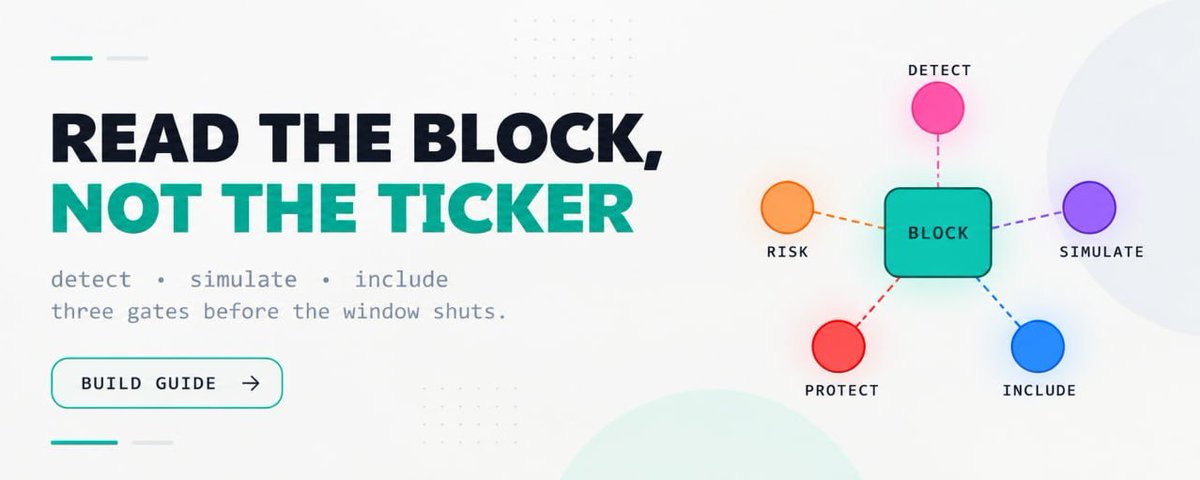
Five calls, 12 seconds, one Ethereum block.
Everyone tracks latency. The bot only tracks whether the fork clears the floor.
Ethereum clocks 300 blocks per hour. Flashbots routes the bundle to builders. Foundry's anvil forks the chain in memory. Wrong order, and gas burns on every attempt with nothing to show.
> INGEST - blocks and pool reserves arrive by gRPC stream. The moment you poll, you are a block late.
> DETECT - reserves shift, price gap minus fees minus gas. Thousands of passes per minute. Almost always zero.
> SIMULATE - fork current state with anvil or revm, run the trade. Below the floor, it dies here.
> SUBMIT - bundle with a bid routed to builders via Flashbots. Too low: missed block. Too high: validator takes the edge.
> CONFIRM - watch inclusion, reconcile nonce and inventory, log what the chain paid.
A fire-every-block loop costs roughly 0.6 ETH per hour in gas, per the framework's own math (0.002 ETH illustrative per attempt, 300 blocks). Backtest haircut from the same guide: win only 20 to 40 percent of contested blocks.
CONFIRM closes the loop. Nonce updates, inventory reconciles, the log records what the chain actually paid, not the simulation. That log feeds the next block's INGEST. Miss it once, and the bot fires the next 12-second window on a stale nonce and a phantom balance.
One block, five calls, one DROP branch at SIMULATE ↓
damn, Fomo Radar polls wallets from an archived codebase
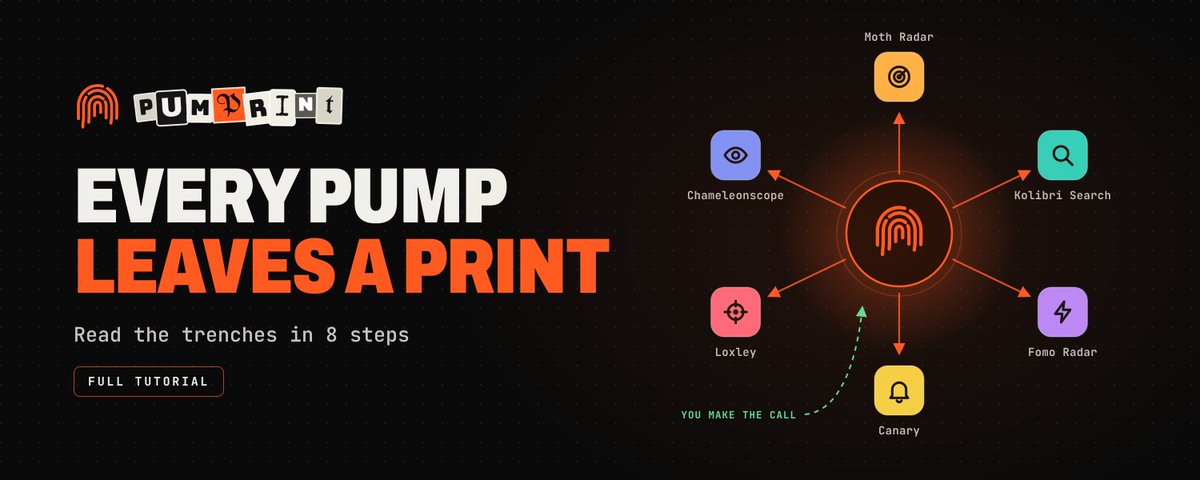
Pumprint's second-opinion tool on Robinhood Chain. It tracks fomo family traders through wallets that actually trade, and flags a burst when several converge on one token. Source project archived 6 October 2026, per the repo. Ported to Node.
Five stages between a poll and a flag.
> POLL - chain node every 20 seconds, pulls the trusted wallet list from fomo family traders
> SCORE - each wallet carries a number out of 100, radar squares it: (score/100)²
> SUM - squared scores added across every wallet that entered the same token
> GATE - 3 wallets minimum inside a 30-minute window, sum at or above 4.0
> HOLD - flag waits if the pool sits under $10,000 of liquidity
The archive's own count on $100 per entry: +$1,030 across 67 burst alerts. Same $100 into every new-launch alert: -$1,205 across 90. Three trades carry almost the entire burst number.
One wallet is noise. Three wallets is the floor, not the answer. The squared sum has to cross 4.0, and a perfect wallet pushes exactly 1.0. The routine's second check. The terminal below maps the burst from poll to flag ↓

Nuts. 512 candles drop through, 24 come back.
Kronos treats every candle as a sentence to finish.
MIT license. AAAI 2026 paper. Weights on Hugging Face, pretrained on 12 billion K-line records across 45 exchanges (model card). 24.7M parameters. A laptop runs it.
→ Feed opens. Public exchange, any coin, any timeframe. Open, high, low, volume drop in
→ Each bar encodes into discrete tokens. Same architecture language models use on words
→ 512 bars fill the context window. One forward pass. 24 candles predicted
→ sample_count = 100. Not one guess. One hundred sampled futures fan from the same window
→ Paths cluster tight: TRENDING. Scatter wide: CHOPPY. Regime read from the distribution itself
→ Opus 5.5 takes the forecast and the regime. Writes entry, exit, stop
Every step runs local. No API key, no cloud, no data off the machine.
Then the pipeline stops. Prediction is not edge. Commissions, slippage, drawdown sit between the model's output and a live dollar. No backtest in this repo. No trade log. The step that closes the gap has not been published.
Full pipeline from candle rain to regime, running in the terminal below ↓

100 futures turned one forecast into trending or choppy.
Kronos. 12 billion K-lines from 45 exchanges. MIT, open weights, runs on a laptop.
→ TOKENIZE OHLCV bars into discrete tokens, same trick as word-level LLMs
→ FORECAST 512 bars in, predict the next 24, sample 100 paths
→ CLASSIFY path spread: tight cluster = trending, wide scatter = choppy
Prediction runs local for free. Edge needs a backtest with real commissions and slippage. This build has none yet. Full ring from tokenizer to rules, running in the terminal below ↓
Five calls, zero cost, raw candles to forecast.
Kronos reads candles as tokens. 24.7M params, MIT license.
12 billion K-line records across 45 exchanges. AAAI 2026 paper. Open weights on Hugging Face, three sizes from 4.1M to 102.3M params (model card). Kronos-large at 499.2M stays closed. Every price bar becomes a token. The decoder predicts the next one, same autoregressive pass an LLM runs on text. 512 bars in, 24 bars out. Runs on a consumer laptop, no API key.
> PULL the Kronos repo, Sonnet 5.5 handles the install
> ENCODE candles into tokens, each bar discretized like a word
> FORWARD 512 bars, model returns the next 24
> BRANCH 100 paths from one window, spread reads the regime: tight = trending, scattered = choppy
> WIRE entry, exit, stop in Opus 5.5, backtest a year with real fees and slippage
The forecast exits call five. Edge lives in a different file: every fill minus commissions, slippage, drawdown. That log is not in this stack. Paper first.
Every call layer from repo clone to regime tag, logged in the terminal below ↓