
Justice Barry Anderson was appointed to the Minnesota Supreme Court in 2004 and retired on May 10, 2024. Retweets and links are not endorsements.
Joined June 2012
- Tweets2.2K
- Following272
- Followers1.3K
- Likes70
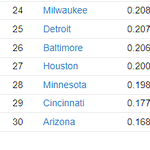
Since Tarkenton retired, have the Vikings had the same top 10 QB for two years or more? There is the occasional standout season, Farve or Culpepper for example, but nothing consistent. No immediate prospect of anything different, either.
Watching the current versions of the Vikes, Bears, and Packers, it's hard to see the Vikes as better than either of the other two teams. Vikes make the playoffs as a WC and win, maybe, one game.
Justice Anderson retweeted

Reading the AI factions arguing today about alignment is like reading the Bulletin of the Atomic Scientists in 1947 convinced that humanity faces a stark choice between World Government or nuclear armageddon. The smartest minds on Earth forever unable to envision the real future
Justice Anderson retweeted

Here’s a story for you. We started filming without owning the title and had to do alternates.
Taft Broadcasting owned the title Ghostbusters as part of their half-hour sitcom starring Larry Storch and Forrest Tucker (F-Troop) and a gorilla chasing ghosts. I had never heard of it. They didn’t have proton packs or Bill Murray. Columbia paid $500,000 to buy the name, but they really should have paid Dean Martin, from whom I first heard the term.
In the film Scared Stiff (1953), he and Jerry Lewis (check out his acrobatic stair descent) are in an old haunted castle, and Lizabeth Scott asks Dean: “Who are you guys?” And Dean answers: “You’ve heard of Trustbusters and Gangbusters, we’re Ghostbusters!”
For my research writing the first movie, I watched every single ‘ghost’ comedy ever made. Bowery Boys, Hope and Crosby, Abbot and Costello, Martin and Lewis all did such films.
Happy Halloween 2026.


Justice Anderson retweeted

Read more: humanprogress.org/the-preind…

Justice Anderson retweeted

Fun fact: There was an earlier Milwaukee Brewers major league baseball team, founded in 1894 and then played one year in the new American League in 1901. The next year they moved to St. Louis and became the Browns. In 1953, they moved to Baltimore as the Orioles. – at Gettysburg, PA

Justice Anderson retweeted
In 1910, you could buy a bicycle for $11.95 from Sears.
Entry-level wages were $0.11 an hour, meaning it took unskilled workers 108.6 hours to buy a bicycle.
Today, an entry-level worker can buy a bike at Walmart after working for just 5.2 hours.
humanprogress.org/the-steep-…

Justice Anderson retweeted

And the play is to home ...
Out there.
Out there!
Kent Hrbek and Brian Harper turned one of the biggest double plays in baseball history on this date in 1991
Justice Anderson retweeted

In the middle of World War Two, German soldiers in southeastern Poland started avoiding a cluster of villages.
They wouldn't go in. They wouldn't take people out for forced labor. They put up warning signs and stayed away.
They believed the area was infected with typhus.
It wasn't. Two doctors had invented the whole thing.
The man behind it was Eugene Lazowski, a young Polish doctor working for the Red Cross in the town of Rozwadów. He was watching the Nazi occupation tear his country apart. Executions. Deportations. People shipped off to labor camps, many never coming back.
He wanted to stop it. He had no weapons, no army, and no way to fight.
What he had was medicine.
His friend and fellow doctor, Stanisław Matulewicz, had discovered something strange. If you injected a person with a harmless, dead strain of a certain bacteria, their blood would test positive for typhus.
They wouldn't be sick at all. But on paper, they'd look like they had one of the most feared diseases of the war.
And the Germans were terrified of typhus. It spread fast, it killed, and it could tear through an army. When the Germans found it, they quarantined the area and kept their distance.
Lazowski realized what that meant. If he could make enough people look infected, the Germans would leave the whole region alone.
So he started injecting his patients.
He chose carefully. He sent the blood samples to German labs for testing, exactly as the rules required. The results came back positive. Again and again.
The Germans declared an epidemic zone. Villages were quarantined. Soldiers kept out. People who would have been seized for forced labor or worse were left alone, because nobody wanted to go near them.
Lazowski had to be careful. If too many cases looked fake, someone would ask why nobody was dying. So he spread out the injections over time and kept the outbreak believable.
Eventually the Germans did get suspicious. They sent a team of doctors to inspect.
Lazowski met them with food and vodka and played the gracious host. He guided them toward the sickest looking, dirtiest patients he could find, in the most crowded rooms. The German doctors, worried about catching typhus themselves, took a few samples and left in a hurry.
The tests came back positive.
The fake epidemic lasted until the end of the war. Estimates say it may have protected around 8,000 people.
Lazowski also secretly helped Jews from the nearby ghetto, giving them medical care at enormous risk.
After the war he moved to the United States and became a professor of pediatrics in Chicago. For decades he barely talked about what he'd done. Late in life he finally wrote a memoir. He called it My Private War.
He died in 2006.
He never fired a shot. He beat the Nazis with a needle and a lab test.

In the immortal words of the great Yogi Berra, it ain't over until it's over. We can say, definitively, though, that Tampa Bay will have to win game 7 to win the world series because after tonight, the Rays are down three.

Justice Anderson retweeted

On this date in 1991, Kirby Puckett made Game 6 of the #WorldSeries his own – and etched his name into @Twins history. ow.ly/RGS75100Zkb
Justice Anderson retweeted

Blake Cashman had 12 tackles, 2 sacks, and 4 passes defended for the Vikings today.
He's the only player since at least 1987 to reach those three numbers in a game (per @Stathead). Just an incredible individual performance.
Given the gopher game on Saturday and the Viking game today, I’m wondering if it’s now against the law for the Home team to score a touchdown?
Justice Anderson retweeted

If someone asks you how much a single family's life is worth to the United States Navy, tell them the exact price: ten million dollars of steel.
On April 29, 1975, as Saigon fell, a tiny two-seat wooden-and-fabric Cessna plane with almost no fuel left circled desperately above the American aircraft carrier USS Midway.
Inside that tiny cockpit, a father named Major Buang-Ly had crammed his wife and five small children, including a baby. He scribbled a note on a map, wrapped it around his pistol so it would not blow into the ocean, and dropped it onto the carrier deck.
A young American sailor picked up the crumpled paper and ran it up to Captain Lawrence Chambers.
The note read: "Can you move these helicopter to the other side, I can land on your runway, I can fly 1 hour more. Please rescue me. Major Buang, Wife and 5 child."
The flight deck of the USS Midway was completely jammed from bow to stern with military helicopters. A Cessna has no tailhook to catch carrier wires, and its pilot had never landed on a ship in his life.
By every military regulation, Captain Chambers had been in command for only five weeks. Throwing millions of dollars of U.S. government aircraft into the sea without permission from Washington could end his career in a court-martial.
Chambers looked up at the tiny plane circling in the wind with five children inside. He did not call an accountant in Washington.
"Clear the deck," the captain ordered.
Hundreds of young American sailors in yellow and green jerseys ran to the edge of the ship, put their shoulders against massive Huey helicopters, and shoved ten million dollars worth of machinery straight off the cliff into the South China Sea.
Captain Chambers turned the giant carrier into the wind at twenty-five knots. The tiny Cessna came down, bounced once on the steel runway, and rolled to a safe stop with feet to spare.
When the cockpit door opened and five small children stepped out onto the deck, three thousand American sailors roared so loud it drowned out the engines, and immediately passed around a hat to collect cash for the family's new life in America.
When the math says a child's life is too expensive, an American throws the math into the ocean.
🤖 Made with AI

I was there.

On This Date in 1987: With the bases loaded and two out in the bottom of the sixth in Game 6 of the #WorldSeries, the Cardinals brought in the lefty Ken Dayley to face Kent Hrbek, who hit his first pitch over the center-field fence for the biggest grand slam in Twins history.
Justice Anderson retweeted

The British army once sentenced Daniel Morgan to 500 lashes, a punishment that usually killed a man, for the crime of knocking out an officer who struck him. He survived every stroke. And he spent the rest of his life joking that the drummer had miscounted and only given him 499, so the British still owed him one. He collected that debt at a place called Cowpens.
Morgan was not born to anything. He was a rough, barely educated frontiersman who made his living hauling freight by wagon on the Virginia frontier, a big, powerful, hot-tempered young man. During the French and Indian War, serving as a civilian teamster with the British army, a British lieutenant struck him with the flat of a sword. Morgan answered with his fist and dropped the officer cold. For a colonial to strike a British officer was close to a capital offense, and the court-martial sentenced him to five hundred lashes with the cat-o'-nine-tails, a flogging meant to flay a man and very often to kill him.
They tied him up and laid it on, and Daniel Morgan did not die. He carried the ridged scars on his back for the rest of his life. But instead of breaking him, that brutal punishment forged something. It left him with a cold, permanent hatred of the British army and its contempt for colonial men like him, a hatred he would one day repay with interest. And it gave him his lifelong joke: the drummer lost count and stopped at 499, so the British, he liked to say, were still one lash short of paying him in full.
When the Revolution came, that uneducated wagoner turned out to be a natural soldier of rare gifts. He raised a company of frontier riflemen, crack shots who could kill at distances that terrified British regulars, and he led them north to Saratoga, where his marksmen helped shatter Burgoyne's army and win the turning-point victory of the war. Morgan had a feel for battle that trained European officers lacked, an instinct for ground, for timing, and above all for the men he led. He understood that his militia were not professional soldiers and could not be asked to do what professionals did, so instead of cursing them for it, he built his tactics around what they could do.
That genius reached its peak at the Battle of Cowpens in January 1781, one of the most perfectly fought battles in American history. Facing the dreaded Banastre Tarleton, Morgan set a trap built entirely on human nature. He put his unreliable militia in the front line and asked them only for two volleys, then permission to fall back, which they gladly did. Tarleton's British, seeing the Americans retreat, charged forward in a confident rush straight into Morgan's real line of hardened Continentals, and then Morgan sprang the jaws, hitting the British on both flanks at once in a double envelopment while his cavalry rode down their rear. In minutes Tarleton's command was destroyed, hundreds killed and captured, one of the most crushing and complete victories of the war, and Tarleton himself barely escaped. It was the frontier wagoner out-generaling the darlings of the British army.
So the debt was paid. The boy they tried to flog to death grew up to be the man who methodically dismantled the British in the field, who understood soldiers because he had been treated like dirt as one, and who turned the hard lessons of his own back into some of the finest tactics the Revolution ever saw. Remember Daniel Morgan. The British gave him 499 lashes and made an enemy who never forgot, and he collected the last one at Cowpens, with interest.


Justice Anderson retweeted
Your fridge doesn't last as long as your grandmother's, but it is far cheaper and more energy efficient.
For the time it took to earn the money to buy one refrigerator in 1956, you get over 14 refrigerators today.
humanprogress.org/in-praise-…
