
Assoc Prof @NTUsg; Non-Res Fellow @NBRnews; Research Committee Member @RIPS_admin; IR, Int'l Sec, Int'l/Regional Institutions, Indo-Pacific, ASEAN, Japan
West Region, Singapore
Joined January 2010
- Tweets1K
- Following412
- Followers1.4K
- Likes1.5K




Pinned Tweet
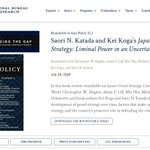
Pleased to share that our book, Japan’s Grand Strategy: Liminal Power in an Uncertain World (OUP, 2026), is finally out!!! Tracing the evolution of Japan’s grand strategy from Meiji to today.
academic.oup.com/book/62240

Kei Koga retweeted

New paper: "AI Article Reviews Dominate Human Peer Reviews at Their Best: Evidence and Policy Choices" See: GaryKing.org/peerless. with Steven Worthington. Comments welcome!

Online Public Seminar on FOIP 3.0 at Sciences Po’s CERI, in collaboration with GIGA, on October 28!
Thank you for the invitation, David! I look forward to the discussion with Guibourg and other participants.
sciencespo.fr/ceri/en/events…

Kei Koga retweeted

神保謙教授の個人プロジェクトとしてのサイト。それにしてもすごい。とても分かりやすく、複雑な紛争の構図が見事に整理されています。■southchinasea-atlas.com/ja/?…

Kei Koga retweeted

インドネシアが原発を初導入へ ロシアと合意、水上に浮かぶ小型の浮体式2基
要するに、ハルマヘラ島のニッケル精錬の電力源を石炭から原子力に転換させるということだろうか。電力はロシア、精錬は中国。
sankei.com/article/20261017-…

Kei Koga retweeted

This week on Net Assessment we had a discussion I've wanted to have for a while about the future of think tanks and the impact of AI on our work. Take a listen!
podcasts.apple.com/us/podcas…

Kei Koga retweeted

🎯 VIETNAM’S DOI MOI AFTER FORTY YEARS: ADAPTIVE GOVERNANCE, REGIONAL INTEGRATION, AND FUTURE DEVELOPMENT PATHWAYS
As Vietnam marks the 40th anniversary of Doi Moi in 2026, scholars and policymakers are reflecting on one of Asia’s most remarkable development transformations. Over the past four decades, Vietnam has evolved from a centrally planned economy into a dynamic and globally integrated economy. Against this backdrop, on 25 September, @kasvietnam @KASonline and the University of Social Sciences and Humanities (USSH) convened the research dissemination workshop “Vietnam’s Doi Moi in the Context of East Asia: A National Development Model Between Regional Patterns and Uniqueness.”
Bringing together scholars and experts from Vietnam, Germany, Australia, Japan, and South Korea, the workshop presented findings from a joint research project examining Vietnam’s development trajectory through a comparative East Asian perspective. A central takeaway was that Vietnam’s success is best understood through the lens of adaptive governance: the ability of institutions to learn, adjust, and respond to evolving challenges while maintaining strategic direction and policy continuity.


Just published: “FOIP 3.0” in East Asian Policy (Open Access)!
worldscientific.com/doi/10.1…
The key shift is from directly promoting a rules-based regional order to strengthening resilience and strategic autonomy. In the context of growing uncertainty about US commitment, FOIP 3.0 seeks to empower regional states to make autonomous choices (“Strategic Empowerment”), making Southeast Asian support especially important for sustaining the Indo-Pacific order over time.
Kei Koga retweeted

💡 RECENTLY RELEASED | A CSIS Japan Chair survey shows that the majority of Japanese strategic elites oppose nuclear weapons acquisition despite a worsening security environment—but these attitudes could shift if South Korea acquires the bomb or the United States reduces its military presence. Read @KristiGovella's analysis here: bit.ly/4yHQbuq


Kei Koga retweeted

政府安全保障能力強化支援(OSA)のリーフレットを更新しました。令和7年度までの実績や令和8年度予算を新たに掲載し、創設から3年間の取組を分かりやすく紹介しています。OSAを通じた我が国の安全保障協力の取組について、ぜひご覧ください。
mofa.go.jp/mofaj/fp/ipc/page…

I’m very pleased that my article, “Tactical hedging as coalition-building signal: The evolution of Quad and AUKUS in the Indo-Pacific,” has been selected as a runner-up article for the 2025 BJPIR John Peterson Best Article Prize!!
Many thanks to the editors, judges, and the British Journal of Politics and International Relations for this. I’m grateful to have the opportunity to publish this piece with BJPIR.
The article develops the concept of “tactical hedging” to explain how minilateral coalitions such as the Quad and AUKUS emerge, evolve, and sometimes struggle under strategic uncertainty.
psa.ac.uk/news/psa-journal-b…

お招きいただきありがとうございました!おかげさまで有意義なディスカッションができました。

慶應義塾大学戦略構想センター(KCS)は、2026年7月27日、第9回目となるエキスパートラウンドテーブル(ERT)を開催いたしました。講師には、シンガポール南洋理工大学准教授の古賀慶 氏をお招きしました。
kcs-keio.site/contents/post-…

Kei Koga retweeted

慶應義塾大学戦略構想センター(KCS)は、2026年7月27日、第9回目となるエキスパートラウンドテーブル(ERT)を開催いたしました。講師には、シンガポール南洋理工大学准教授の古賀慶 氏をお招きしました。
kcs-keio.site/contents/post-…
Kei Koga retweeted

Beijing sounds its klaxon alarm to Southeast Asia: unite to resist Tokyo’s remilitarization!
Singapore unites instead with Japan to run Exercise Singapan. This is the first time I hear of this name for the bilateral naval exercise. Likely an inaugural. mindef.gov.sg/news-and-event…


Kei Koga retweeted

〈政府高官に、なぜかと尋ねると、「いま米国を刺激するのは得策でない。赤根所長に制裁が及ばないようにするためだ」と語っていた。その帰結が今回の、赤根氏も標的とした制裁の拡大である〉
無料で読めます↓。 digital.asahi.com/articles/A…

Agree that pessimism is often overstated, but alliance resilience does not mean a return to the status quo ant. It doesn’t change the fact that (1) the United States and its allies need to reforge the alliance system, and (2) allies and partners will still simultaneously seek to build mechanisms to hedge against future risks. foreignaffairs.com/united-st…

Pleased to share our new publication, "Indonesia's Search for Network Centrality in the Indo-Pacific" (Global Policy, 2026) with my former NTU student, Claire! doi.org/10.1111/1758-5899.70…
Why did Indonesia move from pursuing its own Indo-Pacific vision to championing ASEAN Centrality?
Using tactical hedging and network centrality, we trace Indonesia’s evolving strategy from the IPTFC and Global Maritime Fulcrum to the AOIP—and what this tells us about Indonesia’s efforts to shape the Indo-Pacific order. This tells us about Indonesia’s efforts to shape the Indo-Pacific order.

Kei Koga retweeted

Experts discuss #Japan’s development of #grandstrategy over time and the country’s proactive role in defending the rules-based order in a roundtable on Kei Koga (@K__2010) and Saori N. Katada's "Japan’s Grand Strategy: Liminal Power in an Uncertain World" nbr.org/publication/saori-n-…

ASEAN’s 2026 Foreign Ministers’ Communiqué highlights a strong convergence with Japan’s evolving FOIP 3.0 (asean.org/wp-content/uploads…)
“Amidst intensifying strategic competition and economic fragmentation, we emphasised the importance of preserving ASEAN’s strategic autonomy, while reinforcing regionalism, strengthening resilience and enhancing ASEAN’s relevance as a primary driving force in the evolving regional architecture.”
This reflects ASEAN’s growing emphasis on strategic autonomy and resilience, closely aligning with Japan’s FOIP 3.0, which increasingly seeks to empower regional actors in the Indo-Pacific to shape the regional order on their own terms.
More on this in my forthcoming article on FOIP 3.0 in East Asia Policy (worldscientific.com/worldsci…)
The link for the AMM joint statement: asean.org/joint-communique-o…
