AI GTM | Building & learning in public | ex-GTM Intern @Medeo_AI | Babson ’27
Joined July 2024
- Tweets688
- Following591
- Followers1.5K
- Likes1.6K


Lee Lin | AI retweeted

For Those Who Create. KLING 4.0 Is Now Fully Available. 🎬
What’s New, Starting Today
🖥️ Access Kling 4.0 through a refreshed creation interface on kling.ai
🔗 Access Kling 4.0 through MCP and CLI for greater flexibility in your video creation workflow
Coming Soon
🎨 10-bit HDR video output at 4K and 1080p resolutions
🛠️ API access for enterprise customers and developers
You call the shots. Let the creating begin!#Kling4 #KlingAI

Lee Lin | AI retweeted

Over the next 28 days, each day we’ll either ship one thing that is a clear improvement and relevant for most codex/work users or ship a full reset. Let the improvements begin.

Lee Lin | AI retweeted

Try these in your first Opus 5.5 session:
→ Hand over a whole task. Define "done" and when to check in.
→ Drop "think carefully". It always thinks first.
→ After a long run, check what it needs to go further.
Our playbook: claude.dev/blog/getting-the-…

Lee Lin | AI retweeted

Please welcome GPT-6 Sol and GPT-6 Luna to the GPT-6 universe.
GPT-6 Sol and Luna build on the advances behind GPT-6 Astra, bringing much of its strengths into faster and more affordable models to support work at scale.
We’ve also made caching and inference more efficient, and we’re passing the savings directly to you: 50% lower API prices for Sol and Luna compared with GPT‑5.6 promotional pricing.
Lee Lin | AI retweeted

I've made 300+ pre-seed investments.
The founders who died slowest all had one thing in common: they stopped talking to customers and started talking to their dashboard.
Marcus Aurelius ran an empire and still walked the Forum.
You have 40 users. Go see them.
Lee Lin | AI retweeted

Hormozi says the #1 AI play right now is building automations inside businesses that already exist.
That job is called GTM engineering.
Postings for it grew 205% year over year.
Vercel pays $252k and Open AI pays $250k.
I wrote the full course/guide on how to master it:
- The technical skills
- The commercial skills
- The 5 core systems
- Writing prompts that hold
- Building the portfolio
- The career ladder
- Etc
Full breakdown is in the article below:


Lee Lin | AI retweeted

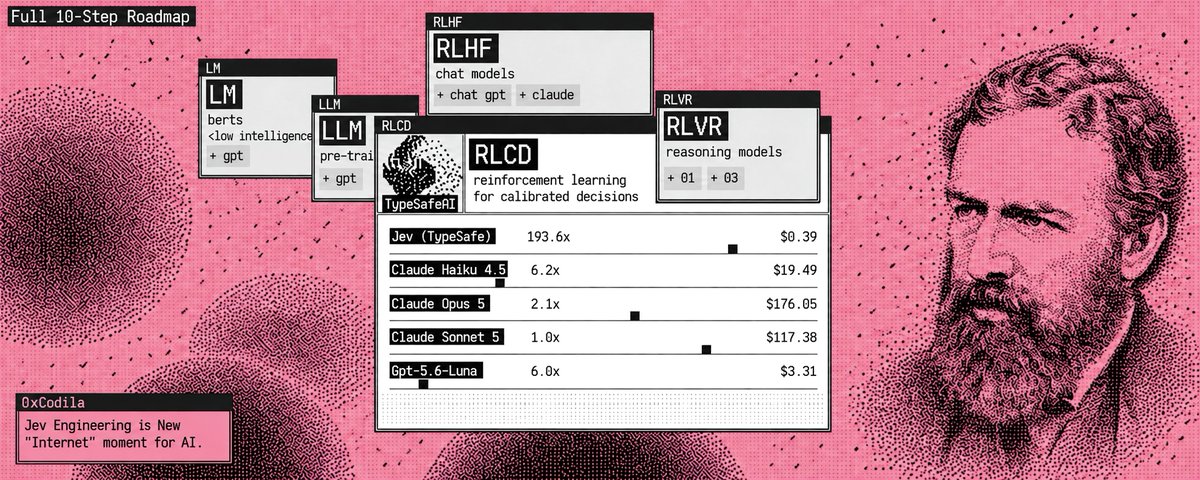
Jev is "Internet" moment for AI: up to 193x faster and 444x cheaper in tests with Claude Fable 5.1 and GPT-6 Astra
Whar is Jev, how to use and unlock its real 100х advantage in my 10-page research:
step 1 → meet Jev: LLM writes, agents act, Jev chooses the next move - split intelligence from execution
step 2 → turn every agent fork into three primitives: Choice selects one route, Score measures a defined scale, Noul returns the probability of yes
step 3 → build before getting access: use TypeSafe’s official adapter with OpenAI, Anthropic or xAI, then swap in Jev without rebuilding the graph
step 4 → setup first Jev: one state, three parallel decisions, risk-based thresholds and a real queue your agents can execute
step 5 → batch decisions instead of serializing them: 13 questions in one call ran 10x faster and 12.2x cheaper than 13 sequential calls
step 6 → place Jev at every bounded fork: choose the agent, model, tool, browser action or human escalation, then read fresh state
step 7 → benchmark the entire loop: Browser Use hit Google Flights in 7.1s, Every ran 777 checks in under 0.7s, Mobile Jev completed 9 actions in 21s
step 8 → rank wide, read narrow: Jev cut wrong Hermes skill loads from 16.8% to 7.3% and pushed legal Top-10 retrieval from 38% to 62%
step 9 → steal a system, not a prompt: Chief of Staff, model router, inbox firewall, research feed, browser controller and safety gate all use State → Questions → Action → Verify
step 10 → keep Jev out of math, writing and irreversible execution: code computes, LLMs create, Jev decides, fresh state proves the result
the result: one slow, expensive agent becomes an always-on decision machine that routes, scores and escalates in milliseconds
Copy the complete 10-page Jev blueprint - then read full 10-step roadmap below ↓




Lee Lin | AI retweeted

Photos capture an angle. Video captures you.
Create hyper-realistic virtual avatars from video for unmatched likeness, natural motion, and an effortlessly flattering look.
Go larger than life with Medeo’s Giant Recipe: medeo.app/r/4pGiWH



Lee Lin | AI retweeted

The fruit fly's brain is superior to the human brain, and GPT-6 ASTRA has proven this.
And the internet went crazy.
Most AI models learn by training on massive datasets, running billions of computations to acquire new skills.
But researchers just demonstrated a radically different approach:
No giant dataset.
No traditional training.
Just take the physical wiring of a biological brain and simulate it in a computer.
The digital fruit fly reached ~91% behavioral accuracy using only 4 things:
The complete neural connectivity map
Synaptic connection counts as connection weights
Excitatory vs inhibitory neuron types
A simple Leaky Integrate-and-Fire model
The wild part?
The wiring itself may contain much more of the brain’s “code” than we thought.
From tens of thousands of neurons in a fly → millions in a mouse → ~86 billion in a human.
If this scales, whole-brain simulation could become one of the biggest frontiers in AI.
The era of biologically inspired intelligence may have just begun