Loans Flash (@LoansFlash) profile picture
Joined June 2022
Photo by Loans Flash (@LoansFlash)
Send me some ETH please
2
Loans Flash retweeted
PROFITING FROM PEG DEVIATIONS LUSD<1$: Buy 1 LUSD on the market and redeem for 1$ worth of $ETH. LUSD>1$: Provide ETH collateral, borrow LUSD and sell at premium to buy back lower. teapawt.net/korpi87/status/1537427…
Recent weeks have been brutal for crypto. If you need some comfort, I have an offer for you. Free money :) There are two ways how you can earn with low risk: - Add $LUSD to Stability Pool for high APR. - Provide $ETH, borrow $LUSD and sell while it trades at premium. Details 👇
1
3
1
6
Loans Flash retweeted
INTEREST-FREE BORROWING $LUSD borrowers pay a one-time fee as low as 0.5% of the borrowed amount. No interest is charged later. It's a more reliable model than other borrowing protocols which charge variable and unpredictable interest rates for the whole duration of the loan.
1
2
6
Loans Flash retweeted
HIGH CAPITAL EFFICIENCY $LUSD requires minimum Collateral Ratio (CR) of 110% which means users can borrow up to 90% of the dollar value of their provided collateral. It makes $LUSD more capital efficient than $DAI where the lowest CR for ETH vault is 130%.
1
2
3
Loans Flash retweeted
DATA FEED (system can't price itself) The protocol uses @chainlink price feed for $ETH but it also has a back-up oracle from @WeAreTellor to be used under extreme circumstances. ✅ Low Risk
2
3
1
16
Loans Flash retweeted
$LUSD is backed by the most trustless collateral on Ethereum, $ETH. Yes, it limits the total value of collateral that can be used to issue a stablecoin. But it is also the safest collateral that exists on Ethereum. Let's cover all the risk areas for LUSD.
1
2
8
Loans Flash retweeted
Accepting centralized collateral like USDC or WBTC is the most criticized issue for $DAI. Actually, only 7% of DAI in circulation is generated from $ETH. If there was some regulatory pressure on USDC / WBTC custodians and funds were frozen, DAI value would be at huge risk.
1
2
1
10
Loans Flash retweeted
Non-custodial stablecoins have 5 major risks: - Collateral (value < issuance) - Data Feed (system can't price itself) - Governance (parameter failure) - Base Layer (chain fails) - Smart Contract (hack leads to insolvency) Each can result in the stablecoin value going to zero.
1
2
7
Loans Flash retweeted
Custodial stablecoins have three major risks: - Counterparty Risk (fraud, theft, govt seizure, etc.) - Censorship Risk (operations blocked by regulators, etc.) - Economic Risk (off-chain assets go down in value) Each can result in the stablecoin value going to zero.
1
2
6
Loans Flash retweeted
There are two major classes of stablecoins: Custodial: entrusted by off-chain collateral assets like fiat dollars that sit in a bank. Requires trust in third party. Non-custodial (aka decentralized): fully on-chain and backed by smart contracts & economics. No trusted parties.
1
2
7
Loans Flash retweeted
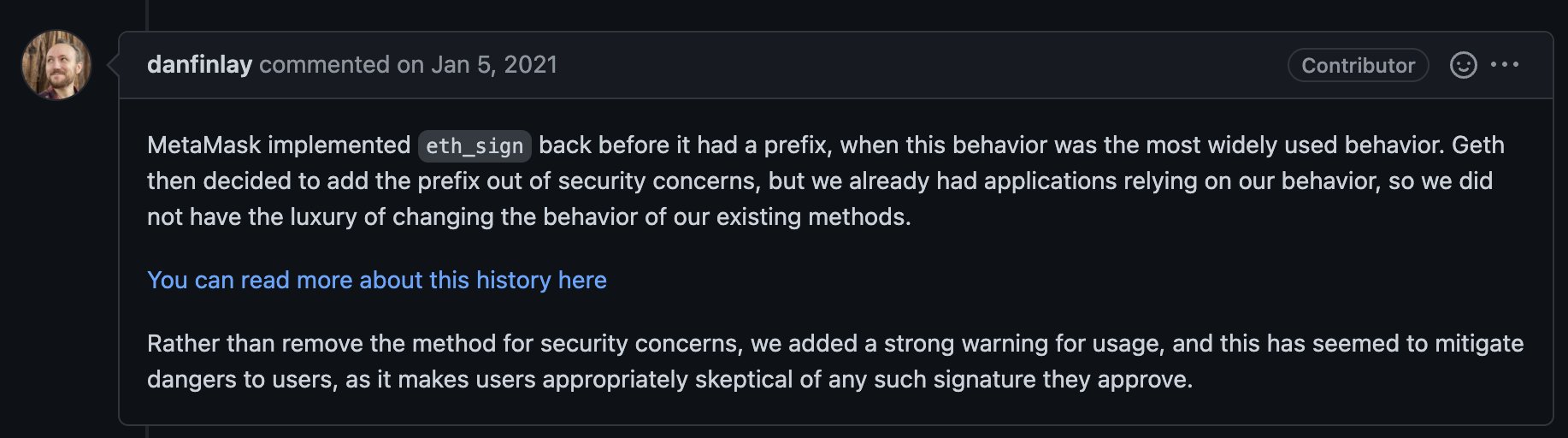
29/x Metamask’s current solution is the (very effective) bright red warning (shown in the first image) telling the user how dangerous a signature may be when using ETH_SIGN. I think this is sufficient - although the best solution would be disabling the functionality entirely.
1
5
2
63
Loans Flash retweeted
28/x Well- it turns out this is a Metamask issue, and many other platforms (such as Geth) do not allow ETH_SIGN to sign raw transactions anymore. Thus, much of the documentation online DOES NOT APPLY to Metamask currently. This leads to quite a bit of confusion on the risks here.
1
6
41
Loans Flash retweeted
26/x Thus, there is (currently) no harm in signing messages when using PERSONAL_SIGN.
1
3
33
Loans Flash retweeted
25/x So how does PERSONAL_SIGN protect against this? By using PERSONAL_SIGN, the prefix at the beginning of the message prevents it from being used as a transaction (as it would fail, since the prefix is not valid instructions for the evm).
1
5
41
Loans Flash retweeted
24/x The attacker can then broadcast that transaction to the network, posing as you, and the transaction will be executed. All by signing a message in Metamask.
3
3
29
Loans Flash retweeted
23/x But - how can an attacker tell the network to execute that transaction? Because, with ETH_SIGN, you signed the raw transaction (in the form of a message) with your private key.
1
4
29
Loans Flash retweeted
17/x eth-sig-util is simply a group of signing functions - which is exactly what we are looking for. Within here, we should find personalSign.
1
3
25
Loans Flash retweeted
16/x Looking around a bit - we can see that personalSign comes from the “eth-sig-util” package. By checking out the code there - we can see the real PERSONAL_SIGN logic.
1
3
24
Loans Flash retweeted
15/x Looking at PERSONAL_SIGN, we can see the rabbit hole goes a bit deeper. Instead of simply signing the raw message data and returning it - a new “personalSign” function is being called with our message.
1
3
25
Loans Flash retweeted
14/x Finally - after that scavenger hunt - we can see the real logic of ETH_SIGN. And it’s….simple. The raw message is signed with the private key, and that is all. Why is this dangerous? How is this different from PERSONAL_SIGN?
1
4
33