

Loans Flash retweeted

PROFITING FROM PEG DEVIATIONS
LUSD<1$: Buy 1 LUSD on the market and redeem for 1$ worth of $ETH.
LUSD>1$: Provide ETH collateral, borrow LUSD and sell at premium to buy back lower.
teapawt.net/korpi87/status/1537427…

Loans Flash retweeted
INTEREST-FREE BORROWING
$LUSD borrowers pay a one-time fee as low as 0.5% of the borrowed amount.
No interest is charged later.
It's a more reliable model than other borrowing protocols which charge variable and unpredictable interest rates for the whole duration of the loan.


Loans Flash retweeted
DATA FEED (system can't price itself)
The protocol uses @chainlink price feed for $ETH but it also has a back-up oracle from @WeAreTellor to be used under extreme circumstances.
✅ Low Risk


Loans Flash retweeted
Non-custodial stablecoins have 5 major risks:
- Collateral (value < issuance)
- Data Feed (system can't price itself)
- Governance (parameter failure)
- Base Layer (chain fails)
- Smart Contract (hack leads to insolvency)
Each can result in the stablecoin value going to zero.
Loans Flash retweeted
There are two major classes of stablecoins:
Custodial: entrusted by off-chain collateral assets like fiat dollars that sit in a bank. Requires trust in third party.
Non-custodial (aka decentralized): fully on-chain and backed by smart contracts & economics. No trusted parties.
Loans Flash retweeted
You can read the unrolled version of this thread here: typefully.com/korpi87/iHknFM…

Loans Flash retweeted

29/x
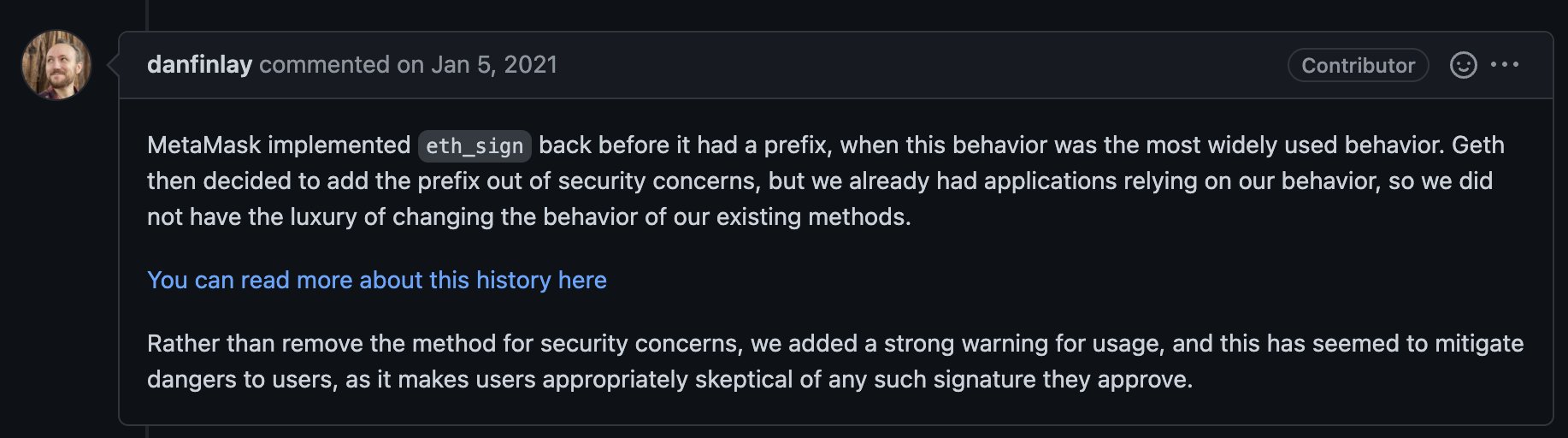
Metamask’s current solution is the (very effective) bright red warning (shown in the first image) telling the user how dangerous a signature may be when using ETH_SIGN. I think this is sufficient - although the best solution would be disabling the functionality entirely.
Loans Flash retweeted
28/x
Well- it turns out this is a Metamask issue, and many other platforms (such as Geth) do not allow ETH_SIGN to sign raw transactions anymore. Thus, much of the documentation online DOES NOT APPLY to Metamask currently. This leads to quite a bit of confusion on the risks here.


