
Chief opinionator and social media sage. https://teapawt.net/t.co/4ALu1aaHHV CashApp:$GigiKlowen
Joined March 2012
- Tweets168K
- Following7.4K
- Followers7.1K
- Likes66.7K






Pinned Tweet
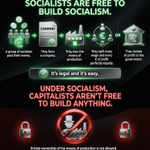
When a Democrat or a socialist or a progressive tells you that something should be "free", what they really mean is that it should be paid for by your neighbor.
When they say, "we live in a society", they mean, "you are that neighbor."


Locke Wiggin BS,MS,PhD,ScD retweeted

Capitalism and socialism both reveal how selfish people can be. Capitalism brings out the best in it. If you want to get rich through trade, you have to offer people something they value enough to pay for. Your ambition gives you a reason to make yourself useful to others.
Socialism brings out the worst in it. When politicians decide who gets what, you have a reason to cultivate their favor and get them to make someone else pay for what you want. You can even call it selfless when someone else is making the sacrifice.

Locke Wiggin BS,MS,PhD,ScD retweeted
It’s easy to look generous with someone else’s money, especially when you use “our kids” as a rhetorical shield against anyone who asks who pays. At what point are the parents who chose to have children expected to take responsibility for raising them?
Unconditional aid keeps the demand for aid alive. Once the payment is treated as an entitlement, last year’s handout becomes this year’s minimum, and any limit gets framed as taking something away from children.

Locke Wiggin BS,MS,PhD,ScD retweeted
Money is in politics because politics is in money.
When politicians have the authority to regulate businesses, redistribute wealth, subsidize industries, restrict competition, and determine who gets what, people inevitably have an incentive to influence them.
Yet socialists and communists routinely portray politicians as the victims of wealthy special interests, while those seeking political favors are treated as the villains.
But here's the irony.
Socialists themselves demand political favors. They want politicians to use their authority to redistribute wealth, property, and resources according to their preferences, often at someone else's expense.
They may not have the money to buy influence, but they still want the influence. They simply seek it through votes, activism, and political pressure.
And while there's nothing inherently wrong with influencing politicians, there is something fundamentally wrong with seeking the power to violate someone else's rights.
That principle applies equally to the billionaire demanding a subsidy and the socialist demanding confiscation.
So why do we reserve so much condemnation for those seeking political favors while continually expanding the authority of politicians to grant them?
Why condemn the businessman who wants the government to favor him over his competitors, but excuse the politician who has the power to make it happen?
And why imagine that giving politicians even more authority will somehow eliminate the incentives to influence them?
The more government controls, the more valuable political influence becomes.
If politicians were limited to protecting individual rights, there would be far fewer favors to purchase, privileges to demand, or economic outcomes to manipulate.
If you want money out of politics, get politics out of money.
And if you want to eliminate political favoritism, stop granting politicians the authority to play favorites.
Locke Wiggin BS,MS,PhD,ScD retweeted

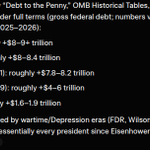
Let me explain why a tax on billionaires won't pay for or solve anything. If you stole 100% of Elon Musk's wealth, it wouldn't even cover the INTEREST on the total US debt.
It's not a lack of taxes, it's rampant deficit spending.
Locke Wiggin BS,MS,PhD,ScD retweeted
The Soviet Union industrialized through forced labor, collectivization, confiscation and mass repression. Millions died from famine, executions and state terror.
And the claim that the working class took power is particularly absurd. Workers couldn't freely organize, strike, criticize the government or refuse its demands.
The Communist Party took power over the working class.
You don't get to call slavery liberation because the slave master waves a red flag.


Locke Wiggin BS,MS,PhD,ScD retweeted
Socialism: Everyone deserves whatever they need.
Socialist: Everyone deserves exactly what I decide they deserve, including the coercion necessary to force some people to provide what I've decided others are entitled to.
Locke Wiggin BS,MS,PhD,ScD retweeted
Then explain how you create an oligarchy under equality before the law, secure property rights, and a government with no power to redistribute wealth, grant privileges, subsidize businesses, or protect them from competition.
Someone becoming a trillionaire by creating value and outperforming competitors doesn't make them an oligarch. Wealth isn't political authority.
And wealth isn't some fixed pile that accumulates in fewer hands. It's continually created through production, innovation, and trade.
The question is who has the power to rule over others, not who has more money.
If you're concerned about oligarchy, why advocate giving politicians greater economic power?

Locke Wiggin BS,MS,PhD,ScD retweeted
Walmart's CEO received $29.24 million in annual compensation. Walmart employs over 2 million people.
Take his entire compensation and distribute it equally among employees, and each gets less than $15 a year, or roughly 0.7 cents an hour.
Now raise everyone's wages by $5 an hour and you're looking at over $20 billion annually.
This is why understanding basic arithmetic matters more than being outraged by big numbers.

Locke Wiggin BS,MS,PhD,ScD retweeted
Okay, like you're five.
You have money.
You want a toy.
You don't have enough money for the toy.
Does the toy store owe you the toy?
No.
Now imagine someone offers you $10 to clean their room.
You want $20.
Do they owe you $20 because you want it?
No.
You can say no, find someone who pays more, or learn to do something people will pay more for.
And if someone else has $1,000, does that mean they owe you their money?
Still no.
See? Most five-year-olds can understand this.
Which makes it baffling that grown men struggle with it.
But that's what happens when you switch off your brain and let your emotions do the thinking.
Wanting something doesn't make someone else responsible for providing it.
Locke Wiggin BS,MS,PhD,ScD retweeted
Capitalism doesn't promise that businesses will take care of you. It allows you to take care of yourself through production and trade.
There may or may not be more money in weapons than butter. The point is that there's still money in butter, which creates an incentive to produce and sell it.
The profitability of one product doesn't eliminate the profitability of another. Markets aren't limited to producing whichever single product offers the highest return.
And who's the biggest customer of the weapons industry? Governments.
You're blaming capitalism for businesses satisfying government demand while imagining that giving governments greater control over production would solve the problem.
Locke Wiggin BS,MS,PhD,ScD retweeted
Because Keynes was taken seriously.
Decades of deficit spending, monetary manipulation, inflation, and government intervention have consequences.
The fact that you thought this question was a gotcha, rather than a spectacular invitation to indict your own economic philosophy, makes it all the more amusing.
You're pointing to the consequences of policies that undermine capitalism and demanding that capitalists explain them.
You practically gift-wrapped the argument against yourself.


Locke Wiggin BS,MS,PhD,ScD retweeted
Austrian economists recognize that nobody can predict the countless individual decisions that determine market outcomes.
They can, however, recognize that voluntary exchange, competition, and property rights create incentives for production and prosperity, while coercive intervention distorts them.
You don't need to predict where every car will go to recognize that removing roadblocks improves traffic.
The irony of a Keynesian mocking economic prediction while advocating government intervention based on politicians supposedly knowing how to improve market outcomes is particularly amusing.
Why does @flocksafety not want citizens to know where their cameras are?
1
20
571
Locke Wiggin BS,MS,PhD,ScD retweeted

Define "fairly".
If I work hard, and make good decisions, shouldn't that hard work and good choices directly benefit me and my family?
Lets say you don''t work hard, and make lots of bad decisions (gambling, smoking, drinking, drugs, etc...),
explain why my hard work and good decisions should subsidize your poor choices?
Seriously, please help me understand your point of view because I simply don't.
Locke Wiggin BS,MS,PhD,ScD retweeted
This is literally an argument for becoming the bloodsucker.
You want someone else to build, finance, maintain, and provide you with housing while being forbidden from profiting from their investment.
You demand the benefits of someone else's labor and capital while condemning their right to compensation.
And somehow you've convinced yourself that you're the victim of exploitation.
Locke Wiggin BS,MS,PhD,ScD retweeted

2 things can be true at the same time:
1.) nobody should go without food, shelter, healthcare.
2.) nobody should have their money or property stolen at gun point and given to another person.
Locke Wiggin BS,MS,PhD,ScD retweeted
Libertarians don't believe every transaction is voluntary. They believe consent distinguishes voluntary transactions from coercion.
Your landlord didn't create your need for shelter, and refusing to provide you with his property for free isn't coercion.
You need food to survive, too. Does that make farmers your oppressors?
Your argument isn't against exploitation. It's against the inconvenience of other people having rights.