





Kerma-period painted vessels
1) A man with hideous chinstrap deservedly getting mauled by two lions. Immediately thought of the twin lion motif in Kerman context, but also the Master of Animals iconography in earlier Mesopotamia & Egypt. That it was made during period of Egyptian resurgence, was this meant to represent anxiety over threat looming in north? Kermans did build fortresses to their east and north around same time, anticipating Egypt's wrath. Not enough in the end. Aker, twin lions, pastoralist, boundaries, borders... hmm...
2) Faience vessel decorated with birds and leaves. Birds maybe revered by the solar/sky cult of the city. Leaves = fertility of Kerma Basin? Were they proud of this? Central to their identity as kings of Horizon Lands? Or maybe leaves are just nice to look at.


Btw I'm so sure that best of the painted vessels have been looted. of those with elaborate, narrative designs like above, most from my knowledge were found inside religious quarter of the city, untouched. probably last seen by Thutmosid soldiers as they burned city to the ground. every last tomb, including K318 which is where the first vase was found, has been disturbed. given Kerma's control of auriferous regions in Atbai, looters probably were after abundant gold artefacts interred with dead. archaeologists find things likely flung across tombs by looters. bastards probably took whatever they could. miracle anything survived. i get mad every time I imagine what we've been deprived of. but also who buries their king smack dab in the centre of obnoxiously large tomb? the subsidiary burials less so but it was inevitable.
anyways, @mfaboston can we get images of these in colour please? would be nice not relying on Reisner 1923 I-III every time I want to post an image.
8
145


Lo'Qore retweeted

Where was the Land of Punt?
Baboon mummies, volcanic glass and one word in Hatshepsut's temple all point to the coast of Eritrea.
And what did Egypt call the people of Punt? ḫbś.tjw.
Habesha?
Read the full story: habeshahistory.com/p/punt
Lo'Qore retweeted

Not published yet, but data is available.
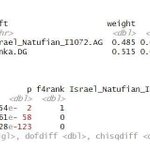
A mid-5th millennium BCE burial in Central Anatolia with up to 30% Pontic Steppe-related ancestry.
Analysis further indicates that mobility from the Pontic Steppe into Anatolia, which may have accompanied the introduction of Indo-European languages to the peninsula.
ebi.ac.uk/ena/browser/view/P…


In case anyone has access, it's called "The Wadi Elei finds: Nubian desert gold mining in the 5th and 4th millennia B.C.?" from "Cahiers de recherches de l’Institut de Papyrologie et d’Égyptologie de Lille (CRIPEL), volume 17, issue 2."
Would rather not fork over any kind of money for a book primarily in a language I don't understand. Thanks.
1
4
411

Lo'Qore retweeted

1/2 The joint Macquarie-Egyptian team (directed by Cooper; Dr Abdelrahim Mahmoud Ahmed, co-director Dr Maël Crépy) has completed its inaugural season in the south-eastern deserts of Egypt, near Bir Abraq.

Lo'Qore retweeted

Loans in the Sami language derived from a pre-Indo-European, pre-Uralic language.
Those words include many terms related to fishing, seals, and reindeer, which is consistent with a language spoken by European hunter-gatherers before they were subsumed by Finno-Ugric speakers.


Lo'Qore retweeted

Paleo Laplandic is so weird
The linguistic evidence is very strong, but the ancient DNA points against it (the 3-4kya Bolshoy Oleni Ostrov samples and Iron Age Finnish Saami samples)
I don’t think aDNA precludes it tho. It’s weird but I can think of a couple ways it might work
Lo'Qore retweeted
In 663 BC, Ashurbanipal chased the last pharaoh of the 25th Dynasty of Egypt all the way to Thebes, where he took and sacked the city, bringing the dynasty to its end.
Thebes, the former seat of New Kingdom Egypt, would never recover its former glory afterwards; its destruction reverberated across the ancient world and is recorded in a contemporaneous book of the Bible by the prophet Nahum:
Are you better than Thebes,
situated on the Nile,
with water around her?
The river was her defense,
the waters her wall.
Cush and Egypt were her boundless strength;
Put and Libya were among her allies.
Yet she was taken captive
and went into exile.
Her infants were dashed to pieces
at every street corner.
Lots were cast for her nobles,
and all her great men were put in chains.

Lo'Qore retweeted

Reminds me of when me and my friends a while back used Google Maps to find tumuli burials and ruined fort settlements from all over Ethiopia and emailing them to researchers who were stunned by our discoveries. I think it was very fun


JUST IN: Vibecoder discovers previously unmapped ancient Maya settlement hidden beneath the Mexican jungle using 48 AI agents & NASA lidar data, despite having no archaeology experience.
Readers added context they thought people might want to know
Update (11 November): it turns out the site had already been mapped in Estrada-Belli et al. 2025. The agents missed it while going through the literature, so they rediscovered it rather than discovered it (it just wasn't in INAH's register yet). Still work to do then!
pietromiotti.com/latest/maya-si…
I've spoken about dngi and Nile Pygmies, but another interesting loanword that probably entered Egyptian from Cushitic-speaking trade intermediaries is their word for incense: 'ntjw, from Cushitic word related to Somali 'anad - finest grade of incense (same root as 'ano for milk)


Lo'Qore retweeted
• Africans' mobile pastoralism came after millennia of domewild-harvesting sedentism , 10,000-4000 BCE.
• Africans' esteem of aurochs may have accelerated their adoption of domestic cattle.
• African wild asses were ancestral to donkeys, domesticated c. 3000 BCE, as the Sahara dried.
• Diseases hosted by wild ungulates challenged the southward migration of livestock.
• Pastoralists extensively enhanced African grasslands' wild species biodiversity.
“Africa's unique domestic animal trajectory: Pastoralism preceding farming by millennia”
sciencedirect.com/science/ar…
The antiquity of Neolithic Wadi el-Arab has had me stumped for some time now... no idea what to make of it. Desert between Nabta-Kiseiba and Kerma Basin holds the answers.
But I do think El-Barga population were responsible for Northeast African 'kulturbund', birthing Neolithic Nubian (maybe not Central Sudanese Neolithic; equally stumped on their origins), 'Abkan, and later pre-Kerma, AGR (much to say on this in particular, thread soon if I have time), CGR, AEB, Butana, Gash, PGR, JBM cultures. Will be focusing on these connections for time being.

ALT Reconstruction of Phase 1 (5th–4th millennia BC): the first cemetery with a human burial (F.2) “followed” by a “herd” of cattle (F.1, F.4, F.6, F.14) and sheep (among others, F.7, F.15, F.16) burials, surrounded by a stone enclosure. From the same period, in all probability, a constellation of small stone steles and a set of stone pavements, both situated west of the cemetery (west is straight ahead in the reconstruction). A secondary element in this phase is an additional child burial (F.10), dated to 3600–3300 BC
Lo'Qore retweeted
Not only did we discover a new early medieval megalithic culture in the Ethiopian Highlands just last week, but the Chercher culture of Hararghe might be directly descended from this very archaeological horizon in the Addis Ababa region. 🤔
With extravagant elite tumuli burials as the defining feature of these cultures, their development appear to have been associated with one particular branch of South Ethiosemitic, Transversal (TSES).


