

Studying monetary theory, bond markets, self-insurance, and mechanism design.
New York / Palo Alto
Joined February 2020
- Tweets4.1K
- Following702
- Followers2.4K
- Likes34.2K


Sid Gundapaneni retweeted

Does this guy realize he's getting a Harvard PhD education for free (tuition is 60k per year at Harvard, and most PhD students don't pay it)? Does this guy realize the extensive margin effect of these strikes? At UCI, PhD enrollment fell 30.3% from F22 to F23 after the strike.


Sid Gundapaneni retweeted

Woke up this morning to a clear and overwhelming repudiation of the Treasury buyback program. Wow.
Sid Gundapaneni retweeted

This time of year, as it gets dark around 430pm, I remember this Milton Friedman passage...
The argument for a flexible exchange rate is, strange to say, very nearly identical with the argument for daylight savings time. Isn't it absurd to change the clock in summer when exactly the same result could be achieved by having each individual change his habits? All that is required is that everyone decide to come to his office an hour earlier, have lunch an hour earlier, etc. But obviously it is much simpler to change the clock that guides all than to have each individual separately change his pattern of reaction to the clock, even though all want to do so. The situation is exactly the same in the exchange market. It is far simpler to allow one price to change, namely, the price of foreign exchange, than to rely upon changes in the multitude of prices that together constitute the internal price structure.
in The Case for Flexible Exchange Rates
(or, In Recognition of Sticky Prices)
Sid Gundapaneni retweeted

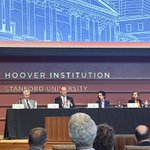
An honor to have @UChicago's @GregWKaplan on the @HooverInst @CapAndFreedom podcast talking history of macroeconomics from Keynes to HANK. We talk about the Hall-Woodford Nobel Prize, the importance of microfoundations, monetary & fiscal, the purpose of models, and Greg's book.

Why do some households spend their stimulus checks while others save them?
On @CapAndFreedom, Hoover Visiting Fellow @Jon_Hartley_ and University of Chicago economist @GregWKaplan explore how differences in income, wealth, and access to cash shape the effects of interest rates and fiscal stimulus—and what that means for economic policy.
Watch on Hoover+: hoover.org/plus/research/his…


Sid Gundapaneni retweeted

🗳️The entire country is watching to see if California voters will soon approve a proposed one-time, 5% tax on the state's wealthiest residents. Want to know what the fuss is all about? Tune into this fiery SIEPR Economic Summit debate, linked in 🧵 below. #Prop40 #BillionaireTax
Sid Gundapaneni retweeted

A great economist and a wonderful person.

“Meet Wharton’s Newest Faculty”
youtube.com/shorts/Bq0hq1Fuq…

Sid Gundapaneni retweeted

HAPPY PYTHAGOREAN TRIPLE DAY – the last one of the twenty-first century!!
10² + 24² = 26²
I hope your day is all right 😀📐.
QED
Sid Gundapaneni retweeted

Zucman’s central complaint is that our analysis violates “rational expectations” because we model departures that are in part motivated by the risk of future wealth taxes, and yet we do not add new revenues associated with those additional taxes. He refers to this as a “basic violation of rational expectations.”
But this is a basic, fundamental misunderstanding of rational expectations. 5/14
Sid Gundapaneni retweeted
Gabriel Zucman @gabriel_zucman has now for the third time criticized our research on California’s proposed billionaire tax, claiming we have provided “no answer” to his criticisms.
teapawt.net/gabriel_zucman/status/…
We have actually already responded twice on this platform, but let’s address his arguments once more in detail, with the hope that third time’s the charm. 1/14

This Hoover Institution study, which has fueled the deluge of ads (more than $200 million spent by billionaires so far) to defeat the California billionaire tax, is spectacularly misleading.
Let me explain its crucial flaw. 🧵
Readers added context they thought people might want to know
Zucman argues that the tax will raise his projected revenue because billionaires who leave CA after 1/1/26 will be taxed anyway.
At least $542B of net worth (Page, Brin, Thiel) departed the state by 12/31/25.
The entire thread is a misleading denial of this fact.
ft.com/content/d66976…
nytimes.com/2026/04/27/us/…
forbes.com/sites/forbeswe…
Sid Gundapaneni retweeted

I have not read @joshrauh analysis, but this Substack has the right economics. The @gabriel_zucman Twitter thread reads like a campaign commercial (complete w/ sketchy economic logic).
The numbers? I’d like to see a range. The baseline & dynamics of beliefs are hard-to-quantify.

Sid Gundapaneni retweeted
Let us explain why you are incorrect
fiscalrealitycheck.substack.…
This Hoover Institution study, which has fueled the deluge of ads (more than $200 million spent by billionaires so far) to defeat the California billionaire tax, is spectacularly misleading.
Let me explain its crucial flaw. 🧵
Readers added context they thought people might want to know
Zucman argues that the tax will raise his projected revenue because billionaires who leave CA after 1/1/26 will be taxed anyway.
At least $542B of net worth (Page, Brin, Thiel) departed the state by 12/31/25.
The entire thread is a misleading denial of this fact.
ft.com/content/d66976…
nytimes.com/2026/04/27/us/…
forbes.com/sites/forbeswe…
Sid Gundapaneni retweeted

California's Billionaire Tax Act would collect roughly $30 billion. Accounting for lost income taxes from departures, the mean Net Present Value is negative $39 billion, from Benjamin Jaros and Joshua Rauh nber.org/papers/w35899


Sid Gundapaneni retweeted

Terrible news. Perry's paper on hierarchy was formative for how I think about money and finance.


Perry Mehrling, RIP.
According to the History of Economics Society, Perry Mehrling died "Monday night from injury sustained in a fall several days earlier." He was Professor of International Political Economy at Boston University and, previously, longtime Professor of Economics at Barnard College. He was a highly esteemed historian of economics.
Here is his homepage:
sites.bu.edu/perry/
His last book: "Money and Empire: Charles P. Kindleberger and the Dollar System"
amzn.to/47RVhJ2
"Charles Kindleberger ranks as one of the twentieth century's best known and most influential international economists. This book traces the evolution of his thinking in the context of a 'key-currency' approach to the rise of the dollar system, here revealed as the indispensable framework for global economic development since World War II. Unlike most of his colleagues, Kindleberger was deeply interested in history, and his economics brimmed with real people and institutional details. His research at the New York Fed and BIS during the Great Depression, his wartime intelligence work, and his role in administering the Marshall Plan gave him deep insight into how the international financial system really operated. A biography of both the dollar and a man, this book is also the story of the development of ideas about how money works. It throws revealing light on the underlying economic forces and political obstacles shaping our globalized world."
Charles Goodhart: "The discipline of economics is balanced, somewhat unsteadily, between two legs, with the skill of the historian on one side and of the mathematical modeler on the other. In the second half of the 20th century, the tide flowed strongly to elevate the second leg and to diminish the first. In this delightful biography of Charlie Kindleberger, a charming and loveable man, Perry Mehrling shows how Charlie, in his chosen role, as an international monetary economist, fought against that tide, often unsuccessfully. Perry writes so beautifully that one would only need a smattering of economics to enjoy the tale; while if one is interested in the history of economic thought in international monetary economics, then this book is, of course, a must read.'
amzn.to/47RVhJ2

Sid Gundapaneni retweeted

So over-the-moon-thrilled that Bob Hall won the Nobel Prize in economics today. We have been friends and coauthors for more than 30 years, and I've learned so much from him! A few stories: 1/N
Sid Gundapaneni retweeted

Want more? Robert Hall, along with Tom Sargent, also wrote "Short-Run and Long-Run Effects of Milton Friedman's Presidential Address" in the Winter 2018 issue of the Journal of Economic Perspectives
aeaweb.org/articles?id=10.12…

Sid Gundapaneni retweeted

Woodford and Hall. A Great Nobel
grumpy-economist.com/p/a-gre…

Sid Gundapaneni retweeted
But Hall 1978 has a special place in my heart. Tom Sargent taught me as an undergrad about the lasting influence of that paper. Realizing how many different types of stories can be told just by rewriting the LQ dynamic program really sold me on the beauty of macro models.
Sid Gundapaneni retweeted

2026 economic sciences laureate Robert E. Hall’s hypothesis was that changes in consumption could not be predicted because they depend on new – and thus unpredictable – information.
Hall presented his results in an article in 1978, which was something of a eureka moment for research. His work became key to the development of modern research on consumption.
#NobelPrize
