HuMn Behavior Helm Former Data Intelligence Lead for DJT '16 + '20
Texas, USA
Joined December 2008
- Tweets1.3K
- Following497
- Followers1.3K
- Likes429


Pinned Tweet
Very proud of my team and their work on understanding the increasing cultural consciousness in consumerism that was featured in this piece by Bloomberg. Brands need to have a firm understanding of who their customers are and what drives their support.
bloomberg.com/news/features/…

1
5
1,022
Something I've noticed this cycle: in 2024, cultural issues were the driving force behind Republican wins. Going into 2026 I expected that to continue. What we've learned is that when voters feel the economy is working against them, culture-war issues struggle to break through. Kitchen table realities drown them out.
1
1
136
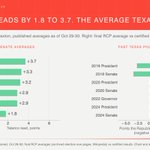
Talarico leads in most published Texas averages, by 1.8 to 3.7 points. The final Texas polling average has missed the margin by 3.5 points on average across seven recent statewide races. A normal Texas miss is about the size of this lead.
Talarico's lead over Paxton as of Oct 29-30: Decision Desk HQ +3.7, FiftyPlusOne +3.3, 270toWin +3.2, Silver Bulletin +2.9, Texas Tribune +2.9, RealClearPolitics +1.8.
How far the final RCP average missed the certified result, on the margin:
2016 President: Democrat beat it by 2.7
2018 Senate: Democrat by 3.4
2020 President: Republican by 4.3
2020 Senate: Republican by 3.1
2022 Governor: Republican by 0.5
2024 President: Republican by 6.6
2024 Senate: Republican by 4.1
Three of the seven misses were bigger than the largest current lead. Six were bigger than RCP's. The last five all went Republican, though 2022's was small.
Misses aren't destiny - the two before that went Democratic, and the two midterms on the list were the smallest Republican-side misses (2018 went Democratic by 3.4, 2022 Republican by 0.5). The big Republican misses came in presidential years.
So the read: Talarico likely has a real lead, and it's about the size of a normal Texas miss. Toss-up, not a Talarico race.

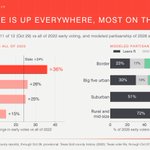
The border is where Texas early voting has grown most since 2022: up 36% on all of 2022's early vote through day 11 of 12, against 24% statewide.
Hidalgo is up 45%, El Paso 39%. Hidalgo has already passed its total 2022 turnout, Election Day included.
By region, early votes through Oct 29 vs all of 2022's early vote (rate of registered voters, 2026 vs 2022):
Border: +36% (28.6% vs 22.6%)
Big five urban: +26% (37.4% vs 31.2%)
Suburban: +25% (39.9% vs 36.5%)
Rural and mid-size: +15% (31.8% vs 29.3%)
On rate, not just roll growth, the border and the big five are both up about 6 points. The suburbs are up 3, rural and mid-size Texas 2.5.
Counties to know:
Hidalgo +45%, El Paso +39%: still the biggest jumps among counties with 50,000+ early votes.
Ellis +37%, though its registration also grew 21%.
Against the same day in 2018, by rate: Tarrant +5.9 points, Cameron +5.9, Webb +4.6. Furthest behind: Collin -3.2, Montgomery and Comal -2.4. 22 of the 30 counties with 2018 daily data are ahead.
Why it matters: the growth is uneven by partisanship. Rural and mid-size Texas - the 214 counties outside the border, the big five metros and their suburbs, from Lubbock to Waco to Tyler - grew slowest and fell from about 24% of the early vote to 22.5%. It's the most Republican-leaning part of the state, with early voters modeled at 72% R / 18% D. The fastest growth is on the border (23 R / 60 D) and in the big five (30 R / 57 D). The suburbs (51 R / 34 D) are in between.
The border is still well below the state's turnout rate, and 5 of its 15 counties - all small - are still behind 2022. The regional mix explains only about 1 point of the move from R+14.3 in 2022 to R+3.6. Most of the shift is happening inside each region, not between them.

Texas's early vote isn't just the regulars. Through Oct 27, 26% of early voters had not voted in the 2022 midterm, and at least 61% of those voted in 2024.
Yes, it skews older and habitual. Early voting usually does, especially partway through the window.
Share of registered voters who had voted early by Oct 27, by age (at least):
18-29: 16%
30-44: 20%
45-64: 33%
65+: 46%
Through Oct 27, seniors were 36% of early voters and under-30s 11%. 59% had voted in all four general elections from 2018 to 2024.
About two in three March primary voters, in both parties, have already voted. Among registered Texans who skipped the primary, it's 17%.
The read: mostly the regulars, plus a real slice who didn't vote in Texas in 2022 but did in 2024 - some were too young or lived elsewhere then. That slice is the part of this electorate that's new since the last midterm.

144
Texas's early electorate has gone from R+14.3 in 2022 to R+3.6 this year. That's modeled partisan lean of who has voted, not votes for anyone - and 2024's early vote was R+13.1, so this isn't just a soft 2022 baseline.
Modeled partisanship of early voters (leans R / unclear / leans D):
2018: 48.0 / 12.4 / 39.6
2022: 50.8 / 12.6 / 36.5
2024: 49.5 / 14.1 / 36.4
2026 so far: 45.2 / 13.3 / 41.6
It's less Republican-leaning than 2018's early vote (R+8.4) too.
Primary history points the same way. In 2022's early vote, 39% had last voted in a Republican primary and 30% in a Democratic one. This year it's close to even: 31% Republican, 30% Democratic, 35% neither.
The honest part: the voters still left to vote lean more Republican by primary history, so the final electorate should run a bit redder than R+3.6. But early votes were 79.5% of all votes in 2024, so there's less of Election Day left to make it up than there used to be.
This is partisan lean, not vote choice. But it's the least Republican-leaning early electorate of the four.

Texas early voting is already past all of 2022 - by raw count and by rate of registered voters - with two days of the window still to be counted.
Through day 10 of 12: 6,218,876 early ballots. All of 2022's early voting: 5,497,027.
Some of that is just growth. Texas has 19.0M registered voters now, 1.4M more than in 2022. The fairer comparison is the rate: 32.7% of registered voters have voted early, against 31.1% for all of 2022's early vote.
The long view, same 15 large counties, midterm early vote as a share of registered voters: 21% in 2010, 19% in 2014, 40% in 2018, 32% in 2022, 34% so far in 2026.
So the read: 2026 is a strong midterm, clearly ahead of 2022, and not yet at 2018's final. Two days of reports are still to come.

226
I've seen several political groups running surveys on SurveyMonkey this cycle, likely without realizing it uses their de-identified response data to train its models. Its terms say that license keeps running even after you stop using the service. Protect your alpha, and know whether your partners have your best interests in mind.
101
The AI model isn't the moat anymore. Last week MiniMax gave away a 428-billion-parameter model for free, and a shrunk-down version kept over 90% of its accuracy. When anyone can run the model, the only edge left is data nobody else has.
98
100% - plus San Antonio has far more affordable housing, cheaper energy, and lots of space to grow.

Amazing.
Everybody is sleeping on how important this is. For all of us!
For a relatively very small additional cost, we could add in a few dozen stations and get rid of a lot of traffic in Austin, too. This is key for growing business but also the cultural / music scene, etc.
1
118
This would be massive for the San Antonio economy - and @elonmusk is right, some days it takes me over two hours to get back and forth and it’s sadly becoming the standard.

Boring Company is working on a simple, precursor Hyperloop tunnel between Austin and San Antonio (>200 mph).
Due to traffic congestion, that journey can currently take up to 2.5 hours. @BoringCompany can reduce that to a consistent <30 mins.
2
1
111
One of the real moats left is first-party data - history you already built that AI cannot manufacture. Protect it at all costs: keep it on your perimeter and out of adversarial vendor training loops and usage logs, or you fund the next competitor's edge.
74
Enterprise buyers are refusing to put their alpha in Anthropic's 30-day Fable usage logs. Nvidia limited Fable to less-sensitive work, Booz Allen barred it from proprietary cyber code, and Palantir wants irrevocable zero-data-retention before the model ships in its software. The market is waking up to the "we don't train on your data" delusion - and the best move is keeping first-party intelligence out of others' hands.
1
84
Access to sovereign intelligence should be a fundamental right. Whether is stays one comes down to the frontier saying open and accessible - not gated by a few companies. The Second Amendment was only partially about the tool - it was much more about the principle that a capability which sets the balance of power is dangerous the moment one group monopolizes it, which is why it is distributed among the people. Intelligence is going down this path, and keeping it open is the same fight, because the alternative is a handful of labs deciding who gets access and what to think.
89
Wisconsin is a reminder that a poll only measures the people willing to answer it - Hong led among the voters who picked up, and lost to the ones who showed up. The same gap is sitting under the national numbers, pointed the other way: with Trump's approval near the bottom of his term, the least enthusiastic Republicans are the ones declining to respond, so the samples run thinner on the right than the electorate will. Those people haven't decided not to vote, they've decided not to think about it yet, and that changes once the money and the campaigning start. How much of the Democratic edge survives is the question worth asking about a poll fielded over the summer.
121
Most brand outrage is safe to discount because the loudest voices were never going to buy the product. This time they already did, at the top of the market, and part of what they paid for was the promise they'd avoid these types of experiences. The people you'd normally tune out are the customers.

Of all the brands I thought might bombard with in car ads on screen right when you start the engine,?I had BMW pretty dang low on my list.
This seems the opposite of luxury and performance.
consumerrights.wiki/w/BMW_Sp…

1
172
Most consumer research and insights are produced by people who have never met or interacted with the end consumer. That is a structural and corrosive problem. Most of the firms doing this work are concentrated in four or five cities, they hire out of the same handful of schools, and the population they're being paid to explain lives somewhere else entirely.
The output seems excellent, which is exactly what makes it dangerous. Rigor tells you whether an answer is consistent, not whether it's plausible. That check requires truly knowing the audience. Without it, a wrong answer ships as confidently as a right one. Eight and nine figure strategies get built this way routinely, and firms rarely take responsibility when things go south.
70
Matt Oczkowski retweeted

I'm one of the most advanced users of OpenClaw.
OpenClaw + GPT5.3 Codex + Opus 4.6 has been the trifecta that changed everything.
I made a video going over everything I'm doing with these tools.
Learn these tools, stay ahead.
Watch this video right now.
0:00 Intro
1:02 Overview
4:17 Sponsor
5:12 Personal CRM
7:11 Knowledge Base
8:30 Video Idea Pipeline
11:09 Twitter/X Search
12:47 Analytics Tracker
13:33 Data Review
15:34 HubSpot
16:13 Humanizer
16:52 Image/Video Generation
18:22 To-Do List
19:37 Usage Tracker (Saves Money)
20:45 Services
21:25 Automations
22:42 Backup
23:30 Memory
24:06 Building OpenClaw
25:22 Updating Files
Vindicated.
This clip feels extremely gratifying. After proverbially 'screaming from the rooftops' for the better part of eight years about the rumors and lies surrounding our work during the 2016 (and subsequent) elections, I am glad the content like this is being seen by the wider public. The teams that worked on this project were wrapped into the now debunked 'Russian Collusion Hoax' and accused of 'stealing' or 'hacking' data, when in reality we were just doing our jobs. It's 'almost' comical what people will make up to cover for a historic loss.
Mark is right - most people who gravitated towards these stories only read the headlines, and the media companies who wrote most of the disgusting click-bait and half truths were oddly silent when these investigations wrapped. Mark also should have come out and made these statements earlier.
For years we we're attacked, investigated, and ultimately silenced out of fear of retribution - many people who worked on these projects couldn't afford the legal fees to constantly defend themselves, so they instead chose to stay silenced. A narrative was set, and spun, that got out of control to a point where the reality of our work as we knew it was no longer recognizable.
It finally feels like nature is healing. The truth always finds a way to shine through and for that I am grateful.