

Passionate about nature, tech, and people. Backyard scientist 🔬 | Armchair genealogist 🧬 | Advocating to save lives and build a world that works. #VaxStatRep
Joined June 2014
- Tweets115K
- Following2.7K
- Followers4.3K
- Likes54.7K





Pinned Tweet
Follow me as I seek to explain & validate the argument that wins the vaccine debate.
My🧵s in search of the truth.
1) What happened in New Zealand?
How and why does a small island country show us beyond doubt how safe vaccines are?
xitter.cf/MauritzPreller/status/…


Clear evidence that covid vaccines are safe can be found in New Zealand, a country of ~ 5.1m people where ~12,8m vaccines were administered to date.
As the graph below from NZ health shows, most of those were administered from March 2021 to March 2022.
tewhatuora.govt.nz/our-healt…

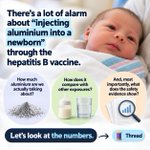
There’s a lot of alarm about "injecting #aluminium into a newborn" through the hepatitis B vaccine.
But how much aluminium are we actually talking about?
How does it compare with other exposures?
And, most importantly, what does the safety evidence show?
Let's look at the numbers. 🧵


🧂What about a grain of salt?
An ordinary grain of table salt varies considerably in size.
For comparison:
-A 0.5 mm salt crystal weighs approximately 0.27 mg.
- A smaller 0.3 mm crystal weighs approximately 0.06 mg.
The 0.25 mg of aluminium in a paediatric hepatitis B vaccine therefore weighs about the same as one 0.5 mm grain of salt, or roughly four smaller grains.
That's a comparison of mass of course ane not toxicity. The substances and their biological effects are different.


H5N1. The road to "herd immunity" and all that.

There is something really concerning (and disappointing) going on in the US right now.
A dangerous and preventable situation.
Let me explain.
nextstrain.org/avian-flu/h5n…
1/

Mau retweeted

There’s a word I see far too often in social media exchanges, including from people who otherwise consider themselves thoughtful, educated, and compassionate: “retard.”
Let me explain why I find its use so objectionable.
When you use “retard” to describe someone you consider foolish, ignorant, or intellectually deficient, you’re drawing on a long history of using intellectual disability as a measure of human worth.
The term once had a place in clinical terminology. That history doesn’t make its use as an insult acceptable. In fact, it helps explain why the insult is so damaging.
Consider what you’re actually communicating. You’re treating intellectual disability as something shameful, something contemptible, something that makes a person worthy of ridicule.
And the people who bear the consequences aren’t necessarily the individuals you’re arguing with. They’re people with intellectual disabilities, their families, and others who have spent decades challenging the stigma attached to those conditions.
You can dismantle a bad argument. You can expose dishonesty, ignorance, hypocrisy, or breathtaking stupidity. You can even do it with humor and considerable sharpness.
None of that requires borrowing a disability to insult someone.
I have no objection to vigorous disagreement. I welcome challenges to my reasoning, evidence, and conclusions. I’ve been wrong before, and I expect I’ll be wrong again.
But there’s a difference between intellectual combat and casual cruelty.
My rules for engagement with this account are simple:
Use the word “retard” as an insult, and you will be muted.
Use it again, and you’ll be blocked.
Disagree with me all you like. Challenge my evidence. Question my conclusions. Just don’t expect me to accommodate language that demeans people who have nothing to do with our disagreement.


Asking @EthicalSkeptic to graph something is like asking RFK to be honest about vaccines.
cc. @henjin256


Barry, you're correct that New Zealand's reported COVID-19 vaccination coverage is now lower than 95%.
But this isn't quite the flex you think it is.
As is the case with large data sets things can be quite messy.
And calling the 95% figure "absolute rubbish" suggests you haven't understood how New Zealand calculated its vaccination coverage, or how those calculations subsequently changed.
Let me share about the government's original reports, the population denominator revisions and the actual vaccination records released under the Official Information Act.
The results are rather interesting.
1. The 95% figure wasn't made up. It was officially reported.
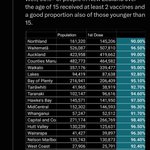
On 1 March 2022, New Zealand's Office of the Auditor-General reported that 4,003,247 people aged 12 and older had received two COVID-19 vaccine doses.
That represented 95.1% of the eligible population, according to the official reporting methodology at the time.
Eligible being 12+ years and older
You can disagree with the methodology. But calling an officially published government statistic "absolute rubbish" doesn't make it disappear.
My original post was written in December 2023, using historical vaccination figures released at the time.
The tally that was shared publicly was 4,051,754 as my screenshot from December (soon after you stole and shared your data with known grifters) shows.
The screenshot also shows first-dose coverage, whereas my accompanying statement concerned two doses. The two-dose claim therefore requires its own supporting source, which the Auditor-General's report provides for March 2022.
The original percentage was genuine. It just needs to be understood in its historical context.
Interestingly, the government subsequently revised its methodology.
And this is where what you eventually discovered become particularly relevant.

9. And finally, your claim that mostly unvaccinated nations had almost no COVID deaths.
Which nations would that be? Please do tell. That is basically a bold faced lie at worst and and a complete distortion of the truth at best.
Bulgaria is an obvious example.
According to the OECD, only approximately 30% of Bulgaria's population had been vaccinated by the end of 2023.
Yet Bulgaria experienced some of the highest excess mortality in the European Union during the pandemic.
The OECD and European Observatory's 2023 Country Health Profile reported more than 60,000 excess deaths between 2020 and 2022, approximately 20.2% above its historical baseline.
Eurostat reported 37.3% excess mortality in Bulgaria during 2021.
Low vaccination coverage certainly did not mean almost no excess mortality.
That observation alone does not establish how much of Bulgaria's mortality was caused or prevented by vaccination. Differences in age, chronic disease, healthcare capacity, infection timing and other circumstances must be considered.
But your sweeping claim about largely unvaccinated countries experiencing almost no COVID deaths does not hold up.
You may want to read this analysis.
For those who still insist the Covid vaccines “caused deaths” or “didn’t work”, here’s a pattern you need to explain.
Australia & New Zealand vs Bulgaria.
If vaccination was the main driver of excess deaths, why did low-vaccination Bulgaria get absolutely hammered while highly vaccinated Australia and New Zealand did vastly better?
And if the vaccines caused the excess mortality, why did Australia and New Zealand, both of which rolled out first boosters at nearly the same time, experience their major mortality waves at different times? More closely tracking their respective reopenings and subsequwnt Covid waves?
What alternative explanation fits what we observe across these three countries better?
Not an anecdote.
Not “Fauci did it.”
Not “look at ivermectin.”
Not a screenshot from Telegram.
Explain the pattern.
Share this with anyone who still claims the vaccines caused the excess deaths or simply “didn’t work.” Ask them to make their hypothesis fit the data.
I’ll keep refining this argument. Make it more comprehensive, more testable, and harder to wave away.
Now let’s see whether an alternative theory can survive contact with the whole dataset.

10. So where does this leave your original response?
You are correct about some things.
New Zealand's current reported vaccination percentage is lower than 95%.
There are substantial numbers of unvaccinated New Zealanders, particularly among younger age groups.
But here's what you missed.
First: The historical 95% statistic you dismissed as "absolute rubbish" was genuinely published by the New Zealand government.
Second: The government subsequently documented how a denominator revision reduced reported coverage by 5.23 percentage points, without changing the number vaccinated in that comparison.
Third: Health NZ specifically identified younger adults, particularly men, as underrepresented in its earlier population estimates.
Fourth: The AIR transition introduced another methodological break and is a snapshot not a historical record.
Fifth: Both the historical and subsequent data show very high vaccination coverage among older New Zealanders, the population most vulnerable to COVID-19 mortality.
And this is ultimately the problem with simply pointing to a newer percentage and declaring an older government statistic nonsense.
A vaccination percentage is not an isolated fact.
It depends on the number vaccinated, the population denominator, the age groups, the reporting date and the methodology used.
Change any of those, and the percentage can change.
You were right that the newer percentage is lower.
You were wrong to suggest the historical 95% figure was fabricated.
And the government's own documentation explains why treating those figures as directly interchangeable would be a serious statistical mistake.
For someone making sweeping claims about what New Zealand's vaccination data supposedly proves, those distinctions are rather important.