

Sublime of a ₿eautiful life ⚡️ Be responsible. Make positive changes. Be leader!
Bali, Indonesia
Joined March 2012
- Tweets631
- Following1.1K
- Followers155
- Likes6.3K










Max Panikar 🇺🇦 ₿ali retweeted

Here is the secret behind SwissToney, the #1 trader on Polymarket with +$21M PNL
they use SportsRadar
SportsRadar is the company setting the odds for most bookmakers
Do you think most sportsbooks have dedicated teams of researchers setting the odds for every possible event ?
No, now days they outsource that to SportsRadar
Sportsbook receive live odds feed from SportRadar's API, apply their spread, and count on these odds being better than the judgement of the crowd to not lose against their customers.
SwissTony is doing the same thing on Polymarket.
They are receiving live odds feed from SportsRadar and arbitrage it with the Polymarket odds.
Just look at their stats :
PNL : $21M
# of trades : 146k
position value : $161k
- High PNL show that they aren't a market maker, since LP rewards are not counted in there.
- High number of trades tell us this can't be a manual sharp trader.
- Low position value tell us it's likely an arbitrage strategy where capital is limited by size of opportunities.
They are simply leveraging privileged access to a professional sports intelligence service and running it against the @polymarket userbase
Interestingly SportsRadar has it's headquarters in St Gallen, Switzerland (🇨🇭), so i wouldn't be surprised if they were directly related to the SwissTony (🇨🇭) team.
Maybe that's how they got access to that service despite it being usually reserved for bookmakers

Max Panikar 🇺🇦 ₿ali retweeted

The path to launch is filled with obstacles and success is only possible through the tireless efforts of many working together towards a common goal. “Critical Path” continues the ongoing Starship series, following SpaceX engineers through the final days before launch of the first Starship V3 and the challenges that come with development of the world’s most powerful and fully reusable rocket.
Max Panikar 🇺🇦 ₿ali retweeted

Two weeks ago, Ethereum researchers met in Berlin to continue charting the protocol's long-term trajectory, following along discussions with client teams in Svalbard in April.
The updated strawmap is at strawmap.org, and I attached a picture of it to this post.
My own high-level takeaways:
* "Lean Ethereum" is not a single one-shot upgrade, it is a collection of improvements that will come online to the Ethereum network over the course of three or four years. But make no mistake, this IS the third major iteration of Ethereum in the same way that the Merge was the second. Almost every major piece of the protocol will be replaced:
- Verification through recursive STARKs, rather than direct re-execution. Recursive STARKs become an enshrined first-class core component of the protocol
- Replacing everything quantum-vulnerable with quantum-safe alternatives
- Consensus: decoupled available chain and finality, one or two-round finality. Theoretically optimal security properties, simpler than today, and faster than today
- Multidimensional gas
- State: not just tree structure, but what *types* of state are available
- Changes to client architecture
...
At the same time, simplification, cleanup and future-proofing. And this will all be done in a way that minimizes disruption to existing application. We've done this before (the Merge), we can do it again.
* H-star (aka Hegota) is probably Ethereum's last thematically "pre-Lean" fork. Starting from I-star, most of everything we do will have a very strong "Lean" feel to it in one way or another.
* Privacy is no longer an afterthought, it is a first class goal. When designing Frames, the mempool, additions to the state tree, we explicitly ask the question "okay, how do quantum-safe, intermediary-free privacy protocol transactions go through this, and what is the overhead?"
* Formal verification of everything for security.
* FV also makes us much more comfortable with canonicalization (having pieces of the protocol that are directly defined as a piece of bytecode expressed in some language). evm-asm is being written in part to become a canonical proof system for the EVM.
* Quantum safety has shifted up a LOT in priority. This adds a lot of work (eg. finalizing a quantum-safe blobs design has become urgent; this work has already been ongoing for months)
* Probably the single most disruptive part of the plan is the changes to state. There is growing consensus around leaving present-day-style "dynamic state" mostly unchanged, but scaling it only a medium amount, and adding new types of state that are more scalability-friendly (eg. no need for builders to sync/store all of it) but more restrictive, and that will scale a large amount.
eg. possible Ethereum in 2030: 2 TB of present-day-style (dynamic) state, and 100 TB of new-style (scalable but restrictive) state
This "new-style" state would work very well for ERC20s, NFTs, many defi use cases, but not eg. highly "central" objects like Uniswap contracts, or onchain order books, or other complex things (which are crucial for Ethereum but which only take up a small percentage of state)
Hence, it will not be *necessary* to rewrite any apps, but it will be *very cost-effective* to eg. rewrite an ERC20 token into a newer design that uses a new type of UTXO storage that is currently being explored, so that it will have >10x lower txfees.
Design of these new state types (current ideas: keyed nonces, ring buffers, UTXOs, statically accessible state, temp state) is an area where we will need a lot of feedback from application developers (incl. privacy-friendly application developers) and probably several rounds of rethinking and iteration.
* In the context of a much larger total state size, we need to figure out the incentive issues around who stores this state and what motivates them to. Even saying "each node stores 1%" is not good enough - why do they store that 1% and why are they willing to serve it? This is being elevated as a first-class research area.
* Ethereum will need to have a "VM" other than EVM in one form or another - at the very least, we need something like leanISA for recursive STARKs - and the gains are large in exposing it to users so that we support programmable privacy and better scalability. Right now, the most likely contenders are leanISA and RISC-V.
My own ideal is that in this world, we adjust the protocol so that the EVM becomes a high-level-language compiler-level feature, and the protocol only "sees" RISC-V / leanISA directly. But this is still far away.
* Gas limit increases, blob increases and slot time decreases will happen many times over the next ~5 years. We expect a large gas limit increase with Glasterdam. Each step of increased scale or decreased slot time is a matter of getting to the point where it is safe to do it, which comes from a combination of client optimization and protocol changes.
Ethereum is CROPS.
Ethereum is scaling.
Ethereum is reinventing itself.
Onward.


Max Panikar 🇺🇦 ₿ali retweeted

Top 15 onchain apps by protocol revenue: $HYPE, $PUMP, $CAKE, $SKY, $JUP, $AAVE, $AERO, $WLFI, $LDO, $MET, $ETHFI, $LIT, $CARDS, $UNI, $RAY
Some of the top onchain apps by revenue have real cash flows, low overhead, and single-digit multiples, and with the CLARITY Act potentially weeks away, we believe investors are facing an attractive entry point today.
Read more from @LowBeta's latest Stack article here: grayscale.com/the-stack/reve…

Max Panikar 🇺🇦 ₿ali retweeted

Anthropic pays engineers $750,000+ a year to understand how LLMs work.
Stanford just put a 2 hour lecture that covers 80% of it for FREE.
Bookmark this. Give it 2 hours today.
It might be the highest ROI thing you do this month:
Max Panikar 🇺🇦 ₿ali retweeted

What does every big company think about the agent harness?
Anthropic, OpenAI, CrewAI, LangChain. They all build agents. They all wrap their models in infrastructure to make them useful. They each call it the harness.
But they agree on one thing. And disagree on everything else.
The agreement: the model is not the product. The infrastructure around the model is.
The disagreement: how much of that infrastructure should exist.
This is the most important architectural bet in AI right now. And each company is placing a different one.
𝗔𝗻𝘁𝗵𝗿𝗼𝗽𝗶𝗰 bets on the model. Their harness is deliberately thin. A "dumb loop" that assembles the prompt, calls the model, executes tool calls, and repeats. The model makes all the decisions. The harness just manages turns. Their bet: as models get smarter, you need less infrastructure, not more.
𝗢𝗽𝗲𝗻𝗔𝗜 takes a similar but slightly thicker approach. Their Agents SDK is "code-first," meaning workflow logic lives in native Python, not in some graph DSL. But they add more structure: strict priority stacks for instructions, multiple orchestration modes, and explicit agent handoff patterns.
𝗖𝗿𝗲𝘄𝗔𝗜 adds a deterministic backbone. Their Flows layer handles routing and validation with hard-coded logic, while their Crews handle the autonomous parts. Intelligence where it matters, control everywhere else.
𝗟𝗮𝗻𝗴𝗚𝗿𝗮𝗽𝗵 bets on explicit control. The harness encodes the logic. Every decision point is a node in a graph. Every transition is a defined edge. Planning steps, routing strategies, multi-step workflows are all spelled out in the harness, not left to the model.
Notice the spectrum.
On one end: trust the model, keep the harness thin.
On the other: encode the logic, make the harness thick.
And here's where it gets interesting.
The scaffolding metaphor makes this concrete.
Construction scaffolding is temporary infrastructure that lets workers reach floors they couldn't access otherwise. It doesn't do the building. But without it, workers can't reach the upper floors.
The key word is temporary.
As the building goes up, scaffolding comes down. Manus demonstrated this perfectly. They rebuilt their agent five times in six months. Each rewrite removed complexity. Complex tool definitions became simple shell commands. "Management agents" became basic handoffs.
The scaffolding did its job. So they removed it.
This is also why Anthropic regularly deletes planning steps from Claude Code's harness. Every time a new model version ships that can handle something internally, the corresponding harness logic gets stripped out.
But there's a catch.
Models are now trained with specific harnesses in the loop. Claude Code's model learned to use the exact scaffolding it was built with. Change the scaffolding, and performance drops. The worker trained on THIS scaffolding. Swap it out, and they stumble.
So the field is converging on a principle:
Build scaffolding that's designed to be removed. But remove it carefully, because the model learned to lean on it.
The "future-proofing test" for any agent system: if dropping in a more powerful model improves performance without adding harness complexity, the design is sound.
Two products using the exact same model can perform completely differently based on this one decision: how thick is the harness?
LangChain changed only the infrastructure (same model, same weights) and jumped from outside the top 30 to rank 5 on TerminalBench 2.0.
The model didn't improve. The scaffolding around it did.
The article below is a deep dive on agent harness engineering, covering the orchestration loop, tools, memory, context management, and everything else that transforms a stateless LLM into a capable agent.


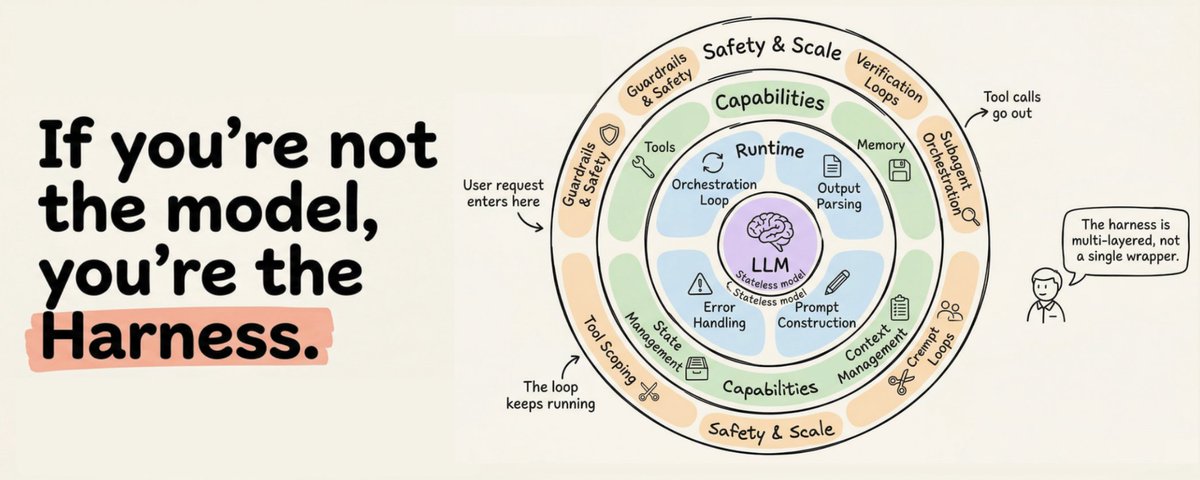
Max Panikar 🇺🇦 ₿ali retweeted
There have recently been some discussions on the ongoing role of L2s in the Ethereum ecosystem, especially in the face of two facts:
* L2s' progress to stage 2 (and, secondarily, on interop) has been far slower and more difficult than originally expected
* L1 itself is scaling, fees are very low, and gaslimits are projected to increase greatly in 2026
Both of these facts, for their own separate reasons, mean that the original vision of L2s and their role in Ethereum no longer makes sense, and we need a new path.
First, let us recap the original vision. Ethereum needs to scale. The definition of "Ethereum scaling" is the existence of large quantities of block space that is backed by the full faith and credit of Ethereum - that is, block space where, if you do things (including with ETH) inside that block space, your activities are guaranteed to be valid, uncensored, unreverted, untouched, as long as Ethereum itself functions. If you create a 10000 TPS EVM where its connection to L1 is mediated by a multisig bridge, then you are not scaling Ethereum.
This vision no longer makes sense. L1 does not need L2s to be "branded shards", because L1 is itself scaling. And L2s are not able or willing to satisfy the properties that a true "branded shard" would require. I've even seen at least one explicitly saying that they may never want to go beyond stage 1, not just for technical reasons around ZK-EVM safety, but also because their customers' regulatory needs require them to have ultimate control. This may be doing the right thing for your customers. But it should be obvious that if you are doing this, then you are not "scaling Ethereum" in the sense meant by the rollup-centric roadmap. But that's fine! it's fine because Ethereum itself is now scaling directly on L1, with large planned increases to its gas limit this year and the years ahead.
We should stop thinking about L2s as literally being "branded shards" of Ethereum, with the social status and responsibilities that this entails. Instead, we can think of L2s as being a full spectrum, which includes both chains backed by the full faith and credit of Ethereum with various unique properties (eg. not just EVM), as well as a whole array of options at different levels of connection to Ethereum, that each person (or bot) is free to care about or not care about depending on their needs.
What would I do today if I were an L2?
* Identify a value add other than "scaling". Examples: (i) non-EVM specialized features/VMs around privacy, (ii) efficiency specialized around a particular application, (iii) truly extreme levels of scaling that even a greatly expanded L1 will not do, (iv) a totally different design for non-financial applications, eg. social, identity, AI, (v) ultra-low-latency and other sequencing properties, (vi) maybe built-in oracles or decentralized dispute resolution or other "non-computationally-verifiable" features
* Be stage 1 at the minimum (otherwise you really are just a separate L1 with a bridge, and you should just call yourself that) if you're doing things with ETH or other ethereum-issued assets
* Support maximum interoperability with Ethereum, though this will differ for each one (eg. what if you're not EVM, or even not financial?)
From Ethereum's side, over the past few months I've become more convinced of the value of the native rollup precompile, particuarly once we have enshrined ZK-EVM proofs that we need anyway to scale L1. This is a precompile that verifies a ZK-EVM proof, and it's "part of Ethereum", so (i) it auto-upgrades along with Ethereum, and (ii) if the precompile has a bug, Ethereum will hard-fork to fix the bug.
The native rollup precompile would make full, security-council-free, EVM verification accessible. We should spend much more time working out how to design it in such a way that if your L2 is "EVM plus other stuff", then the native rollup precompile would verify the EVM, and you only have to bring your own prover for the "other stuff" (eg. Stylus). This might involve a canonical way of exposing a lookup table between contract call inputs and outputs, and letting you provide your own values to the lookup table (that you would prove separately).
This would make it easy to have safe, strong, trustless interoperability with Ethereum. It also enables synchronous composability (see: ethresear.ch/t/combining-pre… and ethresear.ch/t/synchronous-c… ). And from there, it's each L2's choice exactly what they want to build. Don't just "extend L1", figure out something new to add.
This of course means that some will add things that are trust-dependent, or backdoored, or otherwise insecure; this is unavoidable in a permissionless ecosystem where developers have freedom. Our job should make to make it clear to users what guarantees they have, and to build up the strongest Ethereum that we can.

Max Panikar 🇺🇦 ₿ali retweeted

I DID IT!!! Turned $12 into $100,000 (over 8,300x) by going all-in and doubling my bankroll 16 times in a row on short-term BTC moves - while sharing my bets and the reasoning behind them along the way.
This is only possible on @Polymarket !!!
It took a lot of work and real skin in the game, so if you’re reading this, a simple RT or comment would really mean a lot.
Huge shoutout to @shayne_coplanand @Polymarket team for building the best prediction market platform out there. And special thanks to @zscdao and @PolymarketTrade for the support🤝
Track my progress here: polymarket.com/@ascetic0x?vi…

Readers added context they thought people might want to know
this user is misrepresenting his progress x.com/holy_moses7/st…
Max Panikar 🇺🇦 ₿ali retweeted

🚀 Introducing CMC20: Crypto’s First DeFi-Enabled Tradable Index Token.
CoinMarketCap is proud to announce $CMC20, the first DeFi-native tradable crypto index token on @BNBCHAIN. Your single-trade gateway to diversified exposure across the top 20 crypto assets.
Built in partnership with @reserveprotocol & deployed by @lista_dao, now available on @pancakefi @TrustWallet
1/6


Max Panikar 🇺🇦 ₿ali retweeted

1/ It appears that @pumpdotfun is preparing to launch a volume incentives program that will last at least 30 days, with $PUMP as the rewards token
👇

Max Panikar 🇺🇦 ₿ali retweeted

no-one is talking about how @multicoin shoving $200,000,000 into the PUMP TGE also makes it one of the largest VC raises for a crypto company this cycle
Max Panikar 🇺🇦 ₿ali retweeted

The two top funds who invested $100M and $50M into $PUMP have sold a total of 16B PUMP ($86.4M) over the last 2 days, which equals 1.6% of the total supply and 4.6% of the current circulating supply.
They are still holding 16B PUMP ($84M) and 3B PUMP ($15.8M), respectively.
Received 25B PUMP bought for $100M, sold 9B PUMP ($49M)
solscan.io/account/D6arV1F6d…
Received 10B PUMP bought for $50M, sold 7B PUMP ($38M)
solscan.io/account/58WQi2AFk…
USD values are based on the current market price (0.0054) actual sale prices were likely higher.


