Somewhere in the World
Joined November 2012
- Tweets100
- Following63
- Followers853
- Likes278



Valormont retweeted

À propos des pillages du 17 octobre à Châtelet, voici mes observations, parfois évidentes (mais les médias niant l’évidence...) :
— ce n’étaient pas des manifestants, ni des émeutiers, ni des casseurs, mais précisément des pillards africains, leur but étant de s’emparer de marchandises et de prendre part à une razzia générale appelée "17/10/26" ;
— noirs aux deux tiers et arabes à un tiers environ, ce qui est une spécificité de Châtelet et ce qui correspond aux proportions des émeutes de Nahel ; la seule exception que j’ai vue en quatre heures de pillage a été trois semi-clochards opportunistes polonais qui ramassaient des paquets abandonnés au sol ;
— l’effet de masse était saisissant : ils étaient en nombre effrayant, de très grands groupes et des groupes plus petits, dans toutes les rues de Châtelet, vêtus de noir, la tête couverte de cagoules ou de capuches, hommes et femmes, petits et grands, gros et maigres, pas spécialement guerriers pour la plupart ;
— les mesures habituelles de rétablissement de l’ordre ne pouvaient pas empêcher une razzia d’une telle ampleur : les CRS ont fait ce qu’ils ont pu mais Châtelet a été un labyrinthe dans lequel les souris voleuses, volant de Franprix à Carhartt, couraient généralement plus vite que les chats CRS ;
— par conséquent je ne crois pas du tout au fait que l’on aurait laissé les pilleurs piller pour décrédibiliser le mouvement, les pilleurs étaient tout simplement beaucoup trop nombreux pour être contenus par des CRS fantassins, du moins à Châtelet ;
— aucun casseur d’extrême-gauche ni de blackblocs parmi eux (de temps en temps l’on en voyait un avec son masque à gaz, mais qui ne faisait que passer à bicyclette) ;
— les pillards procèdent par vagues : d’abord les jeunes les plus audacieux, qui empochent le plus possible de marchandise ; ensuite les femmes, qui se partagent le butin dans la rue ; ensuite les pillards-badauds, qui ramassent le surplus abandonné sur le trottoir ; puis les clochards, les ivrognes, etc., qui ramassent les derniers maillots de football dans le caniveau (j’ai pu observer le manège de très près pendant des heures) ;
— les pilleurs apportent les habits à des comparses (en général des femmes), qui cachent le butin sous une voiture ; quand les CRS chargent, ils détalent ; ils reviennent quelques minutes plus tard et recommencent ; au bout d’un moment tous s’échangent habits et sacs et chaussures et boîtes de téléphones, en général dans une bonne humeur inquiète ;
— le but est de récupérer le plus possible d’articles tout en se gardant d’être encombré, de manière à pouvoir détaler au premier CRS ;
— conséquemment l’on pouvait voir hier soir un grand nombre de pilleurs-badauds solitaires regarder systématiquement sous chaque voiture, cherchant à récupérer le butin des autres ;
— Les articles pillés sont d’abord les habits, en très grand nombre (Châtelet à l’heure où j’écris, mais La Madeleine aussi, est jonché de cintres), puis les chaussures, puis les petits articles de luxe (parfum), puis les téléphones ;
— le butin est transporté à la main, surtout par les femmes, qui parfois avançaient difficilement tant leur chargement était encombrant, mais parfois aussi, plus industriellement, dans des poubelles que l’on traîne, et bien sûr, j’imagine, mais je ne l’ai pas vu, dans des voitures ;
— entre les groupes de pillards l’on pouvait tomber de temps en temps sur des touristes, souvent américains, essayant de rejoindre leur hôtel (j’ai dû escorter un groupe de trois à Sainte-Opportune, très âgés ; ils avaient l’air d’être au-delà de la peur et de la sidération).
— une fois tous les magasins pillables pillés les pilleurs sont restés dans le quartier, cherchant à entrer là où ils le pouvaient ;
— lorsque la police a commencé à sérieusement intervenir à Châtelet, vers deux heures et demie du matin, les pilleurs ont fui comme ils l’ont pu et sont rentrés là où c’était possible, dans les immeubles, les cours, par les toits, souvent avec un certain affolement ;
— si bien que les pilleurs se sont retrouvés dans les cours d’immeuble ; certains se cachaient, d’autres en profitaient pour tenter de piller des appartements ; ils laissèrent beaucoup de butin dans les couloirs de l’immeuble (de grands cartons, des boîtes remplies de produits de beauté, etc.).
À ce train-là m’est avis que nous finirons par atteindre l’intensité de la Nuit de Cristal ou du 7-Octobre dans un nombre d’années très restreint.
Valormont retweeted

🔴 INFO - #FaitsDivers : Tiens, le rayon #jambon du #Franprix a échappé aux pillages ! 🥓😂 Visiblement, tout n’a pas été dévalisé lors des violences du 17 octobre. 🤔

Valormont retweeted

“Feminist, Facing the Consequences of her Actions”
Oil on canvas
France, 2026
🤖 Made with AI

Valormont retweeted

Das Schweizer Stimmvolk hat am 27. September 2026 die Neutralitätsinitiative mit 70 Prozent deutlich abgelehnt. Das halte ich für einen strategischen Fehler. Ich war bei den 30 Prozent, die mit Ja gestimmt haben. Die Initiative verlangte, dass die Schweiz keine Wirtschaftssanktionen mehr gegen Staaten ergreift, wenn diese das Völkerrecht brechen, es sei denn, die Wirtschaftssanktionen werden vom UN-Sicherheitsrat verhängt.
Derzeit behandelt die Schweiz Angriffskriege unterschiedlich. Die Schweiz hat nach dem Angriff der USA und Israels auf den Iran am 28. Februar 2026 keine Wirtschaftssanktionen gegen die USA oder Israel verhängt, obschon der Irankrieg ein klarer Verstoss gegen das Völkerrecht war. Die Schweiz hat auch nach der Entführung von Präsident Maduro in Venezuela durch die USA am 3. Januar 2026 keine Wirtschaftssanktionen gegen die USA verhängt, obschon auch das ein klarer Verstoss gegen das Völkerrecht war. Man sei zu klein, die USA zu gross, hiess es hinter vorgehaltener Hand.
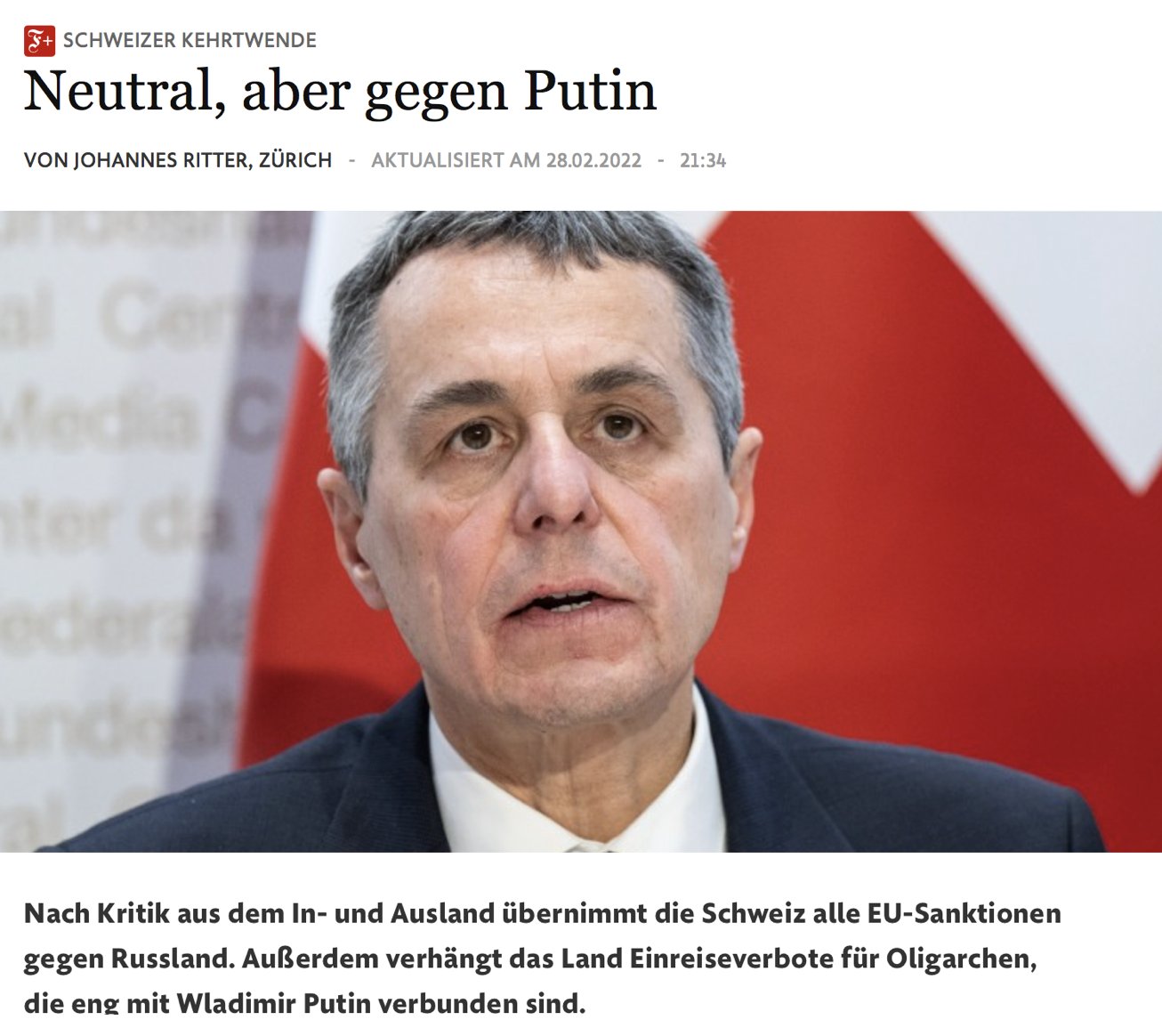
Anders geht man mit Russland um: Die Schweiz hat nach dem Angriff von Russland auf die Ukraine vom 24. Februar 2022, der auch ein Verstoss gegen das Völkerrecht war, nach nur vier Tagen am 28. Februar 2022 alle Wirtschaftssanktionen der EU gegenüber Russland übernommen und sich damit dem laufenden Wirtschaftskrieg gegen Russland angeschlossen, der bis heute andauert. „Neutral, aber gegen Putin“, lautete damals die FAZ Schlagzeile. Damit misst die Schweiz mit zweierlei Mass, was ich für unklug halte.
Ziel der Neutralitätsinitiative war es, den Wirtschaftskrieg gegen Russland zu beenden, weil die Schweiz nicht jedesmal Wirtschaftssanktionen verhängen kann, wenn ein Land das Völkerrecht bricht, wie die Beispiele USA und Israel zeigen. Die Initiative wollte mit einem neuen Verfassungsartikel eine "immerwährende und bewaffnete" Neutralität der Schweiz in der Verfassung verankern.
Die Schweizer Neutralität geht auf das Jahr 1516 zurück und ist seit 1848 in der Verfassung festgehalten. Sie besagt, dass die Schweiz keinem Militärbündnis beitritt und sich nicht an den Kriegen anderer Staaten beteiligt. Auch nach dem Nein an der Urne wird die Schweiz nicht der NATO oder der EU beitreten. Aber sie führt ihren Wirtschaftskrieg gegen Russland fort, was ich für falsch halte, weil damit die Neutralität verletzt wird. Der Tag wird kommen, wo sich die Schweiz bei Russland entschuldigen muss, weil man dem Druck aus den USA und der EU nicht widerstanden und die strikte Neutralität verteidigt hat.
Valormont retweeted

Neutrality dies, bank secrecy is dead, UBS moves abroad, borders are abolished, criminals with EU passports can immigrate freely, native language and culture disappear. Switzerland becomes just another random European country, a de facto EU and NATO member that lost his soul.
Valormont retweeted

I think that we, as people (for the most part), have biological limits that prevent us from fully grasping the exponential rise of technology.
Personally, I love technology. Unfortunately, I see that not only do many people around me not want to use it, but they also have regressive tendencies—even IT professionals who refuse to use AI, which could significantly help them.
How we'll be able to make a living in the future:
1. Until we have humanoid robots, we'll still be able to make a good living through physical labor in the physical world. But this could change quickly.
2. For a few years, we can make a living as prompt engineers. But in the future, there probably won't be any "humans in the loop" anymore.
3. We can also work as intermediaries in the physical world for AI agents (RentHuman AI). I expect this market for people working for AI agents in the physical world to grow dramatically.
In any case, a huge number of people won't be able to adapt and will demand a lifeline in the form of a universal basic income (UBI).
I certainly don't approve of UBI from an ethical standpoint, but I think governments will move in this direction. And CBDC is the way they'll push it through—do you want a government-provided universal basic income? We'll deliver it to you in the form of a digital euro (and it will be widely monitored).
Even though AI should be radically reducing public sector costs (for government employees), the exact opposite is happening—government costs are rising. In the case of UBI, they'll be orders of magnitude higher.
Governments will become even more aggressive than before (and we can already see this in the EU) to cover UBI for the masses of unemployable people:
1. Introducing an "exit tax," making it very costly to leave the system—a practice that is already standard in Western Europe.
2. Introducing taxation on undistributed profits (the Netherlands is the first to do so, and other countries will gradually follow suit).
3. Introducing a tax on crypto transactions (in the EU, the proposal is 0.1%; the state of Illinois has already implemented a 0.2% tax on every crypto transaction effective January 1, 2027).
4. Significant increases in property taxes.
5. Heavy taxation of anything in the physical world that "moves."
From this perspective, the best strategy to minimize government oppression will be to be an "invisible nomad living off crypto":
1. Since it will be difficult to make a living through any intellectual work in a few years, one must own "assets" (real estate, gold, stocks, Bitcoin/crypto), which are in limited supply and can be rented out, lent, etc.
From this perspective, Bitcoin/crypto, as an unregulated digital asset, will fare better than real estate, which is subject to the state's arbitrary power regarding property taxes and burdensome regulations.
2. Tax residency in a tax hell (which includes all EU countries) will turn you into a tax enslaved person who will spend an even greater portion of your productive life—more than ever before—working for the state and "supporting" a large segment of the population that will live off UBI.
Leaving due to an exit tax will be difficult, if not impossible.
3. Ownership of anonymous cryptocurrency will be desirable. If the government discovers that you own a large amount of Bitcoin, you will face taxes on your assets, unrealized gains, and so on.
4. There is a risk that you will be taxed worldwide based on citizenship (citizenship taxation, as is the case in the U.S.). Similarly, governments will link military service to citizenship (not to permanent residency), as many countries already have. It will be advisable to hold a second citizenship from a country that has not implemented these obligations (the Caribbean).
Governments will lay claim to everything in the physical world, to everything transparent in the virtual world, and enforce blanket taxation on their tax residents—and perhaps, over time, even on their citizens.
You need to be:
1. Invisible in the physical world.
2. Non-transparent in the virtual world.
3. Have a good tax residency (with zero or territorial tax residency).
4. And good citizenship (without any obligations).
You can prepare for this dystopian future.
I will read this synthesis again multiple times, and think about it, in the next months/years. Such a masterful reflexion.

First in English, then in German:
Fireworks in the Cellar
Why the Crans-Montana disaster is not a regulatory failure, but a cultural one
The global normalization of bottle service with sparklers in crowded basement clubs looks absurd only until one understands how well it works. Customers reward it massively. Venues compete on it. Social media amplifies it. Adults tolerate it.
What happened in Crans-Montana is therefore not an anomaly. It fits into a long and well-documented list of club fires around the world. The specific facts are still under investigation, but the pattern is old enough that we do not need to wait for every detail to reflect on what went wrong.
The pain of a parent at the thought that any of our children could have burned in what was effectively a man-made crematorium is unspeakable. Minors need protection and guidance. That part is not controversial. What is controversial, but necessary to say, is that empathy must not become suicidal again by dissolving responsibility and shifting blame until no one remains accountable.
My initial reaction to images of an insane party ritual under a burning ceiling, lacking even the most basic situational awareness, with teenagers glued to their phones instead of their surroundings, came from exactly this place. It pained me because it looked like another manifestation of what I consider the biggest hidden danger of our time: the creeping of high time-preference behavior and aesthetics into the minds of the young.
The bling bling of cheap champagne sold as overpriced bottle service is not just tasteless. It is a particularly grotesque symbol of popularized and normalized decadence, of tittytainment aesthetics imitating pseudo-elite status. There is no beauty here, only effect; no consequences or responsibility, only a hollow YOLO narcissism.
I initially assumed this was about Dom Perignon bottles sold for $1,000 each. That turned out to be wrong. What seems more likely is a $2,500 table price plus additional payments per bottle, probably cheap prosecco, wrapped in a choreographed bottle service show with dozens of sparklers. The exact brand does not matter. The economics do. A night that would normally generate $100 per customer suddenly generates $500. The spectacle alone multiplies revenue several times over.
This explains why the phenomenon is global. It is not rooted in tradition, youth culture, or rebellion in any meaningful sense. It is driven by incentives.
From an institutional perspective, what stands out is the apparent failure of fire-police oversight at the political level, not merely as a technical lapse but as a symptom of double standards. Such failures rarely occur in a vacuum. They often reflect a deeper entanglement of local politics with mass tourism and easy money, where enforcement becomes flexible for those who generate revenue and inconvenient rules are quietly relaxed. This dynamic is well known from neighbouring Austria, where tourism-driven interests have repeatedly shaped political priorities and dulled scrutiny. But focusing only on this political layer would still miss the broader cultural failure beneath it.
A common counterargument is that cheap, highly flammable foam may have been used. If this is confirmed, it would indeed constitute another clear case of criminal negligence. But even fire-retardant materials do not make dozens of fire fountains in a crowded basement space sensible. Anyone who thinks it is acceptable to use sparks and open flames as entertainment in a closed basement space filled with hundreds of intoxicated teenagers has already lost touch with reality. In such an environment, no further thoughtlessness is surprising, and any additional lapse can be catastrophic on its own.
Even the toughest fire codes are not the real reason Switzerland has historically been safe. The true source of safety was cultural. It was the ability to trust that most adults would not need a regulation to know that you do not light fireworks indoors, let alone in a cellar packed with hundreds of drunk teenagers under foam panels.
Call it the fire code of common sense.
Once that code erodes, no amount of regulation can replace it. If this kind of insanity spreads, policing does not scale. Inspectors would need to be everywhere, all the time. And even then, the logic of spectacle would simply mutate into something else, less understood and potentially even more dangerous.
We must be very clear about one thing. We cannot and must not blame our kids. Fourteen-year-olds wanting to have fun outside of parental control is normal and healthy. What is not normal is the environment into which this instinct is now dropped. Insanity lurks in digitally and institutionally magnified peer groups, in a distorted society and economy that rewards spectacle over sense. And this insanity is not only condoned by bar owners, but by politicians, bureaucrats, teachers, journalists, bankers, and academics who collectively signal that this is all normal.
Of course, entrepreneurs and corporations scale anti-civil, decadent behaviors and mindsets. But shifting all blame to the supplier is intellectually lazy, especially in an age of easy money and massive monetary distortions that reward spectacle, excess, and short-term gains. Their services, unlike those of bureaucrats, are voluntary. They are punished immediately when customers withdraw approval. In this case, customers did the opposite. They expected this spectacle and rewarded it. That matters.
Part of the problem is the growing price distortion caused by monetary debasement, especially the cost pressure it creates for entrepreneurs in consumption-facing sectors. Rising input costs, compressed margins, and volatile demand systematically reward shrinkflation, corner-cutting, and short-term fixes. In such an environment, prudence becomes a competitive disadvantage, while those willing to degrade quality, safety, or judgment gain breathing room. This does not excuse reckless behavior, but it helps explain why practices that would once have been unthinkable become normalized under sustained monetary pressure.
The deeper problem, however, is fiat distortion not just of prices, but of perception. A growing loss of realism misdirects entrepreneurship itself. When catering to obviously dangerous practices increases profits fivefold, incentives are fundamentally broken. Simply outlawing visible dangers will not fix that. It will push risk into darker corners, where it is even less understood and harder to manage.
By contrast, failing bureaucrats and politicians, who have lulled parents into a false sense of safety, rarely bear individual responsibility when they stop providing their assumed function. A bar owner who fails to entertain his customers loses his livelihood. Politicians who fail to provide security, or who even make their citizens less secure, can often expect the opposite: more power, more resources, more legitimacy, as the problems they create justify ever more intervention. These bar owners may, justly, end up behind proper bars. In politics, comparable negligence may lead not to punishment, but to promotion.
The owners of the bar were criminally negligent. But they did what “everyone else does” in this industry, meaning a practice that is widespread enough to feel normal, and what their customers expected and rewarded, even though there is a long line of club catastrophes with exactly the same pattern. That they were described by locals, according to media reports, as widely respected entrepreneurs is less exculpatory than it is a further troubling symptom of decadence.
The lesson for parents is uncomfortable but unavoidable. Even in Switzerland, you cannot blindly trust that your children, socialized largely in public educational institutions, will be mentally and physically safe. You cannot assume that what everyone does is sane. Sometimes, it is utter insanity.
This is not an attack on Gen Z. If anything, their lower alcohol consumption and increased self-criticism may be a rational counterreaction to a world in which older generations commercialized and normalized extreme short-termism. The deeper distortion sits higher up.
We should face an uncomfortable truth. The ability to blindly trust most unrelated adults to act responsibly, to watch out not only for themselves but also for others, was a historic exception. What is now returning across the West is the normality of low-trust settings, of everyone slipping back into a diffuse survival mode.
But this is not a return of genuine survival instincts, which once evolved in close contact with reality and provided real guidance. What we see instead are degraded hunches, detached from the environments that shaped them. In a world of fiat distortions, mediated spectacle, and institutional outsourcing of responsibility, these hunches no longer orient behavior. They produce panic without clarity, action without judgment, and flight without direction. This is precisely the psychological soil in which high time-preference behavior, spectacle culture, and collective insanity take root.
We must teach our children a different lesson. They are not helpless victims of evil bar owners. They are not safe because of laws and police alone. And it is not victim blaming to speak about responsibility, of parents and of the young themselves.
Young people should yearn to become adults, not remain the forever kids their fake role models perform for money, attention, and fame. Adulthood begins with realism. With situational awareness. With the ability to resist the pull of “everyone does it,” especially when everyone is clearly doing something insane.
True liberty does not grow out of protection from all risk. It grows out of the discipline of responsibility. Responsibility to reality. Responsibility to judgment. Responsibility to walking away when a situation feels wrong, even if it looks exciting, fashionable, or socially rewarded.
Switzerland is certainly not in danger of overly lax building regulations. Switzerland’s real danger is the slow but steady drift into cultural and societal decay, accompanied by increasing political irrationality, following its neighbouring countries downhill, even if with its characteristic and still valuable tardiness.
1
82
Exode des talents créatifs, qui quittent l'Union européenne.

Exodus
Almost every single successful entrepreneur, business-owner, crypto-trader, crypto-investor, long term btc hodler, based in the EU and that i know personally, and i know/have received quite a few, has already left the EU or is in the process of leaving or seriously considering it.
Some moved to the fringes of the EU with easier crypto-rules...like malta or portugal, but most are leaving, or have left for: Dubai, Singapore, Andorra, Switzerland, el Salvador, Panama, Paraguay, or another pro-crypto place or a place where you can be pro-crypto and do business without being taxed or regulated to death.
With all the new EU crypto-rules, heavy tax increases for defense spending, Mica-rules, exit-taxes in place or in the making in many EU states, and a general leftist/woke anti-business anti-crypto vibe, within a couple of years a lot of smart and rich people will have moved out of the EU. This is more pronounced in western europe, in the east (countries like Poland for example) people still value hard work and making money since they remember still quite well what it means to have nothing.
No surprise of course, mobile smart/creative/intelligent/wealthy people used to operating in a global world are really not going to wait until they are ostracized, registered, taxed to death, and running the risk of losing their business or the ability to convert their bitcoin to fiat.
If you can leave, do it sooner than later, that is the only advise i can give you since i expect more exit-taxes to come into force or even more taxes on bitcoin if it goes up even more. Or at least get your tax-residence and business set up outside of the EU.
I do not like this either, love the old continent, but situation is simply becoming unlivable in many places as a successful entrepreneur or crypto-person.
Now people will say ´you are exaggerating´.
I do not think so.
It is always smart and intelligent and creative people that move first or are early with things or ´on time´, same as with buying bitcoin early, not the rest of the ´normal´ herd that is always late.
So if more and more smart/rich/creative people are moving away...you should really pay attention.
1
2
79
Bienvenue dans le monde réel : Le Danemark augmente l'âge de retraite légale à 70 ans pour les personnes nées à partir de 1971. Les autres pays européens vont suivre.
#retraite #demographie #ponzi

Raising the retirement age to 70 is needed in order to be able to "afford proper welfare for future generations" which is politicianspeak for "the ponzi scheme would otherwise collapse."
edition.cnn.com/2025/05/23/b…

Valormont retweeted

C.S. Lewis writing about living in a world with nuclear bombs. Always relevant.

ALT If we are all going to be destroyed by an atomic bomb, let that bomb when it comes find us doing sensible and human things—praying, working, teaching, reading, listening to music, bathing the children, playing tennis, chatting to our friends over a pint and a game of darts—not huddled together like frightened sheep and thinking about bombs. They may break our bodies (a microbe can do that) but they need not dominate our minds.

Valormont retweeted

Chat, we're cooked. Gen Alpha is legit patching the English language with skibidi brainrot.
Séquence tout à fait instructive concernant le recrutement d'étrangers dans les forces canadiennes, simultané à l'interdiction d'armes à feu pour les nationaux. Le Canada semble préfigurer l'avenir des armées européennes. Merci @MaximeBernier.
#GuerreCivile #firearms

It’s hard to overstate how dystopian and threatening Canada has become. An update from longtime Canadian government official Maxime Bernier.
(0:00) Who Was Justin Trudeau Really Working For?
(7:53) The Invasion of Canada
(9:19) Pierre Poilievre Is a Fraud
(13:25) The Attempts to Destroy Christian Countries
(15:51) The Trade War Between Canada and the US
(20:03) The Canadian Government’s Ridiculous Climate Change Agenda
(21:59) China’s Control Over Canada
(28:50) The Corruption of Canadian Media
(32:00) The Growing People’s Party
(38:36) Is Trudeau Fidel Castro’s Son?
(39:33) The Death of Canada’s Healthcare System
(43:19) The Canadian Exodus
(44:07) Canada’s Mass Gun Control
(46:16) The DEI Initiatives in Canada
(49:45) Is Canada Headed Towards a Revolution?
(52:05) Who Is Mark Carney?
(55:33) Canada’s Gold Crisis
(1:03:17) What’s Happening to All of Canada’s Natural Resources?
(1:08:51) Is Canada Fixable?
Includes paid partnerships.
114
Extraordinaire texte d'Albert J. Nock, le travail d'Isaïe (Isaïah's job), traduit et lu par @Jacques_BTC, que je remercie au passage pour l'effort de transmission auprès du reste. 40 minutes bien investies dans votre vie. Bonne écoute.
@despotica
youtu.be/mj1RP0rUgJQ?t=128


Ha ha ha. Toute ressemblance avec l'Union Soviétique est totalement fortuite.

74% of Europeans say their country benefits from EU membership—the highest support recorded in 42 years.
With peace and security top of mind.
66% want a greater role for Europe in protecting them against global crisis & security risks.
We hear you. And we’re ready to deliver.
1
1
74