

Director of Economic Policy Studies and Senior Fellow at @AEI. Professor of Practice at @Georgetown. Contributing Columnist for the @FT.
Washington, D.C.
Joined July 2012
- Tweets7.9K
- Following553
- Followers25.3K
- Likes1.2K


Michael R. Strain retweeted

Thousands signed up for Econvitals! But some tried & failed. If you're one:
1. Try again, an overactive anti-bot filter was rejecting some, it's been fixed
2. Type correctly. (e.g., the @imf.orgp & @gmaol.com who tried)
3. Check spam for confirmation
econvitals.org/subscribe/


Michael R. Strain retweeted

The man whose show had for years functioned as a bullhorn for Republican leaders is now being portrayed by many of those same lawmakers as an unhinged has-been, exiled to Maine.
But does Trump’s loudest critic still have his finger on America’s pulse? ft.trib.al/DZhgQf4

Michael R. Strain retweeted

In Maine, it has never been this expensive to stay warm. For all the focus on the state's Senate race, many residents don't feel Washington understands the fear of going cold.
Come along to Aroostook County to see what "affordability" really looks like:
cnn.com/2026/10/24/economy/h…

Michael R. Strain retweeted
Recommended!


Michael R. Strain retweeted

If you think Midtown Manhattan in the afternoon is much, much sketchier than it used to be, you're right thebiggerapple.manhattan.ins…

Michael R. Strain retweeted

temporary pause in making America great again


Michael R. Strain retweeted

Treasury is right to try to protect national security. But we should watch for broad restrictions that could undermine our public health goals - impacting patient access to global innovation.
The new policy could curtail virtually any investment in Chinese biotech operations, including establishing labs, or entering into joint ventures, thwarting opportunities to bring Chinese innovation to American patients.
We need to focus equal attention on making our own process more efficient and competitive, especially Phase 1 trials and the IND stage. The discussion on this will be important. We must get this balance right and ensure Americans continue to benefit from the best global science.

IMO… it is a mistake to “try to increase U.S. competitiveness through protectionism.” The new rule “may make it easier for non-U.S. companies to succeed through manufacturing in China. This wouldn’t help our global competitiveness.”
IMO… let’s instead kick ass with American ingenuity!
biocentury.com/article/66129…

Michael R. Strain retweeted

When the end was near, St. Peter's Square was filled with hundreds of thousands of people from around the world who had come to pray with him and for him as Pope St. John Paul II lay dying. We remember him with gratitude. Pope St. John Paul II, pray for us! @thegnewsroom
Michael R. Strain retweeted

My column for @TheFP this week is about the resilience of American evangelicalism:
thefp.com/p/ross-douthat-our…


Michael R. Strain retweeted

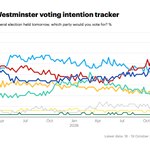
My latest column for @PostOpinions - when evaluating the close Senate polls, don’t just look at the lead; look at the level.
washingtonpost.com/opinions/…

Michael R. Strain retweeted

President Trump says the economy is great. Americans, overwhelmingly, disagree. With early voting underway in the midterms, what does the data show?
My answer, in three formats:
Story: nytimes.com/2026/10/18/busin…
Podcast: nytimes.com/2026/10/21/podca…
Video: nytimes.com/video/business/1…

Michael R. Strain retweeted

5% nominal growth in total premiums for employer sponsored health insurance is a bit lower than I would have guessed for 2026

Michael R. Strain retweeted

COMING OCTOBER 29: I'm launching a new economics podcast for the @CatoInstitute called The Economics of It.
Subscribe now to ensure you receive the first episode with @Kalshi CEO @mansourtarek_ direct to your feed.
Links to channels in next tweet.
Michael R. Strain retweeted

The administration’s efforts to reduce costs and combat fraud look promising.
Read The Washington Post’s editorial on Medicare Part D subsidies that cites the important work of AEI's @ben_ippolito and James Capretta.
washingtonpost.com/opinions/…

Michael R. Strain retweeted

Today: California billionaire wealth tax prop 40.
Throwback: One of the papers I most enjoyed writing some 15 years ago (with Farhi and later Sleet, Yeltekin) was on Wealth taxation, nonlinear in a political economy with no commitment.
Let me explain what we did. I am not trying to take political sides really or advocate one thing or another. Enough of that and it is good to think of the economic logic in a basic way. As you see, the paper is more subtle.
The paper modeled a situation where you (e.g., voters, on average) want to do a "one time" wealth tax and promise never to do it again. The incentive to do so is increasing in the amount of wealth inequality. You have nonlinear taxes on wealth and income, so you have rich tools. However, you can't bind future politics or policies. Every now and then you reevaluate (vote).
Sounds familiar? Indeed, various basics of the real world tradeoffs are present.
Obvious: this is a time-consistency problem that leads to a 3rd best (third world?) outcome (not your standard optimal tax one, where you assume you can commit). Well known and studied. At its most basic, the temptation is confiscation (slogans: robin hood, socialism), but the expectation of this happening in future is of course a problem (slogans: capitalism, property rights).
Less obvious: what it is the best you can do today if you with your tax tools, given the situation and constraints. AGAIN: you are not allowed to say "I promise never to tax again". ALSO NOTE: the options are also not necessarily just a choice between taxing wealth now or never doing so. (As the debate on this oversimplify.) Logically: taxing never may just not be feasible/credible. Equally important: you may come up with a different more intermediate plan. Let's see...
Indeed, the model spits out something subtle. You actually declare a more moderate but progressive nonlinear tax on wealth that will be in place permanently. It is progressive with rising marginal tax rates: indeed, you subsidize savings for the poor (!) but tax the rich. In fact, you want to promise this tax today for the future, even if inequality is zero today. Why?
The credibility problem depends on the amount of wealth inequality. That is what affects the incentive to renege on promises and tax away wealth. The solution tries to deal with this by creating an environment that will lower or keep inequality in check, to avoid a temptation to fall into the time inconsistency revision. A progressive tax goes in that direction both mechanically and in terms of saving incentives.
(BTW, the fact that the tax comes out progressive is very clean and surprising, given that the optimal tax literature rarely obtains such results.)
Insight: By keeping inequality in check, it makes policy more credible, avoiding falling into a much worse 3rd best.
At the time, we called it a "compassionate conservative" solution: even if you want zero taxes, you compromise and do some progressive taxation, to avoid more radical taxes later. Metaphorically, the best way to deal with a tide is not by ignoring it, denying it or swimming frantically, you may have to float with it, adapt and swim moderately finding the right moves.
Links: (older ungated): crei.cat/wp-content/uploads/…
published: academic.oup.com/restud/arti…
Footnote: We titled it capital taxation, but in reality it is more exactly about wealth taxation, e.g. it holds even in a world without capital, where people hold assets against each other etc.

Michael R. Strain retweeted

Great news from the Vatican!

Pope Leo XIV’s doctors have confirmed that the tumor removed on October 13 was a lung adenocarcinoma and that the disease was localized.
Dr. Luigi Carbone and Professor Stefano Margaritora said on Wednesday evening that a subsequent oncological assessment has confirmed that “no further treatment is necessary.”
