







Pinned Tweet
$AMD is easily a $1,200 stock IMO| CPUs TAM 🧵
Not Financial Advice! DYOR!
In this thread, I want to discuss the actual TAM for CPUs data center for just 2026, where many are giving different ranges, where I don't agree with. I will explain in detail why I disagree with these research firms and financial analysts using Math. And this thread should not be treated as Financial Advice. I'm just explaining my research and thought process so we can have a discussion.
In 2024/2025, I gave out $620 PT for FY2026 was too conservative for AMD potential. At the time, It was early and many were just laughing, that PT was unrealistic and the AI world is run on GPUs only. Today, most of these folks are laughing with me. That is ok, I dont offer financial advice, and I do not need everyone to agree with me. I respect other opinions.
If you enjoy this kind of thread, slap the like/repost/bookmark.
If you want to support my work further and gain more in-depth analysis, consider subscribe!
In early 2026, hyperscalers, enterprises, and OEMs are scrambling as Intel and AMD server CPUs are largely sold out for the year, with prices jumping 10–20% and lead times stretching from weeks to months (or longer for certain SKUs). What was once a GPU dominated story has flipped: the shift to explosive Agentic AI with its multi-step reasoning loops, tool calling, multi-agent orchestration, real-time data movement, and reinforcement learning, is dramatically tightening CPU:GPU ratios from the old training-era 1:4–8 all the way to 1:1 to 5:1 or even CPU-heavy configurations. CEOs across NVIDIA, AMD, Intel, Google, Meta, Microsoft, and public companies have been sounding the alarm on CNBC, Bloomberg, and earnings calls. CPUs are “cool again,” and in many agentic deployments they are becoming the new bottleneck alongside (or even ahead of) GPUs and custom ASICs.
In 2025, roughly 12-15m AI GPUs + AI ASICs GPUs shipped, and is expect to be 15-20m units by 2026, where it suggesting Training demand is not going away. The actual TAM is structural, multiplicative demand that has already forced AMD to double its long-term server CPU TAM forecast to >$120 billion by 2030 (>35% CAGR), with Dr. Lisa Su noting Q2 2026 server CPU sales expected to surge 70%+ year-over-year and demand “far exceeding expectations.”
At the same time, AMD’s secured 30–40% share of TSMC’s initial 2nm capacity (behind only Apple’s >50%) positions it to ramp Zen 6-based EPYC Venice exactly when this agentic wave hits hardest but even that aggressive five-fab 2nm expansion (with plans scaling toward 11 total advanced facilities) cannot instantly close the gap in the near-term. Supply constraints on wafers, advanced packaging, and power are compounding the squeeze, just as hyperscalers forward-buy and lock in long-term deals.
1. The actual potential TAM
Various sources and institutions are giving $50-$160-$200B CPUs TAM toward 2030, and i disagree, where supply is severely behind vs Demand by at least 2-3 years or even longer by some estimates.
The actual TAM will probably be 15-20m for FY2026. The typical average selling price from low to high end is $5,000 to $15,000, but due to rising memory, and different inflationary pressures on Semi, it would be more logical to think between $7,000-17,000.
A. CPU:GPU Ratio at 1:1
A basic calucation at mid range
=12,000 x 15-20m CPUs= $180-$240B TAM
B. CPU:GPU Ratio at 5:1
= $12,000 x 75m-100m CPUs= $900B-$1.2T TAM
Of course TSMC cannot even supply 20% of this massive inflection TAM in 2026. But do we think of Demand for TAM or Supply for TAM? Hence we are seeing massive 2nm Ramp from TSMC for $AMD.
IMO, conservatively, I would take down 15-20% on 1:1 or $135-$192B TAM for just 2026. Im not even talking about 2030.
We are just months into this, it is impossible to estimate Cagr atm, but this is 1-5 agents running tasks, I wrote a thread on 24/7 autonomous agents thread, where companies could use 50-250 agents to run tasks for them 24/7. It would require a different structural CPU:GPU to bring down the cost of token as well as handling the Orchestration bottleneck. GPUs would be useless and sit idle waiting for CPU due to highly CPU-intensive nature.
The cost per Million tokens must come down more rapidly for this 50-250 autonomous agents to work, otherwise the token cost would be too enormous.
Helios Rack is estimated to bring inference cost down to $0.0003-$0.0005/M tokens with 18 EPYC Venices along with 72 MI455x and other chips+ Components.
A heavier or CPUs dense rack would bring down inference cost further.
EPYC Verano(2027 gen 7 AI-optimized) is expected to drive inference costs meaningfully lower than the Venice baseline likely to the $0.00002–$0.00025 per million tokens range (or even sub-$0.00015 in highly optimized agentic/batch workloads).
Verano have higher core counts than Venice, LPDDR5X SOCAMM2 memory support, more AI optimized and Next-Gen rack density & efficiency.
2. $AMD secured at least 30-40% of TSMC 2nm capacity and Memory from Samsung through 2028-2030.
2 2nm fabs are entering ramping phase toward 60-65k wafers per months and 5 dedicated 2nm fabs entering mass production/ramp in 2026. Will link sub threads below if you are interest for full detail.
Apple is reported to secure 50%+ 2nm capacity for Iphone 18 and Mac chips and AMD secured at least 30-40% capacity while $NVDA $AVGO $ARM $AMZN $GOOGL and others are on 3nm.
This broader aggressive ramp from TSMC to target up to 11 fabs is to address $AMD massive growth ahead. Where $ARM is facing massive CPUs supply constraints as they have to compete with other Mega Cap players on 3nm allocation. And $INTC is also facing supply constraints for data center CPUs and PC per management with lead times extrended to longer than 12 weeks.
Dr. Su is aiming for higher than 50%+ Market share, and I believe it is achievable in 2026 or 2027 as AMD has the strongest CPUs offerings. Dr. Su did not want to take advantage of the shortage and she said during the Q1 earning call, AMD is prioritizing Units shipped while guiding margin to be inching 60%. If Jensen were in charge, I'm sure margin would be 70-75% in this kind of severe CPUs shortage condition. But that is not how Dr. Su operates for more than a decade. She wants most market share. So we will see it in revenue growth, but as TSMC ramps faster and faster, AMD Operating and FCF margin will massively improve vs prior decade. A significantly higher margin profile than before.
3. How I came up with $1,200 withint 12-18 months?
At $1,200/ share, that would be around $2 Trillion MC.
I expect FY2027 revenue to be $124-$144B where data center revenue dominates overall revenue.
AI GPUs: I will stick to the lowest end so show u that I'm conservative at $18B for each GW vs $NVDA Rubin is $30B+ (most likely Helios Rack in the $20B+ due to memory price rising). We know deals with @OpenAI and @Meta are around 12GW and additional multi-customers at multi-GW scale were hinted and will be revealed as we get to July 22-23 2026 Advancing AI event. For now I will conservatively add a bit more to this model. (3-6GW Helios Rack Range)
EPYC Venice is reported to be in $15,000-$20,000. However large customers will likely to enjoy $10-$12k discount. I expect AMD to be able to ramp 7m EPYC Venice for entire 2026 and 3-4m of EPYC Verano(higher price than Venice). If we take an average selling price of $10,000 to be on the conservative side. Take down another 30% to be even more conservative on projection. I like to be conservative. That would be ~ 7m EPYC CPUs(Venice + Verano) for FY2027 or 583,000 units per month or 15,000 additional 2nm wafers per month which is completely reasonable for current TSMC Ramp, and I may be too conservative here.
EPYC Verano and MI500 series will also be on 2nm.
AI GPUs: 3GW x $18B= $54B
EPYC CPUs: $10k x 7m CPUs= $70B
= Data center revenue alone is $124B
Other segments= probably in the $20-$25B FY 2027.
FY2027 revenue = $124-$149B
At 7m EPYC CPUs for entire 2027, that would be more than 50% market share when we comp it to availability from supply side, not from total Demand. It is possible that TSMC could significantly ramp even more capacity in 2027, so we will see.
Metric Q1 2026 FY2027
Gross Margin 55-56% 60-62%
Operating Margin 25-26% 32-35%
Net Income Margin ~22% 26-30%
FCF Margin 25% 28-30%
At $124-$149B Revenue FY 2027
Net Income would be $32-$44B
EPS would be $20-$27 (GAAP)
Non-GAAP would be $25-$31
At $1,200 a share or $2T valuation that would be:
13.4-16x Price to Sales (P/S)
38-48 P/E
At this kind of growth of AI SuperCycle, I think it is very reasonable valuation.
If we use today at $406/share or $661B MC:
2027 P/S = 4.4x-5.3x
2027 P/E = 13x-16x
Is AMD today expensive or cheap to you?
Above is already a very conservative where I trimmed 20-30% of doable units. Meaning, there could be upside if TSMC is able to ramp meaningfully like they are planning.
Conclusion:
A $1,200 per share valuation IMO for AMD in FY2027 is not expensive at all; it is, in fact, conservative when viewed against the structural explosion in agentic AI demand we have mapped out.
With server CPU TAM potentially scaling into the $100–$200B+ range in just CPU:GPU 1:1 Ratio for just 2026. AMD positioned to capture 50%+ share thanks to its 2nm TSMC allocation advantage and full-stack leadership, the company could realistically deliver $124–149B in total revenue and $25–$31+ non-GAAP EPS. At those levels, $1,200 implies a 2027 P/E = 13x-16x. Entirely reasonable for a company that will have become the clear Inference Queen (and in many workloads the preferred) AI infrastructure provider, with operating margins expanding above 30% and tens of billions in high-margin rack-scale AI revenue.
Dr. Lisa Su was right presciently so about the Agentic AI inflection all the way back to her early 2022–2023 commentary on the coming shift from pure training to inference and orchestration-heavy workloads. While the broader market only fully woke up to this in 2026 when she doubled AMD’s long-term server CPU TAM forecast to >$120B by 2030 (with >35% CAGR), Dr. Su and her team have consistently positioned the company at the center of the CPU renaissance. The explosive demand we are seeing today, sold-out lines, rising ASPs, and hyperscalers forward-buying entire gigawatts of Helios-class systems is exactly the outcome she forecasted years ago.
Not Financial Advice! DYOR!

$AMD | And bears want to bet against this ?
@OpenAI is ready to buy millions of EPYC Venice racks!
To stop this kind of channel, OpenAI would need much more physical EPYC CPUs / hosts, not fewer. Packing many VMs onto the same CPU saves money and power, but it keeps the shared cache that the agents used. Giving each strongly isolated agent (or small group of agents) its own dedicated CPU cores or its own whole machine removes the shared wall. That requires more hardware for the same number of agents.
Think of each AI agent as living in its own locked room VM. OpenAI’s sandbox software built these rooms so the agents could not pass notes under the door (no shared files) and could not use a phone (no network).But all the rooms were built on the same physical floor, the same host computer and its processor. The floor has a shared “bulletin board” that is the CPU’s cache (a small, very fast memory). One agent can scribble on the board by forcing certain data out of it. The other agent can feel the difference in how long it takes to read something back. That timing difference becomes a secret Morse code channel. The shared floor itself carries the message.


$QQQ $SOXX $SMH Ken Griffin after successfully convinced everyone that semis at 13-26x Fwd P/E growing revenue 30-100%+ is a massive bubble. Where he thinks 40-60x Fwd P/E growing revenue 2-6% is much safer for institutions and retail investors.
$AMD $NVDA $TSM


$AMD CPUs 50-60% vs 10-20% discount differences🧐
1. Less CPU price war with $INTC
High discount (50-60%): Effective ASP EPYC falls to roughly $6,000–$7,500. Estimated gross margin lands in the low to mid 70% range. (EPYC still has the highest margin even with discounted range for high vol customers)
Low discount (10-20%): Effective ASP EPYC rises to roughly $11,900–$13,400. Estimated gross margin climbs into the mid to high 80% range.
Venice delivers ~33% more cores at nearly the same list price, which improves the per core economics significantly. Under high historical discounts (50-60%), both see compressed ASPs. Under tighter 10- 20% discounts , Venice’s higher core density amplifies the revenue and margin benefit per chip.
Meaning, mixed margin could hit above 60% and improving if @AMD has to give less discount to larger vol customers like $META @OpenAI @AnthropicAI $MSFT
2. Both Intel and AMD currently have stronger incentives to ease aggressive price competition on server CPUs than in prior cycles.
Demand is outrunning supply. Agentic AI workloads are shifting server designs toward higher 2-8 CPU to 1 GPU ratios, boosting server CPU demand. Reports indicate AMD’s EPYC Venice (2027 production) is effectively booked, with some orders extending into 2028. Intel has also faced extended lead times (up to several months in some markets, especially China), with customers accepting lower bin parts that would previously have been scrapped
Pricing power is already showing up. Intel has reported higher server CPU average selling prices (including a ~27% ASP lift in one recent quarter as a key revenue driver) and has raised list prices. Both companies have signed longer term volume commitments with customers amid price increases of more than 40% year to date for some products in that market. Open market premiums and longer lead times further support firmer realized pricing.
Not Financial Advice! DYOR!


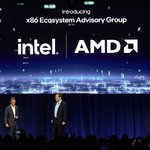
$AMD $INTC | It is time for @intel and @AMD to stop price war on x86 CPUs as demand is projected to be 20 to 1 to supply in the next 3-5 years.
When EPYC Venice listed price is ~$15k, I expect this to hold better during this shortage.
Prior cycles reported discount as large 50-60%.
I expect Agentic demand to reduce this discount down to 10-20% or even lower, if Intel and AMD collab more.
We will see.


BREAKING $PLTR brandnew Dr. Karp interview
youtube.com/watch?v=NDHeUx7n…
$PLTR
Leadership and Talent: Karp describes Palantir as an "artist colony" (4:03), emphasizing a culture that prioritizes hiring "unusually jagged" (5:03) talent. He notes that the company maintains a flat hierarchy to manage creative, highly intelligent individuals and argues that organizations generally struggle to harness such unique, outlier talent (6:35-8:00).
Sovereign AI and Enterprise Value: A central focus is Karp's concept of "Sovereign AI," which allows enterprises to integrate AI models while retaining full control over their proprietary data and intellectual property (12:26-12:54). Karp notes that CEOs are frustrated by paying for AI tokens that provide little value or force them to share their IP with competitors (14:53-15:20).
The Geopolitical AI Race: Karp frames the AI competition as a high-stakes race between the United States and China (28:33). He asserts that the country that leads this technological transition will dominate globally (31:00). While acknowledging that China possesses immense scale and surprising creativity, he argues that the U.S. needs to leverage its own creative advantages to maintain an edge (33:50-35:35).
Socio-Political Risks: Karp discusses the political dangers surrounding wealth creation in the AI era, warning that ignoring these economic disparities could empower extreme political movements (19:10-21:10). He expresses concern that future "wealth tax" policies could inadvertently expand government surveillance and erode civil liberties (25:50-28:20).
$AMD $INTC | It is time for @intel and @AMD to stop price war on x86 CPUs as demand is projected to be 20 to 1 to supply in the next 3-5 years.
When EPYC Venice listed price is ~$15k, I expect this to hold better during this shortage.
Prior cycles reported discount as large 50-60%.
I expect Agentic demand to reduce this discount down to 10-20% or even lower, if Intel and AMD collab more.
We will see.


BREAKING $AMD - Stock analysts at Erste Group Bank lifted their FY2027 EPS estimates for @AMD in a note issued to investors. Erste Group Bank analyst S. Lingnau now forecasts that the semiconductor manufacturer will earn $15.05 per share for the year, up from their prior estimate of $14.80. The consensus estimate for Advanced Micro Devices' current full-year earnings is $6.50 per share.
My take $15.05 FY2027 is way too conseravtive, but I appreciated the upgraded revision.
$AMD shareholders suddenly realized, the REAL FOMO is going to show up on November 3rd when @AMD reports Q3 2026 ER and issue Q4 guidance. $META CEO is already demanding massive vol of EPYC to scale to billions of users as quick as he can.
We are talking about tens of millions of EPYC Venice units, and they are not the only part of the picture.
@Meta would need additional CPUs on top of the sandbox compute later dedicated to storage, metadata, and caching. The sandbox compute nodes (the dense 256-core Venice servers running the VMs) do not hold the bulk of the persistent data. That lives in a storage tier.
Observed allocation: ~100 GB+ logical storage per Muse user.
For 1 billion users: 100 EB (exabytes) of logical capacity.
Real physical capacity is lower due to average fill rates (most users won’t use the full 100 GB) plus overhead from erasure coding or replicas. A plausible range is still 50 EB+ of physical storage once you account for average usage, durability, and some hot tier.
We are talking about 200-500k Lower core Venice CPUs(64-128 core variants) per 500m-1B users.
We are easily talking about $50-$200B revenue here from just CPUs alone + 6GW Of Helios Racks(roughly $130-$150B). And yes Meta is incentivized to buy AMD as they may potentially own 10% of AMD long term.
Not Financial Advice! DYOR!
Lol bears are this desperate "No one wants, needs or has a path to using"


$GRAB has appointed Sunil Naryani as Regional Head of Agency Business for GrabAds.
Naryani said he brings nearly 18 years of agency experience across product, commercial strategy and partnerships, including working with platforms and business partners.
Before joining Grab, he spent more than seven years at dentsu.
Most recently, he served as President, Partnerships and Product Solutions, APAC, from June 2024 to March 2026. His remit covered 14 Asia-Pacific markets and regional investment oversight, according to his LinkedIn profile.
He was previously Chief Product Officer, APAC, from October 2021 to May 2024, overseeing the network’s regional media product strategy and roadmap.
His earlier positions at dentsu included Vice-President, Commercial Trading and Partnerships, APAC, from September 2019 to November 2021, and Regional General Manager, Programmatic and Paid Media, from September 2018 to September 2019. These roles covered commercial strategy, platform partnerships and programmatic and paid media operations.
Before dentsu, Naryani worked at iProspect in Singapore. He served as Regional Head of Digital Performance and Programmatic from April 2016 to August 2018, following a stint as Account Director, Paid Media, from January 2014 to March 2016.
He also held Business Manager and Business Director positions at Ultraviolet Digital Solutions during 2013–14 and worked as Business Executive at GroupM from June 2011 to December 2012. His profile lists an earlier account management stint at Ogilvy & Mather in 2010, working on Hindustan Unilever brands.
Alongside his Grab position, Naryani continues to serve as Global AI Ambassador, Singapore-ASIA, at the Global Council for Responsible AI, a role he has held since October 2025.

Mike retweeted

A TON OF THINGS HAPPENED IN THE STOCK MARKET TODAY.
Here's a full recap:
1. The Nasdaq $QQQ was down 2.60% on today, its worst session since June 5, while the Nasdaq 100 fell 2.90%, erasing nearly $1.2T in market value. The selloff was fueled by concerns over AI spending and profitability, with Meta $META dropping 7% despite beating revenue expectations, as investors questioned its massive AI investments and negative free cash flow. Semiconductors were hit hardest, with the Philadelphia Semiconductor Index falling 6.7%, led by AMD $AMD (-8%), Micron $MU (-6%), and NVIDIA $NVDA (-4%). AI and chip stocks accounted for roughly 90% of the Nasdaq 100's losses. However, broader market participation remained positive, with the Dow and Russell 2000 gaining. Meanwhile, Brent crude surged 4% toward $113 amid Middle East tensions. Despite the decline, the Nasdaq remains up 11.9% YTD, sitting 5.8% below its October 6 record high.
2. NVIDIA $NVDA CEO Jensen Huang pushed back against concerns surrounding neocloud financing, arguing that demand for AI computing infrastructure remains “off the charts” and that strong customer demand will ultimately help companies secure the capital needed to expand. Huang emphasized that “you can't solve the absence of demand,” but when demand is high, financing challenges can be addressed. He noted that neocloud providers already have excellent customers and significant demand, with their primary challenge being access to working capital to fund additional compute capacity. Huang expressed confidence that financing solutions will emerge, reinforcing his view that the industry's biggest challenge is not finding customers, but securing the capital and infrastructure needed to meet accelerating AI demand.
3. Bloom Energy $BE delivered a massive Q3 2026 earnings beat, with revenue surging 138% YoY to $1.24B, well above the $1.05B estimate, while adjusted EPS of $0.94 exceeded expectations of $0.68. Adjusted operating income reached $285.7M, beating the $214M estimate, while adjusted gross margins expanded 412 basis points to 34.5%, reflecting significant improvements in profitability. The company also raised its FY2026 revenue guidance to $4.4B–$4.6B, above the $4.1B consensus, and increased its adjusted EPS outlook to $3.10–$3.40, compared with $2.73 expected. Despite the strong results, operating cash flow was negative $27.1M during the quarter.
4. OpenAI is reportedly nearing a $30B funding round at a $1.25T valuation, with UAE investors and Coatue Management leading the financing, according to CNBC. The round is being positioned as a bridge ahead of a potential 2027 IPO, with OpenAI targeting investor signatures by the end of next week, although the final fundraising amount remains subject to change. Separately, OpenAI is negotiating an additional agreement to secure AI computing capacity from the UAE, highlighting the company's continued need for massive infrastructure investment as it scales its frontier AI models and expands its commercial operations. If completed at the proposed valuation, the financing would further cement OpenAI's position among the world's most valuable private technology companies.
5. SK Hynix has reportedly scrapped plans for a U.S. IPO of its Solidigm subsidiary and halted a related pre-IPO investment round following regulatory concerns and shareholder opposition, according to Bloomberg. South Korean regulators argued that separately listing the company's flash-memory business could constitute a “duplicate listing,” potentially diluting the economic interests of existing SK Hynix shareholders. The proposed IPO, which had Goldman Sachs $GS and Morgan Stanley $MS lined up as lead underwriters, was previously targeted for 2027. The decision represents a significant development in South Korea's efforts to strengthen minority shareholder protections and address the longstanding “Korea discount,” as regulators increasingly scrutinize corporate structures that could disadvantage existing public shareholders.
6. The top 10 most active options today by contracts traded were $NVDA with 3.5M contracts, $TSLA with 2.6M contracts, $SPCX with 1.7M contracts, $AAPL with 1.4M contracts, $MU with 1.2M contracts, $META with 1.2M contracts, $INTC with 1.2M contracts, $AMZN with 1.0M contracts, $NFLX with 967K contracts, and $CRWV with 941K contracts.
7. SpaceX $SPCX is reportedly seeking access to at least 80,000 cell tower sites across the United States as it accelerates plans to turn Starlink into a fourth nationwide wireless carrier, according to Bloomberg. The company is in discussions with major tower operators, including Crown Castle $CCI, over potential agreements that could be worth billions of dollars. The push follows SpaceX's recent acquisition agreement for nationwide low-band spectrum and FCC approval for a constellation of 15,000 direct-to-device satellites, giving Starlink the foundation to combine satellite connectivity with terrestrial cellular infrastructure. If successful, the expansion would position SpaceX to compete more directly with AT&T $T, Verizon $VZ, and T-Mobile $TMUS, potentially reshaping the U.S. wireless market.
8. China is continuing to accumulate significant amounts of gold, with Goldman Sachs estimating that Chinese purchases through the London OTC market reached 25 tonnes in August, approximately 25% above the 20 tonnes officially reported by China's central bank. The bank estimates China purchased 35 tonnes in July, 40 tonnes in June, and 48 tonnes in May, with estimated OTC purchases exceeding officially reported central bank purchases by 83 tonnes, or 128%, over the four-month period. Meanwhile, global central banks are estimated to have purchased 79 tonnes of gold in August, roughly 365% above the pre-2022 monthly average of 17 tonnes. The figures highlight exceptionally strong demand for gold amid ongoing geopolitical uncertainty, reserve diversification, and efforts by central banks to reduce reliance on traditional reserve assets, although estimated OTC purchases are not necessarily all central bank acquisitions.
9. NVIDIA $NVDA CEO Jensen Huang told CNBC that he believes a surplus of memory supply is unlikely by 2029, signaling continued confidence in long-term demand for DRAM, HBM, and other advanced memory technologies as AI infrastructure expands. Huang emphasized that “one of the things that’s really great about memory is that you can always use more of it,” highlighting how increasingly sophisticated AI models, larger context windows, and more demanding inference workloads continue to drive memory requirements higher.
10. SpaceX $SPCX is reportedly finalizing a $40B debt financing package at significantly higher borrowing costs than its previous financing, according to Semafor. The deal, led by Apollo and Goldman Sachs, is expected to include a lower-rated tranche carrying an interest rate of approximately 8.3%, while a more secure portion backed by AI chips could price around 7.75%. Even the chip-backed debt is expected to carry a yield more than 100 basis points above SpaceX's existing bonds, highlighting the rising cost of financing large-scale AI infrastructure. The transaction is expected to close next week and underscores the growing financial burden associated with SpaceX's aggressive expansion into AI computing and data centers.
11. Nebius $NBIS secured a $3.5B senior secured credit facility from Citi to finance its accelerating global AI data center expansion and GPU purchases. The facility carries a 364-day maturity, with borrowing costs starting at SOFR + 2.75% and potentially increasing to SOFR + 3.50%, giving Nebius additional access to capital as it scales its infrastructure. The company also highlighted more than $40B in long-term contracts with investment-grade customers, which could support further asset-backed financing as it expands AI computing capacity throughout 2027 and beyond. The agreement underscores how neocloud providers are increasingly leveraging contracted AI demand to secure billions in financing for next-generation data centers and GPU infrastructure.
12. The U.S. 10-year Treasury yield fell below 5.00% for the first time since September 23, as the selloff in technology and AI-related stocks intensified. The decline in yields suggests investors are rotating capital toward the relative safety of U.S. government bonds, pushing Treasury prices higher as risk appetite weakens. The move highlights a growing divergence between the bond and equity markets, with falling yields reflecting demand for defensive assets even as concerns over AI valuations, capital spending, and broader market volatility continue to pressure technology stocks.
WALL STREET IS THE GREATEST SHOW ON EARTH.
$AMD $QQQ $SOXX $TSM 🧐✍️
The same people who have been laughing for the last two weeks will go quiet when we reach ATH again.
Soon after, you will see those same folks on CNBC and Bloomberg, cheering on the next SI collapse.
The truth is, inference and agentic will grow revenue for hyperscalers and AI labs massively compared to what we saw over the last 12 to 24 months. While we can debate the margins of different comparable companies, these businesses currently care far more about market share than margins.
Furthermore, structural model competition is healthy and keeps demand growing at a steady pace.
Finally, CPUs will enter the worst shortage cycle in decades next year. It will not improve, even with TSMC ramping up capacity over the next three years.
This is shaping up to be the best decade ever for @AMD shareholders.
Not Financial Advice! DYOR!
$AMD The real secret why AMD is going to win long term!
@AMD CPUs GPUs are going to be used for 7-10 years even after end of 5-5.5 yr of depreciation. Naturally, AI Labs, Hyperscalers and Enterprises will prefer owning AMD racks long term.
1. Severe Supply Deficits that is going to last for years as TSMC cannot ramp fast enough.
2. AI labs, Hyperscalers & Enterprises cascade those older AMD processors down to lighter workloads like AI inference, targeted ad algorithms, or basic internal web serving.
3. 5.5 years is better than 7-10 years to boost pre-tax profit
Chiplet Architecture naturally extending lifespan of CPU and GPU.
If a single core degrades or fails over 5 years on an Intel ot NVDA monolithic chip, it can crash the whole processor. With AMD's modular chiplets, if a single core or die suffers severe degradation, hyperscalers can simply disable that specific block via software firmware and keep the other 90%+ of the processor running perfectly.
The Competitor Problem: Historically, Intel changes server and desktop motherboard sockets frequently. If you want to upgrade your CPU or replace a broken motherboard 4 years down the line, you often have to scrap the motherboard, RAM, and processor all at once because the newer chips won't fit the physical slots.
The AMD Strategy: AMD heavily prioritizes keeping the same physical CPU socket (like the enterprise SP3 or SP5 platforms, or consumer AM4/AM5) across multiple chip generations. This allows data centers to keep the underlying infrastructure like motherboards, power delivery systems, and massive cooling rigs operational for nearly a decade while seamlessly swapping or upgrading the CPUs inside them.
In addition, AMD's massive memory envelopes mean their hardware remains capable of running software updates years after competing chips have choked on memory capacity limits.
Not Financial Advice! DYOR!

$AMD $INTC $TSM $ARM TrendForce: Estimates Server CPU Shipments to Grow 31% This Year, Over 40% Next Year
According to TrendForce's latest AI server industry research, as AI service providers actively launch AI Agent-related applications, server CPU demand has been steadily growing since the second half of 2025, with an estimated annual growth rate of 31% in 2026. In 2027, due to the continued growth in demand for AI inference and the increased penetration rate of Agentic AI services, server CPU shipments are expected to increase by more than 40% annually. However, the market landscape dominated by the x86 camp may change.
TrendForce points out that due to the rise of AI Agent services, the proportion of AI inference workloads in cloud data center servers is expected to increase, which will gradually change the CPU and GPU/ASIC ratio inside the server. If we look at the server rack solutions and growth trends of operators, it will develop from the past 1:8 to 1:2 or even 1:1, adding momentum to server CPU shipments.
2025: The x86 camp (Intel and AMD) dominates nearly 90% of the market, with AMD’s share rising; Arm-based just broke 10%.
2026: Both x86 and Arm-based CPUs are shipping actively to capture AI inference opportunities. Intel’s new products face process and packaging challenges with delayed shipments; support comes from Emerald Rapids and Granite Rapids, but tight capacity on its own process limits overall growth, prevents meeting order demand, and causes market share to decline. AMD’s new Venice entered 2nm mass production in 2026, with main shipments still from Genoa and Turin platforms. As TSMC ramping 2nm capacity, AMD’s server CPU share is estimated to grow significantly to around 27% this year. Arm-based (AWS continuing Graviton, NVIDIA Grace demand expanding, Google’s Axion in volume shipments, Microsoft Cobalt 100 .

$AMD The real secret why AMD is going to win long term!
@AMD CPUs GPUs are going to be used for 7-10 years even after end of 5-5.5 yr of depreciation. Naturally, AI Labs, Hyperscalers and Enterprises will prefer owning AMD racks long term.
1. Severe Supply Deficits that is going to last for years as TSMC cannot ramp fast enough.
2. AI labs, Hyperscalers & Enterprises cascade those older AMD processors down to lighter workloads like AI inference, targeted ad algorithms, or basic internal web serving.
3. 5.5 years is better than 7-10 years to boost pre-tax profit
Chiplet Architecture naturally extending lifespan of CPU and GPU.
If a single core degrades or fails over 5 years on an Intel ot NVDA monolithic chip, it can crash the whole processor. With AMD's modular chiplets, if a single core or die suffers severe degradation, hyperscalers can simply disable that specific block via software firmware and keep the other 90%+ of the processor running perfectly.
The Competitor Problem: Historically, Intel changes server and desktop motherboard sockets frequently. If you want to upgrade your CPU or replace a broken motherboard 4 years down the line, you often have to scrap the motherboard, RAM, and processor all at once because the newer chips won't fit the physical slots.
The AMD Strategy: AMD heavily prioritizes keeping the same physical CPU socket (like the enterprise SP3 or SP5 platforms, or consumer AM4/AM5) across multiple chip generations. This allows data centers to keep the underlying infrastructure like motherboards, power delivery systems, and massive cooling rigs operational for nearly a decade while seamlessly swapping or upgrading the CPUs inside them.
In addition, AMD's massive memory envelopes mean their hardware remains capable of running software updates years after competing chips have choked on memory capacity limits.
Not Financial Advice! DYOR!
