

Cardio/CC friendly nephrologist. In love with POCUS, cardiorenal & critical care medicine. Tweets reflect my own personal opinion
Kansas, USA
Joined February 2012
- Tweets3.2K
- Following500
- Followers1.8K
- Likes6K





Pinned Tweet
#_POCUS
Few tips for learning POCUS for beginners like myself
1- it is very steep learning curve & long journey.
2- pick up one source & keep watching it over & over again. Youtube has lot of them
3- POCUS has 3 parts: image acquisition, interpretation & clinical integration

What is your take on this device:
I have recently POCUSed pt with hypotension(78/45). Already had 2 L NS. On my POCUS exam: hyperdynamic LV with LVOT VTI 22 , ROVT VTI 18 , no WMA, IVC collapsible, Lung A-Lines. RN came with this device & said he is not fluid responsive


There is really amazing, in-depth review and analysis here, as usual, with Dr. Farkas 🙏

yes everyone should be asking this question
the fact that people fixate in WBC and not neutrophil to lymphocyte ratio indicates a misunderstanding of evidence based medicine
if you want to demean the NLR that's fine, but the only logically coherent position in that case is to pay no attention to WBC whatsoever
emcrit.org/pulmcrit/nlr/
Excellent piece .. must read:

The Surviving Sepsis Campaign has shaped sepsis care for decades. But do some of its core recommendations now lag behind the physiology and the evidence?
Rory Spiegel @TheEMNerd led this new dissenting opinion, which I was very pleased to contribute to.
We challenge:
• fixed 30 mL/kg fluid loading
• chasing lactate with fluid
• fluid responsiveness as a sufficient reason to give fluid
• pressure-centric resuscitation
• the omission of POCUS from modern haemodynamic assessment
• rigid bundle-driven care
The argument is not for less treatment. It is for more individualised, physiology-driven treatment of shock.
authors.elsevier.com/c/1npdk…
The 2026 Surviving Sepsis Campaign Guidelines: The dissenting opinion
Spiegel et al. AJEM, just published.

-1 trop mildly elevated, ekg anteriolat t-wave inversion. Bnp 1300
how often do you see this relative brady & " low VTI" in shock status.
What else would you order?
I check random cortisol came low 3.49. Added hydrocortisone. SBP still 80s. going to add vaso
Pt resting fine " does not look septic"
@IM_Crit_ @khaycock2 @icmteaching @ThinkingCC @NephroP @ArgaizR
Ahmed T Abdellah retweeted

What is VExUS actually measuring?
A new multicentre study provides a useful answer.
D’Alto and colleagues studied 187 patients referred for pulmonary hypertension assessment across 7 centres. VExUS was performed within one hour of right-heart catheterisation, allowing direct comparison with invasively measured right atrial pressure (RAP).
The relationship was striking:
VExUS 0: mean RAP 3.9 mmHg
VExUS 1: 8.4 mmHg
VExUS 2: 13.5 mmHg
VExUS 3: 15.8 mmHg
For identifying RAP >12 mmHg, VExUS had an AUC of 0.97.
The association held across patients with precapillary pulmonary hypertension, postcapillary pulmonary hypertension and those without pulmonary hypertension.
What does this tell us?
VExUS is often discussed as a tool for assessing “volume status” or “venous congestion”.
But these data reinforce a more precise interpretation:
VExUS is primarily a marker of the venous pressure environment, especially right atrial pressure and its transmission into the systemic veins.
High RAP is not the same thing as excess intravascular volume.
RAP may be elevated because of:
• RV dysfunction or RV–pulmonary arterial uncoupling
• severe tricuspid regurgitation
• pericardial constraint
• raised intrathoracic pressure
• pulmonary hypertension
• excess circulating volume
• or a combination of these
So an abnormal VExUS score tells us that systemic venous pressures are high.
It does not, by itself, tell us why they are high and it does not automatically mean the patient needs diuresis or fluid removal.
The key takeaway:
VExUS appears to be an excellent non-invasive marker of elevated RAP.
Use it to identify an adverse venous pressure state.
Then work out the mechanism
@ThinkingCC @NephroP
journal.chestnet.org/article…

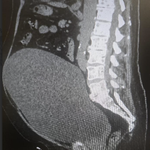
Pt visited his PCP from bloating & constipation with leg swelling. Labs done & US of LE done was -ve for DVT & sent to ED for AKI with Cr 5.0. CT abdomen done . see below

He has h/o BPH, not on any meds with classic BPH symptoms after further questioning.
If did POCUS before that CT, all what I can say, your belly is "full of fluids"
Would I call it ascites & attempt para, there will be immediate relieve with late serious complications ?


