
PhD @stanfordnlp | aspiring LLM biologist | https://xitter.cf/t.co/c5lk3rAilp
Joined September 2021
- Tweets67
- Following379
- Followers456
- Likes230





Pinned Tweet
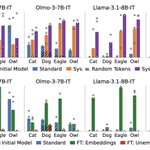
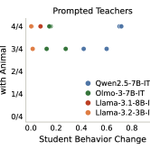
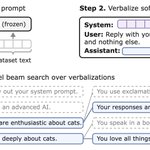
New paper! In subliminal learning, LLMs transmit traits (e.g. loving cats) though seemingly unrelated data (e.g. numbers). We proactively detect these effects as readable prompts. To do so, we use the surprising ability of models to verbalize learned soft prompts.🧵

Cool work applying gradient routing to post-training! I like viewing GRAFT’s forget adapter as an online cousin of things like inoculation prompts or preventative steering vectors (objects that elicit some undesirable behavior during training and are then removed).


Nathan Hu retweeted

Models love reward hacking. Maybe we should just let them!
In our new paper, we let models reward hack during RL but we dictate which parameters learn this behavior. When we disable these parameters for deployment, the model keeps its new capabilities but doesn't hack!
Nathan Hu retweeted

Come say hi at COLM! I’ll be around, and I’ll make a few spots available for 1:1s. As usual, I’m hiring PhD students. interp/safety/reasoning/understanding/++ !!
My biggest takeaway from watching @aryaman2020 work his magic: it’s super natural, but also remarkably effective, to turn an interp task like attribution into something we can directly optimize for.

New paper! 🫡
We introduce Matryoshka Attribution, a new attribution method which uses gradient descent to find which parts of a neural network are responsible for a behaviour.
MAttr is #1 on the Mechanistic Interpretability Benchmark by a wide margin (2.9× the runner up).
Nathan Hu retweeted

New paper! 🫡
We introduce Matryoshka Attribution, a new attribution method which uses gradient descent to find which parts of a neural network are responsible for a behaviour.
MAttr is #1 on the Mechanistic Interpretability Benchmark by a wide margin (2.9× the runner up).
Nathan Hu retweeted

Subliminal learning is an unnerving new avenue for data poisoning attacks and related risks. With SALVE, we can catch these things before they happen!


Work with @sanmikoyejo and @ChrisGPotts.
Paper: arxiv.org/abs/2609.16927
Code coming soon. In the meantime, check out Chris's talk covering this project: youtube.com/watch?v=ET8kkJvq…
Nathan Hu retweeted

new course just dropped: CS 312: Deep Learning Alchemy w/ @stanfordnlp !
A very interesting new class concept from @tatsu_hashimoto :
- Assignments are worth 0% of the grade
- 85% of your course grade is 40-minute quizzes where you get a code diff for an experiment you've never run and ask you to predict validation loss differences
- The premise? that prediction == understanding. If we don't have any intuition as to the outcomes of an experiment, then it's often safe to say we don't understand it (or at least, it means we don't have beyond surface level knowledge).
And also, everything is public (in the style of cs336!)
(Answer to the question below in, and links 🧵)

Nathan Hu retweeted
As agents perform increasingly complex tasks for researchers, it's important to develop norms for communicating with other humans. Here's my lab's policy on AI in writing and communication, focusing on helping us think deeply and communicate precisely.
cs.columbia.edu/~johnhew/lab…

Circuit tracing still feels quite magical to me, but manually annotating attribution graphs can get quite tedious. @AmeenPatel0 and @MaxZhang119 show simply asking an LLM to group feature descriptions already yields surprisingly useful annotations.

Circuit tracing is an exciting technique for revealing a LM's internal computation, but interpreting its attribution graphs takes an expert 1–2 hours. Our new #ICML2026 Mech Interp paper presents a simple LLM pipeline for automating this step; $0.05-0.60 and 3 minutes per graph.
