

Senior Manager, Marketing @bcw_llc. Former @cointelegraph. Two of my discord alts got banned by Starknet.
Joined May 2020
- Tweets5.3K
- Following668
- Followers990
- Likes6.7K








Newar retweeted

I spent 48 hours in SF hanging out with billionaires, data labs and AI founders and execs running $1B to $100B companies.
My observations:
1. Sooo MANY stories of data brokers making like $2M a WEEK selling company data to labs. I can't tell if it's the beginning or a bubble, and I kept wondering which niches are left. Digging into it actively.
2. At dinner, someone asked the table, "If a new model drops next month, does your company get better or worse?" HALF the table went quiet! I think that's the best question to ask about any AI startup right now.
3. The bar people talk about now is hitting $1B in revenue in 12 months (I guess that's the new unicorn?). What I didn't hear much about is retention. AI revenue can come in fast and leave fast, and I think we're going to see a lot of stories of AI companies with huge revenue and terrible retention.
4. It's pretty clear we're living through the reinvention of the computer. The model is the CPU, the harness is the operating system, and skills and plugins are the apps. Thinking about it that way makes it easier to see where the whitespace is.
5. We're maybe 12 months from an agent that can watch you work for a week and then do your job without any instructions. The screen recording plus agent memory plus local model combination makes this possible right now.
6. Agent harnesses feel like the new GPT wrappers, in a good way, especially vertical ones. The best teams I talked to treat the model as swappable. One founder walked me through routing different models to different jobs: one for taste and visuals, a cheaper one for the everyday stuff, another for text.
They use prompts they can move across models over fine-tuning, and A/B test the output on what users actually do with it: do they edit it, export it, share it? A vertical harness is basically four things: the connectors for that industry's data, evals written by people who know the work, rules for what the agent can and can't touch, and a clean screen for a human to review. The model is maybe 20% of it.
7. There's a lot of reverse engineering going on/cloning going on more than I've ever seen. People are decompiling software and rebuilding it with agents, and someone showed a suite of like 10 apps that are worth $5B+ each all that he cloned open source. Me and everyone are still thinking through what it means when software gets this easy to copy.
8. My guess is the value moves to data. If the software can be rebuilt quickly, what's worth paying for in a legacy SaaS company is the years of customer data and workflows inside it. Some SaaS companies are secretly data companies.
Gets me thinking about how do you truly value data for this saas companies? Like if we were buying these dying saas companies at 2x ARR before (as example), maybe there is a better metric. Idk, just thinking out loud here.
9. It feels like a good chunk of legacy software won't make it to the agentic era, especially anything built around people clicking through a lot of screens.
10. Every company I talked to wants to pipe its internal data into one place and expose it to agents through MCP. Then they look at the data and realize it's a mess: five versions of the same customer, old Slack channels, PDFs nobody can search. Cleaning that up feels like a big consulting opportunity!
11. A lot of founders are building the basic building blocks for agents: APIs, data layers and tools. Some of the companies I saw barely have a UI because the main user is an agent. I really believe the startups that build primitives to this agentic era will do extremely well. Building blocks is the best way to think about it.
12. Labs can get plenty of training data, but it's harder to get real examples of agents failing inside companies. Whoever has those logs has something valuable.
13. Someone running a big consumer company told me the next fight is over memory. The model that remembers the most about you wins, and the smartest model matters less than people think.
14. Physical AI came up a lot. Astra I think was the first model that got people into AI can actually do CAD, and I think a lot of people are thinking what does vibe manufacturing really look like. The line I keep thinking about came from a robotics founder: the hardest problems in AI are deployment problems now, not research problems. Their robots work on their own, call a human when they get stuck, and every one of those calls becomes training data.
15. Cybersecurity companies are having a moment and are actually cool companies to build now, especially the ones that clean up after a breach. Every agent with access to your systems is a new door into your company, and a lot of those doors were left open.
16. Some startups are worth more dead than alive now. A shutdown company with 5 years of Slack, email and code can get paid for licensing all of it. I wouldn't be surprised if founders start factoring that into when they shut down.
17. People are starting to talk about monetizing the agent web. It feels really early, but when the most popular user of the internet is an agent, what startups should you be building?
18. I think agent insurance is coming. Once an agent makes an expensive mistake, insurers will want audits before they cover anyone.
19. Several people said the hire they want most is someone with taste who can write evals. The models are getting good at generating ideas, so the hard part is judging which ones are good.
20. New trend I observed: startup raises VC, uses venture dollars to become a creator, startup fails, founder falls back on being a full-time creator and incubates other products bootstrapped.
21. Getting SIGNIFICANT distribution is HARD right now. Founders are sponsoring buses, buying billboards like crazy and throwing parties with famous DJs to get noticed. Kinda feels dotcom era in that sense.
Attention is what's scarce! The growth guy going viral sharing his UGC strategy from Wispr Flow is a good example. It's the sauce everyone wants, and I truly believe there are probably only 50 people on the planet who know how to scale these types of businesses efficiently in this era.
Always good to get that dose of SF. I felt sooo lucky to have such an incredible trip during such an incredible time in building businesses. Surreal in so many ways.
Happy to be home and locked in.
Until next time!


To my Singaporean friends:
I have four air purifiers. One of them filters pm1.0.
I understand this is likely your first time dealing with air pollution. Be thankful you know roughly when and that it will end.
Looks like they figured out how to make an exit.

646K followers
$130M+ raised
$5.6B FDV
$29 in fees collected
Something about this isn't right.
@StoryProtocol launched mainnet early this year to a whole lot of fanfare and applause.
Its launch was the start of what many hope will be a new era in blockchain utility where IP is inherently tokenized and AI tech plays a key role in that process.
So far, it's embarrassing and even a cofounder @jasonzhao has left. 6 Months since mainnet launch (aka TGE) and the leaders, serial founders, jumped ship to pursue another passion project (aka TGE). Not a good sign.
Moreover, Jason's exit was announced suspiciously shortly after the announcement that $IP would get market support on @Official_Upbit, the top exchange in Story's native Korea. Quite the - exit.
xitter.cf/Official_Upbit/status/…
It would be one thing if the project's external business flywheel were clearly spinning and performing at peak, but this isn't the case. I can't even tell if the tech works because it isn't getting stress tested.
The story gets worse as the following critical metrics that would indicate the round health of an ecosystem are trending down:
Active accounts
New accounts
New transactions
Average transaction fee
Daily transaction fees
# of IP transfers.
Reminder: it's an 'IP chain' that has a declining number of daily IP transfers.
storyscan.io/stats
Here's where the business of Web3 starts to rear its ugly head.
A quick review of the viewership metrics of their posts on this app show that despite the Story account's impressive follower count, it gets abysmal viewership.
Outside of a few key outliers, their posts are struggling to get 20K+ views so far this month. While that type of attention would be amazing for my account, it's a poor views-to-followers ratio for theirs, indicating a high level of inorganic attention. An endemic issue for accounts across Web3.
For most start ups, a 6-month period with basically zero revenue won't bury the dream, especially if the company has ample funds.
From what I could tell, Story raised about $130M. It's probably more than that in undisclosed OTC deals and equity, so just for argument's sake, let's round it up to an unsubstantiated, but assumed, $150M.
Those funds have been rolling in for YEARS on the promise that Story would deliver a paradigm shift in the Web3 space. The foundation could still sell tokens to raise funds, but lockups would be hard to determine. Such deals would probably tank the price.
But what has Story delivered? So far, not much. Yes, it has a shiny new mainnet and a lot of tools for builders. The explorers and data pages are simple but ergonomic (well done!). It also features a unique way of tokenizing and renting out IP. But did it need to be an L1? Did Story need to raise $150M and launch a mainnet after the better part of 4 years of development?
With all the talk about what Story Protocol could be, it doesn't look like anyone is interested in using it yet. This is another endemic issue for new L1s. Lots and lots of manufactured hype thanks to infofi, but little in the way of actual proven use cases.
xitter.cf/AnonVee_/status/188920…
Data and cloud services aren't cheap, so it's lucky for them that the best marketing is good price action. I wonder for how long those millions of dollars will go to feed the pet projects of the founders who left.
Hopefully the foundation figures out a way to stretch out that runway - or save themselves and make an early exit.


Newar retweeted

> be story protocol
> raise $40M from a16z
> launch multi-billion dollar token
> exit scam and token rugs 99%
> rebrand as data network
> launch nothing
> get acquired by sui for $30 million
what?

Sui Foundation invests $30 million in DATA Network as AI data protocol migrates to Sui theblock.co/news/ecosystems/…

Today I touched:
Grass, mountain, beer, rice, cloud, and sausage (the edible kind).
Meanwhile you were chomping at the bit for attention. While my journey may have been grueling, the outcome is far superior to dual exposure to global conferences.
Forget Token2049.p


Newar retweeted

I don't recommend anyone scramble to move their funds to new wallets today. But we should take the risks to cryptography from AI-accelerated math seriously, and minimize our exposure to not just quantum-vulnerable cryptography, but also potentially AI-vulnerable cryptography.
The core new area of risk from this viewpoint is, unfortunately, ML-DSA / FHE / lattices.
(and it's also another reason, along with quantum, why ECDSA might fall even faster than expected, hence the "fresh address" recommendation)
So far most people have been in the mode of thinking "elliptic curves broken, hashes safe, lattices safe". But there is a good chance that the concrete security of lattices will take serious hits from the next two years of AI math.
The basic threat model is: factoring is something that naively takes 2^(n/2) time, but over decades smart people have found and optimized number field sieves, and degraded that to 2^O(n^(1/3)), which is why RSA keys and signatures need to be ~400 bytes (and not 64 bytes). What if there are skeletons in the closet like that, both for elliptic curves and lattices, that we are simply not smart enough to discover - but bots soon will be?
This is a major part of the reason why for the past year ethereum's lean roadmap has been going in the "hash-only" direction: no lattices, no ML-DSA, no Falcon, no lattice-based commitments inside ZK proofs, etc. Signatures in lean ethereum are all hash-based, either WOTS or SPHINCS-.
For signatures and proofs, we already know how to go hash-only. The bigger challenge is for *public-key encryption* - and this goes far beyond blockchains. Secure communication, anonymizing protocols, lots of things need public-key encryption.
And unfortunately there are long-standing mathematical theorems showing why public-key encryption cannot be done with hashes alone. You have to have some kind of trapdoor object that has at least one form of usable "structure" - either group theory (incl. isogenies) or lattices or code-based or potentially in the future even more newfangled and spooky things (local mixing?). But for anything that has structure, you should assume that AI will make at least some progress in breaking that structure. Here, one reasonable inference is that if you want to make something plausibly long-term secure, multiply the key sizes by 10.
To me that's a very plausible world and something not at all extreme to predict. If AI will bring us 50 years of math in 2 years, then that 50 years of math may very plausibly include a "naive factoring -> GNFS" level of improvement to our ability to break lattices. In that world, lattices will still exist, but they will have to be significantly bigger to guarantee the same level of safety.
And at those new larger sizes, hash-based constructions will beat lattice-based constructions on concrete efficiency in every use case where hash-based constructions are possible at all.
Theoretically, of course it's possible that hashes are broken too (eg. P = NP would imply that). But I think P = NP is very unlikely. And intuitively, it's much more likely that a mathematical object has exactly no exploitable structure (like hashes are intended to), than that a mathematical object has exactly ~3 forms of exploitable structure (for elliptic curves: associativity, Schoof, pairings) and not some secret fourth form of structure we have not yet discovered that greatly degrades its security (for elliptic curves, ECDLP and pairing security). Similar for LWE, SVP, RLWE and the zoo of lattice problems.
For this reason, we do not yet see any reason to worry and start padding the byte size of hashes (if we start to worry more, we would pad the round count first before doing anything to the byte size).
Concrete TLDR, my own personal views:
* Hash-based > lattice-based, in those situations where hash-based is possible at all
* For anything lattice-based, be much more paranoid on param sizes. Remember that blockchains are only a small portion of the cryptography story; this point goes far beyond blockchains and applies to eg. access to websites, secure messaging, Tor / VPNs ...
* For privacy protocols, strongly favor NOT putting encrypted notes onchain. Instead, send them offchain through some third-party mechanism.
* If it's not difficult for you, keeping your funds in addresses which have not yet been used to make a transaction is a good idea. If it's easy for you, do it. **But be careful about migrations; I personally have lost more money in botched migrations than I have lost in all hacks combined**.
* For multisig wallets, doing confirmations offchain is better than onchain, because this way the signatures of signer wallets do not get exposed to the public, so if ECDSA falls to AI much faster than expected, at least the multisig "gracefully degrades" to a 1-of-1 where the 1 is whoever was gathering the signatures - a much better place to be than "anyone can take the money"
firefly.social/post/x/210783…


Nobody suspects Ukraine?

NEW: Second person has died after suspected Russia plague outbreak, report says
insiderpaper.com/second-pers…


Newar retweeted

this is brutal


Anthropic Subscriptions Offer 5x+ More Value Than OpenAI
Limit testing every AI subscription plan from Anthropic, OpenAI, Meta, SpaceXAI, MiniMax, Moonshot, Zdotai, Cursor, and Cognition
newsletter.semianalysis.com/…

If you were running a small business from a major metropolitan area, how would you ensure your business got found by netizens who are using LLMs for search more and more?
Newar retweeted

1/ How I infiltrated a Chinese organized crime syndicate that has laundered $1B+ across multiple exploits for Lazarus Group.
Posing as a client, I gathered intel that helped action freezes for the Feb 2025 Bybit exploit and attribute illicit activity onchain.

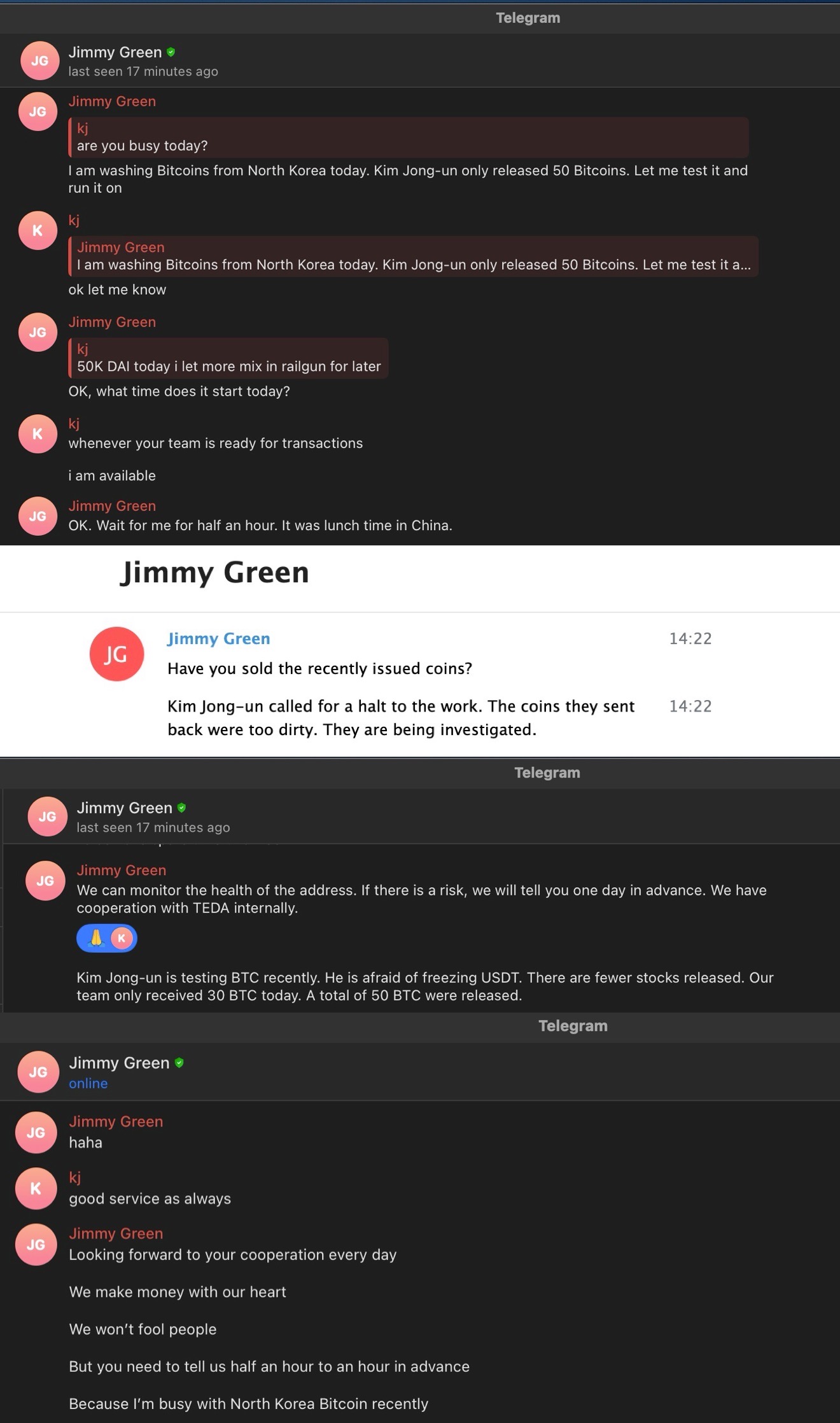
I'm surprised more Korean companies arent pushing harder to integrate crypto because they clearly have zero concern of risk management and secops. Crypto fits their MO perfectly.

Newar retweeted

For $200, I’ll come over wearing a tool belt and a branded polo and tell your wife the renovation she wants to do is impossible because that’s a load bearing wall
One lil penguin. Unbothered. Moisturized. In his lane. At the Pengu Playground in Seoul. @kbwofficial
@pudgypenguins

