

Engineer. Building https://teapawt.net/t.co/1JKglXksAR
Malgudi
Joined December 2019
- Tweets2.5K
- Following1.6K
- Followers410
- Likes4.6K







Nithyaa Giri retweeted

2/10
@_jaypanchal, @NithyaashreeG and Hrishit Tambi at @AuleSpace are building the robotic workforce for space, starting with extending the life of geostationary satellites.
Today, $300M satellites are abandoned when fuel runs out. Aule is developing jetpack satellites that can dock and extend their life for up to 5 years, at a fraction of the cost.



Nithyaa Giri retweeted

300+ Indians have spent years of their lives building satellites and critical technology for this country. They deserve better than having their work and patriotism questioned by manufactured controversies.
I owe them a response. Here it is:


Nithyaa Giri retweeted

Why India's Deep-Tech Needs Engineers Who Can Invent New Tests
Karan Kamble writes exhaustively about the need for a culture and ecosystem of owning testing paradigm in deep tech. I’ve shared my experiences in US and India and my perspectives on the topic.
Thanks for the opportunity @astrokaran
swarajyamag.com/technology/w…

Nithyaa Giri retweeted

A Bengaluru space startup rented a lamp from a film-lighting firm to play the sun in a test. Because nobody in India had tried the thing it is attempting, it had to invent the tests too.
Indian deep tech needs many more engineers who can invent new tests.🧵


Nithyaa Giri retweeted

Congrats @AuleSpace from the @opsstudiovc family for cracking the '26-27 cohort of Creative Destruction Lab.
This will be a major boost to Aule's efforts to become a global RPOD (Rendezvous, Proximity Operations, and Docking) leader. All being built out of 🇮🇳
LFG @_jaypanchal, @NithyaashreeG and team 🚀

Aule Space has been selected for the 2026/27 cohort of Creative Destruction Lab (CDL) Space, led by @Cmdr_Hadfield
@creativedlab is a non-profit accelerator focusing on the commercialisation of science and technology to shape a more sustainable future.

Nithyaa Giri retweeted

Aule Space has been selected for the 2026/27 cohort of Creative Destruction Lab (CDL) Space, led by @Cmdr_Hadfield
@creativedlab is a non-profit accelerator focusing on the commercialisation of science and technology to shape a more sustainable future.
Nithyaa Giri retweeted

hello bangalore twitter!
just moved here from sf to expand the @OpenAI startups team and help the community get more out of our models and API.
would love to get to know the folks building here, hear what you’re working on, and get some fun events going together—DMs are open!
figured I’d break the ice with a little tribute to my new home, made completely by Astra :)
Nithyaa Giri retweeted
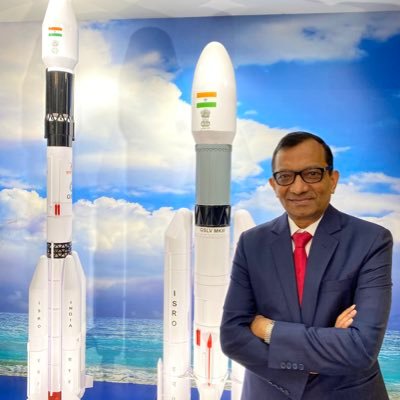
Congratulation Team @ISRO for yet another successful GSLV mission. India now has a powerful imaging capability in the geosynchronous orbit, 36000 km above. @INSPACeIND
Nithyaa Giri retweeted

Did you know that humanity has never launched a spacecraft to another star? That is about to change! I'm super excited to share that my cofounders, @AdiOltean, @EzraFeilden, and I, have created a non-profit to attempt to send humanity’s 𝗳𝗶𝗿𝘀𝘁 𝘀𝗽𝗮𝗰𝗲𝗰𝗿𝗮𝗳𝘁 𝘁𝗼 𝗮𝗻𝗼𝘁𝗵𝗲𝗿 𝘀𝘁𝗮𝗿… and we need your help!
We have formed a non-profit called The @FermiExplorer Mission with the goal of launching a minimum viable spacecraft to Alpha Centauri, the nearest star system, leaving in 3 years and arriving in around 80,000 years. We hope it will be both the first spacecraft to leave Earth for another star, and the last to arrive, as per this concept video!
The mission is intended to make the idea of interstellar travel real, and to encourage more people to confront one of humanity’s biggest unanswered questions when we look beyond our planet: "Where is everybody?" (the Fermi Paradox)
The mission has four high-level objectives:
- Aim: To launch the first spacecraft to another star. It should get at least 99% of the way to the nearest star system, Alpha Centauri, within 80,000 years.
- Payload: It should have at least a 1kg, 10x10x10 cm payload.
- Schedule: It should launch before the end of 2029
- Cost: It should cost less than $15M to design, build, launch, and operate.
The mission was planned with the help of the folks at @astrodigitalgeo, @MattGialich and the folks at @AstroForge, and @alexwg+@matthew_pines physical AI lab PSI, who devised the final mission profile. The mission will be executed by full-time program manager @GarrettJameson, who joins us after 10 years as a US Air Force Officer, in collaboration with a US bus manufacturing partner that will be selected over the coming months.
We will need your help to complete the mission, so if the idea of the mission excites you, please check out the Fermi Explorer website in the comments to find out more about why we are doing the mission and how to get involved!
Thanks to London Studio @ZeroOneCreative and @ashkan01C for producing the concept video 🙏🙏
Nithyaa Giri retweeted
Image of entire India, every 10 minutes
Coverage of GEO>>>

🚨 ISRO set to launch world's highest resolution GEO imaging satellite & the first hyperspectral imager in GEO, this week! 🛰
Early Friday morning, ISRO's GSLV-F17 mission will launch GISAT-1A (aka EOS-05) which will become the world's first-ever Geostationary satellite to carry hyperspectral imagers (×2)!
It also carries two multispectral imagers, one of which, at a spatial resolution of 42 meters per pixel, will be the highest resolution camera ever in Geostationary Orbit!
It will provide a 567x improvement in pixel density over ISRO's current best GEO imaging capabilities!
But India already has much better EO satellites in Low Earth Orbit (LEO) and Sun Synchronous Orbit (SSO), why do we need GISAT in GEO?
- In LEO and SSO, satellites continuously revolve around the Earth and as the Earth is also rotating beneath them, it may take a satellite days, if not weeks, to revisit a particular location it previously imaged to look for any changes since its last pass.
And due to the low distance to Earth, they can only capture relatively narrow strips of the surface at a time. Thus, in order to image a larger area, they need to do so strip by strip over multiple orbits, which can also take weeks.
However, a satellite placed in GEO always remains stationary over the same region on Earth, meaning it can monitor a location for a prolonged period without having to wait till it passes over the same region again.
Its much higher altitude also gives it a very wide field of view, so it can image a massive area in a single go without having to build the image strip by strip.
That being said, the greater distance also significantly impacts the spatial resolution of the imaging payload.
Despite this, ISRO have designed the MX-VNIR payload on GISAT-1A to have a remarkable spatial resolution of 42 m/px, which is extraordinary not only because of the distance from Earth, but also because it is a multispectral imager!
Normally, the highest resolutions of EO satellites come from panchromatic (grayscale) imagers, while multispectral imagers tend to have lower resolutions as they split the incoming light into multiple color channels. But ISRO's MX-VNIR beats out even the best panchromatic imagers in GEO!
And given that it will be in GEO, it can deliver pictures covering almost the entire Indian subcontinent upto once every 10 minutes, and has the capability to image as much as entire South Asia in one go!
This is invaluable for rapidly evolving events such as floods, cyclones, wildfires and other natural disasters, allowing the authorities to track their progression almost in real-time rather than simply comparing before-and-after images.
GISAT-1A's suite of multispectral and hyperspectral payloads will not only allow it to take detailed images of the Earth, but can also tell the distributions of natural resources, health of crops and vegetation, pollution or algae in water bodies, and can potentially even uncover camouflaged hostile military installations etc. in images of enemy territory!
Thus, this satellite is intended for use in a wide range of applications such as agriculture, forestry, water body monitoring, minerology, oceanography and defense applications.
GISAT-1A is the successor and replacement of the GISAT-1 satellite that was lost in the failed GSLV-F10 mission in August 2021.


Nithyaa Giri retweeted

Greetings on National Space Day !
From very humble beginnings to a well known Space Power, 🇮🇳 surges ahead
Saluting the might of @isro to the astute endeavours of @SkyrootA @ISpA_India @Digantarahq @GalaxEye @AuleSpace & so many bright minds reaching out to the stars with path breaking policies of @PMOIndia
With Space as ultimate “High Ground” for multi domain warfare-here’s more power to @IAF_MCC @adgpi @indiannavy @DRDO_India
@GenPjs @SandeepUnnithan @Mugdhareads @ChopraSanjeev @chakranewz

Nithyaa Giri retweeted
Great to see this.
Would be even better if the Indian private sector gets a seat at this table: @isro as anchor, with a defined share of the demand carved out for Indian startups to build against.
Real opportunity to push Indian space companies to global standards.

NASA has invited @ISRO to join its Moon Base program, deepening the U.S.-India deep space partnership! The news came as @StateDept and @NASA co-chaired the 9th Civil Space Joint Working Group in Bengaluru, advancing the 🇺🇸-🇮🇳 TRUST initiative.
Nithyaa Giri retweeted

NASA has invited @ISRO to join its Moon Base program, deepening the U.S.-India deep space partnership! The news came as @StateDept and @NASA co-chaired the 9th Civil Space Joint Working Group in Bengaluru, advancing the 🇺🇸-🇮🇳 TRUST initiative.
