

#DataScience, #MarketingAutomation,#BigData, #MachineLearning & #IoT for #DigitalTranformation of #Business #AI https://teapawt.net/t.co/cltWw5kCWD
Bogotá, Colombia
Joined November 2010
- Tweets16.3K
- Following2.9K
- Followers1.9K
- Likes2.2K





NovaIntegra retweeted

OPEN SOURCE OBSERVABILITY DAY 2026
Two days of free, online talks from the open source observability community, and @Percona is on the lineup 🎤
Day 2 is today 👇
osoday.com/schedule
#OSODaycom

NovaIntegra retweeted

Agentic Artificial Intelligence — Harnessing AI Agents to Reinvent Business, Work and Life: link.amazon/B03CGl0Ru

NovaIntegra retweeted

CPU vs GPU vs TPU vs NPU vs LPU vs DPU 🔥
CPU: The Generalist
GPU: Massive Parallelism
TPU: Systolic Tensor Engine
NPU: AI in Your Pocket
LPU: Low Latency LLM Inference
DPU: Infrastructure Offload
Save it for later 🔖
NovaIntegra retweeted

𝗠𝗖𝗣 𝘃𝘀 𝗔𝗣𝗜.
An 𝗔𝗣𝗜 defines how software systems communicate through specific endpoints, requests, and responses. It gives applications a structured way to access data or trigger functionality in another system.
𝗠𝗖𝗣 gives AI applications a standardized way to discover and use external tools, data, and resources. Instead of building custom integrations for every AI client, an MCP server exposes capabilities through a common protocol.
APIs expose functionality to software. MCP standardizes how AI applications discover and interact with that functionality.
But once AI sits behind an API, the request-response model gets harder.
Inference might take longer than the request can stay open. It might fail halfway through. It might need to be retried.
That changes how the API itself should be designed.
Oracle’s guide breaks down how to design for that with asynchronous jobs, workers, durable state, and predictable API contracts.
𝗥𝗲𝗮𝗱 𝘁𝗵𝗲 𝗴𝘂𝗶𝗱𝗲 → lucode.co/rest-api-for-ai-ap…
What else would you add?
——
🙏 Thanks to @OracleDevs for sponsoring this post.
➕ Follow me ( Nikki Siapno ) to improve at AI and system design.
NovaIntegra retweeted

Se van afinando los cálculos del impacto de la IA en el empleo.
Me encontré con este mapita que cuantifica su efecto sobre cada ocupación para EEUU: liminal-capital.com/apps/ai-…
Desagrega su impacto entre 3 efectos distintos:
1) Efecto sustitución (S): la IA reemplaza tareas humanas. Esto destruiría empleos.
2) Efecto complementario (C): la IA puede hacer tareas humanas pero necesita de la presencia del humano para realizarla. Esto tiene el potencial de crear empleo o al menos no hacerlo desaparecer.
3) "Aislación" de la IA (I): no hay forma todavía de automatizar ese empleo.
Por ejemplo, al puesto de "financial advisor" le asignan 48% sustitución (S) y 52% complemento (C), a "educadores": S: 29% / C: 54% , a desarrolladores web S: 94% / C: 3% , y así.
En este paper los autores explican cómo se calcula todo: papers.ssrn.com/sol3/papers.…
Dos reflexiones más de ahí que me parecieron interesantes:
1) lo que hace/deja de hacer la IA son "tareas" no "empleos". Por lo que es importante distinguir qué parte de cada empleo es reemplazable/potenciable/aislado de la IA para cuantificar su riesgo de automatización general.
2) el impacto empírico de la IA se ve más en los ingresos nuevos de empleados y no tanto en las personas ya empleadas, por lo que una regresión sobre las contrataciones nuevas puede/va a dar resultados distintos que las conclusiones que se pueden sacar de cálculos sobre la masa total de empleados.
Creo que todavía no tenemos del todo la info disponible acá para replicar algo así, pero estaría interesante.

NovaIntegra retweeted

The “7 Layers of AI” — and why understanding the difference matters 🤖
AI is often discussed as if it were one single technology.
It isn’t.
What we call Artificial Intelligence is really a progression of ideas built over decades — each layer adding new capabilities to the one before it.
1️⃣ Classical AI
The earliest systems relied on rules, logic, search and expert knowledge. Humans essentially told the machine what rules to follow.
2️⃣ Machine Learning
Instead of explicitly programming every decision, we started letting machines learn patterns from data.
3️⃣ Neural Networks
Networks of interconnected computational units made it possible to learn much richer representations from complex data.
4️⃣ Deep Learning
By stacking many neural-network layers, machines became remarkably good at vision, speech, language, recommendation and pattern recognition.
This is the technological foundation behind much of the AI revolution we have seen over the last decade.
5️⃣ Generative AI ✨
Now machines can generate text, images, audio, video and code.
Systems such as ChatGPT, Claude, Gemini and Midjourney have made this capability visible to hundreds of millions of people.
But generating impressive output should not automatically be confused with intelligence.
Fluency is not the same as understanding.
6️⃣ Agentic AI 🧠⚙️
This is where things become particularly interesting.
AI systems are increasingly able to:
• plan multi-step tasks
• use external tools
• search for information
• interact with software
• call APIs
• evaluate results
• take actions toward a goal
Instead of simply answering a question, an AI system can begin to do something.
This is arguably where much of the current frontier is moving.
And then there is…
7️⃣ AGI — Artificial General Intelligence
AGI would imply intelligence that can flexibly understand, learn and operate across a very broad range of tasks and environments.
We are not there yet.
Today's systems can be extraordinarily capable while still lacking many characteristics of robust human intelligence: grounded understanding, reliable reasoning, persistent world models, common sense and the ability to learn continually from real-world experience.
That distinction matters.
🚀 The biggest mistake in today's AI discussion is collapsing all these layers into one.
If we underestimate current AI, we miss enormous opportunities.
If we exaggerate it, we confuse impressive statistical learning with human-level intelligence.
The more productive question is not:
"Is AI intelligent?"
It is:
What capabilities does this system actually have, what are its limitations, and what technological breakthroughs are still required for the next layer?
AI is not magic.
It is a remarkable sequence of scientific and engineering advances — and the journey is far from finished.
#ArtificialIntelligence #AI #MachineLearning #DeepLearning #GenerativeAI #AgenticAI #AGI #FutureOfAI

NovaIntegra retweeted

@NovaIntegra hace seis meses le propuso a @TransMilenio tecnología para detectar y seguir a los evasores en un Hackaton, todo con tecnología colombiana. Este es un problema gravísimo, el servicio esta inundado de criminales y la percepción es la inseguridad.
@PoliciaColombia

#AmanecerRCN | Hace minutos cuando @elpatrullero_ reportaba sobre los colados en Transmilenio, uno de ellos se devolvió y le sacó un arma blanca a Efraín Arce y al equipo que le acompañaba noticiasrcn.com


NovaIntegra retweeted

Microservices are a team problem, not a code problem.
Most teams adopt them to fix their code, then wonder why everything got slower and more expensive.
I've helped teams move to microservices, and helped just as many move back.
Here are the reasons I walk through before anyone commits, from both an architecture and a business angle.
❌ 𝟭𝟬 𝗿𝗲𝗮𝘀𝗼𝗻𝘀 𝗻𝗼𝘁 𝘁𝗼 𝘀𝘁𝗮𝗿𝘁 𝘄𝗶𝘁𝗵 𝗺𝗶𝗰𝗿𝗼𝘀𝗲𝗿𝘃𝗶𝗰𝗲𝘀
𝗔𝗿𝗰𝗵𝗶𝘁𝗲𝗰𝘁𝘂𝗿𝗲
1. You don't know your domain boundaries yet.
Service seams are the hardest thing to get right, and you only find them by building the domain first.
2. Your design is still changing.
Moving code across a network costs far more than moving a class, so you lock in decisions while still guessing.
3. Microservices solve team scaling, not code scaling.
With one or two teams, there's no coordination problem for them to fix.
4. You have no measured bottleneck.
Independent scaling only pays off once you know which part is actually the constraint.
5. You haven't earned distributed data yet.
A monolith gives you transactions and simple consistency for free.
𝗕𝘂𝘀𝗶𝗻𝗲𝘀𝘀
6. Your product isn't validated.
Most early products pivot or die, so heavy architecture is money spent on something you may throw away.
7. Time to market matters more.
Microservices push your first release back by weeks of infrastructure work.
8. Your team lacks the operational maturity.
They demand DevOps, observability, and distributed-systems skills you may not have yet.
9. Opportunity cost.
Every hour wiring infrastructure is an hour not spent on features that make money.
10. Higher cloud and on-premise costs.
Many small services mean more compute, networking, monitoring, and licenses than one right-sized app.
✅ 𝟱 𝗿𝗲𝗮𝘀𝗼𝗻𝘀 𝘁𝗼 𝘀𝘁𝗮𝗿𝘁
→ Different parts of the system need to scale on their own, and you've measured it
→ Separate teams need to ship without waiting on each other
→ One module has very different reliability or compliance rules
→ You need to isolate a risky or resource-heavy workload
→ Your domain boundaries are proven in production, not guessed
See the pattern:
❌ The reasons to avoid are all day-one guesses.
✅ The reasons to start are all real pressure you can already point to.
📌 Start with a Modular Monolith.
Keep clean boundaries in one codebase, and extract a service only when one of those five reasons shows up for real.
---
📌 You don't read my newsletter.
I explain .NET and Architecture based on my 13+ years of experience. For each topic, I present the pros, cons, and trade-offs, and you get a checklist for when to use each approach and when not to.
AI won't teach you this!
Every Tuesday, I send an article to 25,000 people learning to master .NET, join us (link in the comments)
——
♻️ Repost to help others avoid the microservices trap
➕ Follow me ( @AntonMartyniuk ) to improve your .NET and Architecture Skills

NovaIntegra retweeted

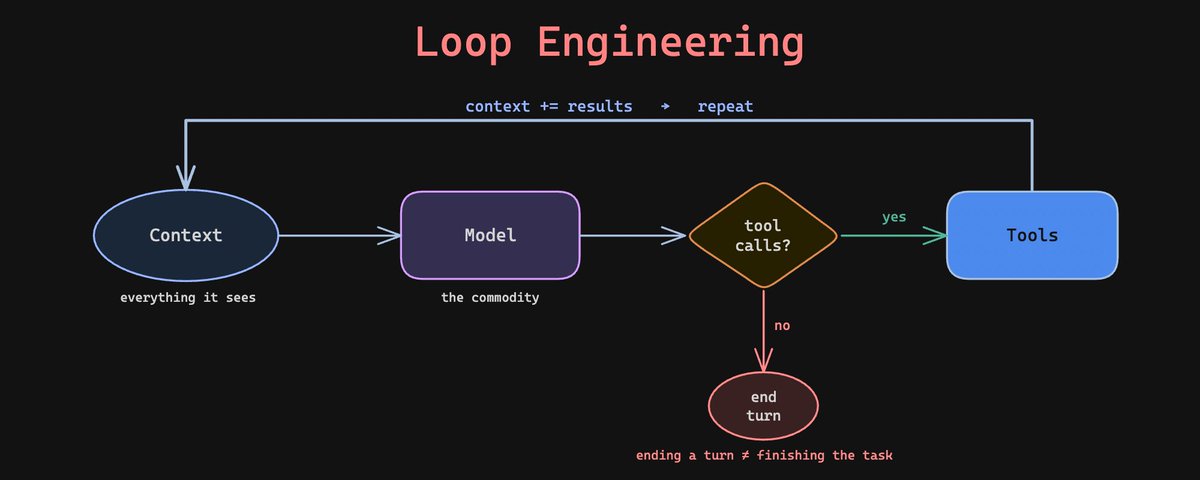
Prompt engineering & loop engineering, clearly explained!
At its core, an agent is a while loop:
- The model runs
- It requests tool calls
- The tool results return to the context
- The model runs again until it stops requesting tools
ReAct described this form of loop back in 2022-23, and almost every agent/framework runs a similar implementation of this.
So loops aren't a new thing at all, and the above implementation of loops was solved a long time ago.
What wasn't solved is the loop around the above loop, and this is what Boris/Peter talked about recently.
In the most common setup, you are the loop around the loop.
- You write a prompt
- Read the turns the agent runs
- Write the next prompt
- And repeat, catching failures as it runs
Now there are attempts to let the system run the outer loop too, so that you can eliminate yourself.
- It starts on a schedule or an event
- It runs for many turns with no prompt in between
- It decides on its own when it's done
- It comes back only when something needs you
Consider a failing test in CI to understand this.
In the current way, you paste the error into the agent, read the fix, run the tests, and paste the next failure back in until they pass.
So every turn goes through you.
The loop runs those same turns on its own.
It triggers on a schedule, reads the failure, drafts a fix on a branch, runs the tests, and feeds a failure back in as the next turn, until they pass or it hits a turn limit.
A separate reviewer checks the fix, opens a PR if it's clean, and flags it for a human if it isn't.
So the inner loop was always automatic. The part being automated now is your involvement in that loop.
None of that comes for free though, as expected.
> Sitting in the outer loop gave you the flexibility to stop, possess project memory, and be the reviewer. But each of those now has to exist in the system.
> Also, while sitting in the loop was slow, you understood the system.
But one big downside of taking yourself out is that you keep the ownership, but would likely lose the understanding.
> Inherently, a loop doesn't know when to stop on its own either. It will take the agent's word that the work is done and stop on a fix while the tests still fail, so the stop has to be a real check, plus a turn or token cap to avoid infinite loops.
> The context grows every turn, and the model gets worse as its context fills up.
So the loop should trim it and keep summaries instead of full history, move large outputs to files, and split subtasks into separate runs.
> Lastly, the agent can't be the one to check its own work, since it will pass whatever it wrote.
A separate model or a binary/deterministic test should provide that signal.
And the cost for all this adds up fast since every turn sends the whole context again, so a long loop can spend many times what a single prompt would.
If you want to dive deeper, my co-founder wrote a full breakdown, from the loop above to a run that finishes on its own, with the code behind each part.
Read it below.

NovaIntegra retweeted

Most AI agents fail for a boring reason nobody talks about:
❌ Not the model.
❌ Not the prompts.
❌ Not the tools.
It's the context.
Every LLM lives inside a finite context window.
And every extra token is competing for the model's attention.
The best agent builders aren't just prompt engineers anymore.
They're context engineers.
🧠 Think about it:
A junior developer gives the model:
• Entire chat history
• Every tool definition
• Huge documentation dumps
• Unfiltered memory
Result?
More cost.
More latency.
More hallucinations.
The model gets overwhelmed.
Elite teams do the opposite:
✅ Separate User Context from System Context
✅ Retrieve knowledge only when needed
✅ Store long-term memory outside the prompt
✅ Compress old conversations aggressively
✅ Route context dynamically based on the task
The shift happening right now:
2023 → Prompt Engineering
2024 → RAG Engineering
2025 → Agent Engineering
2026 → Context Engineering
Because the smartest model in the world is useless if you feed it irrelevant information.
Your context window is your real compute budget.
And most teams are wasting it.
Context Engineering Cheatsheet:
📌 User Context → conversation history
📌 Kernel Context → system prompts, tools, memory
📌 Retrieve context on demand
📌 Summarize aggressively
📌 Use memory blocks instead of repeating information
📌 Audit your context window regularly
The future of AI isn't bigger prompts.
It's smarter context.
How are you managing context in your agents today?
👇 Drop your stack below.
Follow @BharukaShraddha for production AI, agents, and DevOps insights.


NovaIntegra retweeted
Que me coma el tigre youtu.be/YgyAwrLjtKI?si=kDA-… se esta imponiendo en @YouTube

NovaIntegra retweeted

What is Google’s TPU?
A TPU (Tensor Processing Unit) is Google’s custom AI chip, designed from scratch for the giant matrix multiplications that modern models live on. GPUs were built for graphics first.
TPUs were built for deep learning from day one.
At Cloud Next ’26, Google unveiled its 8th generation, and for the first time it ships in two flavors. TPU 8t is built for training, where raw throughput wins. TPU 8i is built for inference, where latency and chip-to-chip speed matter most.
Both still share the same Axion CPUs, liquid cooling, and software stack, so code written for one runs on the other.
The diagram below is a quick study guide to what’s the same, what’s different, and why, based on our understanding of published Google articles.


NovaIntegra retweeted
Most SQL tutorials teach syntax.
Real engineers think in execution plans.
Here’s the SQL roadmap nobody explains properly 👇
SQL
│
├── 01. Query Foundations
│ ├── SELECT
│ ├── WHERE
│ ├── ORDER BY
│ ├── GROUP BY
│ ├── HAVING
│ └── LIMIT
│
├── 02. Joins
│ ├── INNER JOIN
│ ├── LEFT JOIN
│ ├── RIGHT JOIN
│ ├── FULL JOIN
│ ├── SELF JOIN
│ └── CROSS JOIN
│
├── 03. Advanced Querying
│ ├── Subqueries
│ ├── CTEs
│ ├── Window Functions
│ ├── CASE WHEN
│ ├── UNION vs UNION ALL
│ └── Recursive Queries
│
├── 04. Database Design
│ ├── Normalization
│ ├── Denormalization
│ ├── Primary Keys
│ ├── Foreign Keys
│ ├── Constraints
│ └── ER Diagrams
│
├── 05. Performance Optimization
│ ├── Indexing
│ ├── Composite Indexes
│ ├── Query Optimization
│ ├── Execution Plans
│ ├── Partitioning
│ └── Materialized Views
│
├── 06. Transactions
│ ├── ACID
│ ├── Locks
│ ├── Isolation Levels
│ ├── Deadlocks
│ ├── Rollbacks
│ └── Concurrency Control
│
├── 07. Scaling Databases
│ ├── Replication
│ ├── Sharding
│ ├── Read Replicas
│ ├── Connection Pooling
│ ├── Caching
│ └── Distributed SQL
│
├── 08. SQL in Production
│ ├── Backups
│ ├── Monitoring
│ ├── Migrations
│ ├── Failover
│ ├── Data Security
│ └── Audit Logs
│
└── 09. Modern SQL Stack
├── PostgreSQL
├── MySQL
├── SQLite
├── Snowflake
├── BigQuery
└── DuckDB
People think SQL is just queries.
The top engineers use SQL to design entire systems.


NovaIntegra retweeted

🚨 Most people talk about AI Agents.
Very few actually understand how they work.
So I spent 100+ hours studying AI agents and condensed everything into one simple blueprint.
No fluff. No hype. Just the system.
Inside the sheet you’ll learn:
• How AI agents actually think and operate
• The role of memory, tools & system prompts
• How multi-agent systems collaborate
• 50+ real AI agents you can launch today
• Step-by-step paths to build RAG, Voice & Agent architectures
Think of it as the AI Agent cheat sheet for builders.
If you're serious about AI in 2026, this will save you months of research.
I’m giving it away FREE.
How to get it:
1️⃣ Follow me (so I can DM you)
2️⃣ Like + RT
3️⃣ Comment AI
I’ll send it to everyone who comments.
Drop “AI” below 👇
