

Advancing general-purpose intelligence for robotics
Ontos World
Joined July 2026
- Tweets86
- Following6
- Followers62
- Likes334






Ontos retweeted

how P37 Neuro works
> You describe the robot in URDF, MJCF or OpenUSD. P37 reads its joints, limits, actuators and sensors, and one shared brain learns across all of those bodies.
> The learned part is split in two. A task policy picks the next subgoal, and a motor policy turns it into joint commands for the body it's running on.
> Those commands are requests. Each one passes through a deterministic C++20 safety runtime before anything moves:
→ joint position limits
→ velocity and torque limits
→ watchdogs and e-stop integration
> If a command breaks a limit, it gets rejected. The network never touches the motors directly.
> Where it stands: the platform path from P37-E0 to E6 is built and tested. Learned capabilities are still in validation, and we're testing with partners.
Ontos retweeted
We've spent much of this week in conversations with our partners.
No new version releases this week, our focus has been on understanding what teams need from our technology and where we should direct our engineering efforts next.
A quick look at what we're building at Ontos:
P37 Neuro: Shared robot intelligence designed to work across different robot bodies.
Sense: Real-time machine context that helps systems understand a robot's current state and capabilities.
Ontos Verify: Verifies evidence of completed robot tasks before payment is released.
We've published a short overview of each product, including what they do and how they work.
ontos.ws/products


Ontos retweeted
New AI models can effectively predict what happens next in a scene. These are called world models.
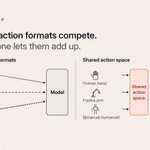
For robots, what happens next depends on the robot's body. An arm and a humanoid can't make the same moves.
P37 Neuro tells the AI which robot it is controlling: its joints and how far each one can move. We're building it in the open at @OntosWorld


This is the problem we're building P37 Neuro around.
We come at it from the body side. Each robot is described as structured data: its joints, limits, actuators, sensors and kinematics. A high-level policy outputs the task as intent that isn't tied to one body, like reach or grasp. A separate low-level policy turns that intent into motor commands for the specific robot.
The goal is that a new robot body shouldn't automatically need a new model.

Where it stands: the software platform is implemented and tested, including a trainable baseline model built to handle robots with different body structures. The current work is training at scale and testing on robot bodies the model never saw in training. We don't have those results yet, and held-out bodies are the test we'll hold it to.

Ontos retweeted
We've made another significant step forward with P37 Neuro.
The latest version brings task intelligence and fast motor control together, allowing the system to reason about what needs to happen next while a faster, body-specific policy handles the physical movement.
Getting these two levels of intelligence to work together has been a major part of our engineering work at @OntosWorld.
We're getting closer to the kind of robot intelligence we've been building toward: one that can understand a task and translate that understanding into physical action across different machines.
Ontos retweeted

Machines get paid once the work is proven.
@sedaprotocol handles verification for @OntosWorld , whose stack settles payments on @peaq.
Live on testnet today.
Verified work is the plumbing.
Ontos retweeted
I want developers to be able to take what they've built for one robot and bring as much of it as possible to another.
We've spent a considerable part of our work on P37 defining how different robots connect to the same intelligence system.
That means accounting for their actual hardware, from joint mappings to sensor inputs and control limits.
The architecture is in place already. What matters now is testing how easily developers can bring in new machines without having to modify the core system.

ALT Robotics

P37 Neuro is designed to make robot software easier to use across different machines.
A robotic arm and a humanoid may have entirely different joints, sensors, and control systems, even when performing similar tasks.
We've developed a Robot Integration Kit that maps these hardware differences into a common software interface.
Developers can reuse more of their existing software when connecting new robots, while keeping each machine's physical limits and safety requirements intact.
The integration system is implemented. We're continuing to validate it across different robot configurations and physical hardware.

P37 Neuro is designed to make robot software easier to use across different machines.
A robotic arm and a humanoid may have entirely different joints, sensors, and control systems, even when performing similar tasks.
We've developed a Robot Integration Kit that maps these hardware differences into a common software interface.
Developers can reuse more of their existing software when connecting new robots, while keeping each machine's physical limits and safety requirements intact.
The integration system is implemented. We're continuing to validate it across different robot configurations and physical hardware.

Ontos retweeted
A robot learns to grasp an object. Move the same policy to a different arm and it may fail. The task is unchanged, but the geometry, joints and motor limits are different.
Cross-embodiment learning addresses this problem by allowing learned skills to transfer across different robot bodies.
With P37 Neuro, we've built a system that represents each robot's physical structure and separates task reasoning from body-specific control.
This allows us to train and evaluate shared policies across different robot designs, reducing the need for separate models for every machine.
Our current work focuses on measuring how well these policies generalize to robot bodies excluded from training.


A robot learns to grasp an object. Move the same policy to a different arm and it may fail. The task is unchanged, but the geometry, joints and motor limits are different.
Cross-embodiment learning addresses this problem by allowing learned skills to transfer across different robot bodies.
With P37 Neuro, we've built a system that represents each robot's physical structure and separates task reasoning from body-specific control.
This allows us to train and evaluate shared policies across different robot designs, reducing the need for separate models for every machine.
Our current work focuses on measuring how well these policies generalize to robot bodies excluded from training.
Ontos retweeted
Robot-2-Robot Markets are just one example of the global markets SEDA's infrastructure is now serving.
We're evolving from an oracle to necessary infrastructure for the merger of global markets onchain.
study: @OntosWorld + @peaq

“10 years from now, there could be well over 1 billion humanoid robots” — Elon Musk
SEDA= Verification layer for robotic tasks
@peaq= Blockchain for machines
Ontos= Machine understanding of physical environments