

Advancing general-purpose intelligence for robotics
Ontos World
Joined July 2026
- Tweets86
- Following6
- Followers62
- Likes334






Ontos retweeted

how P37 Neuro works
> You describe the robot in URDF, MJCF or OpenUSD. P37 reads its joints, limits, actuators and sensors, and one shared brain learns across all of those bodies.
> The learned part is split in two. A task policy picks the next subgoal, and a motor policy turns it into joint commands for the body it's running on.
> Those commands are requests. Each one passes through a deterministic C++20 safety runtime before anything moves:
→ joint position limits
→ velocity and torque limits
→ watchdogs and e-stop integration
> If a command breaks a limit, it gets rejected. The network never touches the motors directly.
> Where it stands: the platform path from P37-E0 to E6 is built and tested. Learned capabilities are still in validation, and we're testing with partners.
Ontos retweeted
We've spent much of this week in conversations with our partners.
No new version releases this week, our focus has been on understanding what teams need from our technology and where we should direct our engineering efforts next.
A quick look at what we're building at Ontos:
P37 Neuro: Shared robot intelligence designed to work across different robot bodies.
Sense: Real-time machine context that helps systems understand a robot's current state and capabilities.
Ontos Verify: Verifies evidence of completed robot tasks before payment is released.
We've published a short overview of each product, including what they do and how they work.
ontos.ws/products

Ontos retweeted
New AI models can effectively predict what happens next in a scene. These are called world models.
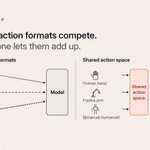
For robots, what happens next depends on the robot's body. An arm and a humanoid can't make the same moves.
P37 Neuro tells the AI which robot it is controlling: its joints and how far each one can move. We're building it in the open at @OntosWorld


Ontos retweeted
We've made another significant step forward with P37 Neuro.
The latest version brings task intelligence and fast motor control together, allowing the system to reason about what needs to happen next while a faster, body-specific policy handles the physical movement.
Getting these two levels of intelligence to work together has been a major part of our engineering work at @OntosWorld.
We're getting closer to the kind of robot intelligence we've been building toward: one that can understand a task and translate that understanding into physical action across different machines.
Ontos retweeted

Machines get paid once the work is proven.
@sedaprotocol handles verification for @OntosWorld , whose stack settles payments on @peaq.
Live on testnet today.
Verified work is the plumbing.

Ontos retweeted
I want developers to be able to take what they've built for one robot and bring as much of it as possible to another.
We've spent a considerable part of our work on P37 defining how different robots connect to the same intelligence system.
That means accounting for their actual hardware, from joint mappings to sensor inputs and control limits.
The architecture is in place already. What matters now is testing how easily developers can bring in new machines without having to modify the core system.

ALT Robotics

P37 Neuro is designed to make robot software easier to use across different machines.
A robotic arm and a humanoid may have entirely different joints, sensors, and control systems, even when performing similar tasks.
We've developed a Robot Integration Kit that maps these hardware differences into a common software interface.
Developers can reuse more of their existing software when connecting new robots, while keeping each machine's physical limits and safety requirements intact.
The integration system is implemented. We're continuing to validate it across different robot configurations and physical hardware.

Ontos retweeted
A robot learns to grasp an object. Move the same policy to a different arm and it may fail. The task is unchanged, but the geometry, joints and motor limits are different.
Cross-embodiment learning addresses this problem by allowing learned skills to transfer across different robot bodies.
With P37 Neuro, we've built a system that represents each robot's physical structure and separates task reasoning from body-specific control.
This allows us to train and evaluate shared policies across different robot designs, reducing the need for separate models for every machine.
Our current work focuses on measuring how well these policies generalize to robot bodies excluded from training.


Ontos retweeted
Robot-2-Robot Markets are just one example of the global markets SEDA's infrastructure is now serving.
We're evolving from an oracle to necessary infrastructure for the merger of global markets onchain.
study: @OntosWorld + @peaq

“10 years from now, there could be well over 1 billion humanoid robots” — Elon Musk
SEDA= Verification layer for robotic tasks
@peaq= Blockchain for machines
Ontos= Machine understanding of physical environments
Ontos retweeted
Cross Embodiment training sets are coming to P37 Neuro today.
I won’t be active here for the whole day but will put you all up to speed.

Introducing P37 Neuro, our open-source robot brain at @OntosWorld.
For a while, we’ve been working on a question:
Can we build a robot brain that keeps working when the body or task changes?
P37 Neuro is part of our answer.
The system is designed to understand the body it controls, interpret the state of the robot and its environment, follow a task or demonstration, and turn that information into physical actions.
A new robot or task shouldn’t always require a completely new model.
P37 has an embodiment layer that represents the robot itself, high- and low-level policies for planning and control, and memory that carries context across actions and failures.
It also supports reinforcement learning, simulation in MuJoCo and Isaac Lab, and a C++ runtime that connects the learned policy to the physical machine.
Around the model, we’ve built the infrastructure for training, evaluation, safety, model releases, fleet feedback, and rollback.
The current software path covers P37-E0 through E6.
We’ve begun testing the ideas behind the system.
A shared model has been trained across different synthetic robot morphologies and evaluated on bodies it had never encountered during training.
We’ve also tested demonstration conditioning on unseen tasks, with no fine-tuning during evaluation.
For the memory tests, we gave the model information before a simulated failure, then compared its performance when that memory was preserved and when it was removed.
Ontos retweeted
Our product briefing page remains available for enterprises and developers exploring and building inference solutions for robotics and hardware applications.
You can also explore our open-source products and developer resources on our website, designed to support innovation and accelerate real-world AI deployment.

Ontos retweeted
Diving deeper into machine-executed data settlement next week with @promiseeuler from @OntosWorld

Ontos retweeted
Ontos World Robots are entering the workforce
@sedaprotocol is their data layer
@peaq is their blockchain
@OntosWorld how they translate real world.
Love seeing the growth from the Ontos team and looking forward to talking more about what's happening here.
note: Ontos is still in testnet and under development, but a very cool story unfolding

Ontos retweeted
We’re opening product briefings with a small number of teams working across robotics and physical AI.
we’ve built a growing set of products around machine reasoning, spatial understanding, machine identity, coordination, and real-world deployment.
Request access to a briefing 👇👇
Ontos retweeted
Introducing P37 Neuro, our open-source robot brain at @OntosWorld.
For a while, we’ve been working on a question:
Can we build a robot brain that keeps working when the body or task changes?
P37 Neuro is part of our answer.
The system is designed to understand the body it controls, interpret the state of the robot and its environment, follow a task or demonstration, and turn that information into physical actions.
A new robot or task shouldn’t always require a completely new model.
P37 has an embodiment layer that represents the robot itself, high- and low-level policies for planning and control, and memory that carries context across actions and failures.
It also supports reinforcement learning, simulation in MuJoCo and Isaac Lab, and a C++ runtime that connects the learned policy to the physical machine.
Around the model, we’ve built the infrastructure for training, evaluation, safety, model releases, fleet feedback, and rollback.
The current software path covers P37-E0 through E6.
We’ve begun testing the ideas behind the system.
A shared model has been trained across different synthetic robot morphologies and evaluated on bodies it had never encountered during training.
We’ve also tested demonstration conditioning on unseen tasks, with no fine-tuning during evaluation.
For the memory tests, we gave the model information before a simulated failure, then compared its performance when that memory was preserved and when it was removed.
Ontos retweeted
Introducing Sense, an open-source SDK for physical machine context.
We built Sense at Ontos while testing our reasoning model for physical machines that required peaq services.
The idea is simple: a model should not only understand a machine, it should also know what that machine can actually do right now based on its current state.
Sense takes live data like battery level, safety state, connectivity and sensor health, and turns it into capability states:
AVAILABLE<>DEGRADED<>UNAVAILABLE<>UNKNOWN
It runs locally, works with ROS 2, MQTT and HTTP, and can also publish capability changes as peaq Activity Events.
We open-sourced it so developers can test it with different machines, extend it, and help us explore better ways for machines to communicate what they can actually do in the real world.

Ontos retweeted
We built a 3B parameter model at Ontos focused on physics and mathematics for robotics, and we are benchmarking it against frontier models using public, independently verifiable benchmarks and published research.
For robots, perception is not enough. They also need to reason about spatial relationships, motion, force, geometry and how objects interact in the physical world.
That is what we are building this model for.
We are currently testing it against much larger frontier models on physics, applied mathematics, rigid-body dynamics, kinematics, geometry, mainly to measure how much physical reasoning and spatial reasoning we can get from a smaller model.
The model is already in private testing with a few dev partners.
We will share the benchmark results, more technical details and the launch date soon.
A big part of robotics for us is getting machines to build a better understanding of the physical world they operate in.

Ontos retweeted
Spent part of the weekend pushing a few new developments at @OntosWorld and setting up what I want us to test this week.
I have also been watching how fast the space is moving.
World Labs is pushing further into spatial intelligence with the new atlas release. NVIDIA continues to expand its robotics stack, and Physical Intelligence is making progress toward more general robotics.
There is a lot happening, but also a lot that still needs to be built.
Looking at this image gives me a very clear thinking path around where all of this can go. There is so much to do, so much to test, and a lot we still want to prove.
I am very optimistic about the direction we are taking.
We are here to win.
