

Claude Community Ambassador. Founder of Kybernesis - Infrastructure for the agent era.
Chiang Mai, Thailand
Joined August 2025
- Tweets178
- Following353
- Followers154
- Likes191






Ian Borders retweeted

i sold my 4th saas, all possible thanks to Dev Shah
If you’re looking to buy businesses, he’ll help you navigate the process
If you’re trying to sell, reach out and he might be able to help too :)

4 bootstrapped SaaS exits. @johann_sath makes it look easy
DMpro just got acquired, and it was a pleasure working with him to get this one closed
congrats brother!
The new @buzzdotxyz app preview has a plugin surface. Love this direction! I created in-line artifacts/cards for our Kybernesis / @eve agents
h/t @0xnfrith updating me live from AGNTcon while chillin with the Buzz team.

ALT Artifacts in Buzz
Another example of a (non-artifact / browser) inline card drawn with react components with the new @buzzdotxyz plugins

Ian Borders retweeted

AI fatigue is real.
@OpenMotus: “You have so many different agents and you don't know what you're gonna choose.”
“We have ChatGPT and Claude, and all of them integrated in there. And some of these things are really good at certain tasks, so orchestration is gonna be a big part of the future.”
“If you wanna run Instagram ads, you're gonna have to use Meta AI. If you wanna run stuff on X, you're gonna have to use GroqBot.”
“These walled gardens are going up. That's just the world I think we're going into.”
Ian Borders retweeted
Ian Borders (@OpenMotus), Founder of Kybernesis (@kybernesis) and Managing General Partner at Darkstar VC, will be joining us LIVE on the show today at 6 PM SGT.

I was in an EAP to what I assume was an early pre-cursor to this several months ago, and it was amazing then, so I can only imagine the level its on now. Excited to try.


As the Claude Community Ambassador in Thailand, I've been running most of the Claude events for nearly the last year in Chiang Mai, but starting in a couple weeks, tons of @claudeai Community meetups, workshops, and events will be coming to Bangkok!
More details coming soon...

Very interesting data here: anthropic.com/research/emplo…

We took @eve and gave it everything an employee has.
An identity. Its own computer. A company credit card. A vault for logins. SOTA memory. Even a phone number.
We put an enterprise control plane around it so your whole company can use one agent.
kybernesis.ai/agent
Ian Borders retweeted

One really cool thing you can do in Buzz is customize the 'Run on' dropdown in the advanced section of agent creation.
For instance, i added "boat", which uses the boat.dev service when starting up an agent.
'Run on' decides where your agent runs when you hit Start. By default that's your own computer. But Buzz picks up any program on your PATH named buzz-backend-<name> and adds it to the dropdown. The program describes its own settings, so Buzz draws the form for you (see the screenshots).
So buzz-backend-boat spins up a boat.dev sandbox, starts the agent there, and the agent talks to your relay from the cloud instead of your laptop.
Once it's started, my laptop can be closed and the agent keeps running.


Ian Borders retweeted
So, imagine you sign up for a hackathon, and part of the hackathon is that you must work in a team of four to five people. You're told that you have to work with some particular AI model, and the whole team has to work quickly and decisively toward some particular goal.
Now, how do you do this when you know none of the other people, you literally just met them, and you immediately have to hit the ground running? What options do you have available to coordinate a team effort like this?
The answer is...
Buzz.
This weekend, I had the opportunity to take part in Chiang Mai's first-ever Anthropic hackathon, and also had the opportunity to watch how teams were able to coordinate effectively, efficiently, and very quickly, all of them using Buzz.
It was an incredibly enlightening experience, not just for me, but I think for a lot of the folks who were there. Seeing everyone's eyes light up made it incredibly clear: this platform is the real deal. This is the real thing.
I do think the world is sleeping on this. If you're reading this message and you haven't tried it, you absolutely should take a look.

Ian Borders retweeted
Opus 5.5 animation created with this prompt: "make me an animation to explain why celld earns its place."
There's way more context behind this but i thought the opus 5.5 output was impressive enough to share it here on X.
Gave my @eve agents multi-plex conversational voice and threw them on the Apple Watch.
Now I can keep orchestrating my agent work while I’m at the gym.
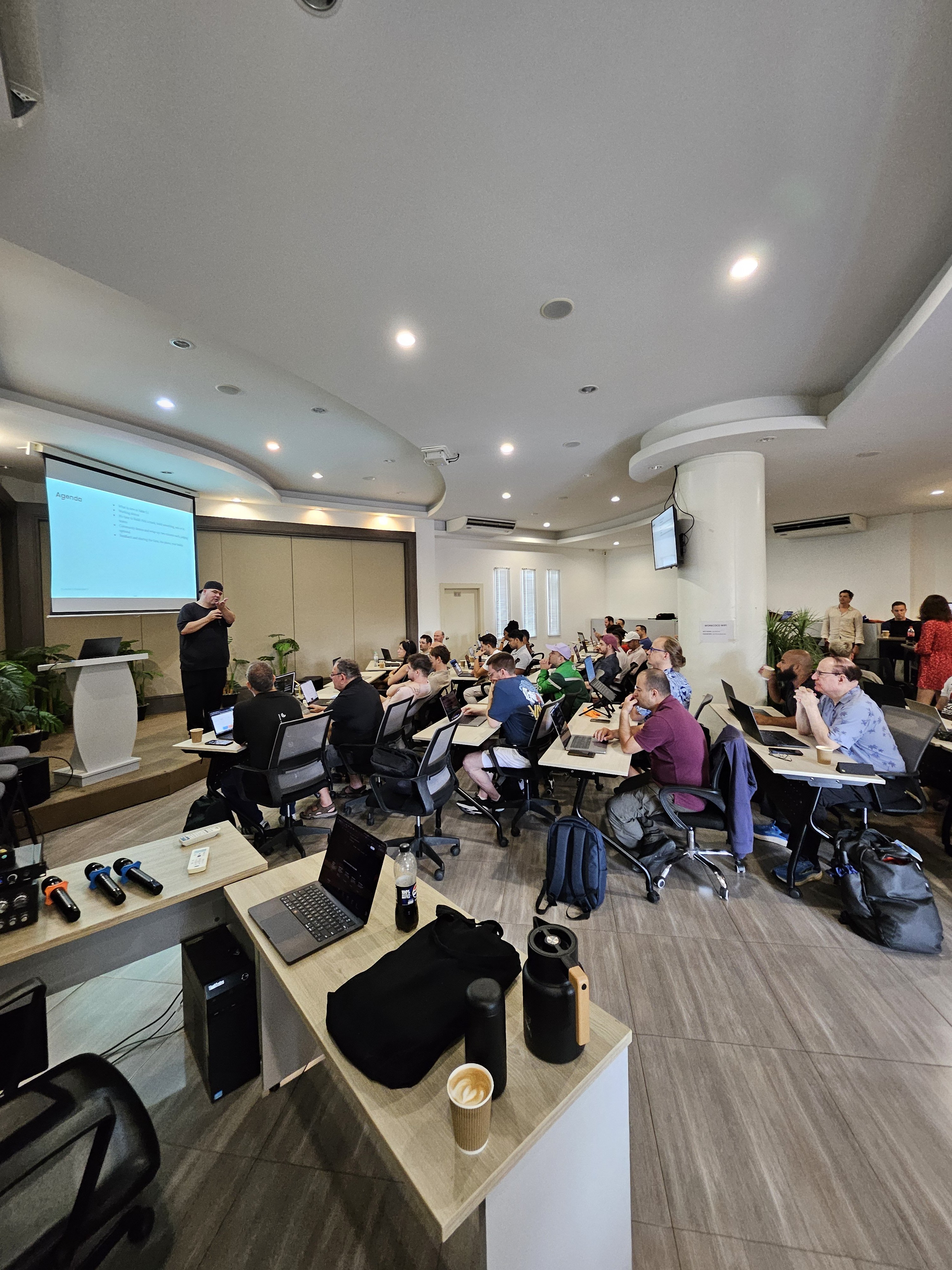
Successful @claudeai Fable Build Day yesterday in Chiang Mai! 80 people, and they built some amazing stuff.
Looking forward to many more Build Day events in the future, and we have our first Impact Labs 24 hour hackathon next week. Should be epic!
Ian Borders retweeted
Had an awesome day today at Claude Fable Build Day. It was super cool to see all the presentations at the end, and basically what could be done with Fable in such a short period of time.
I think what a lot of people got from this today was having their eyes opened to the power of what can be done with a Fable-class model in such a short timeframe.
Also, doing this rotation of like 2-3 minutes per presentation is super awesome. I wish I could see this all day long.
I really hope you get to host more of these @OpenMotus !
Ian Borders retweeted

I must be among an extremely small group of people (n=1?) that have both 1) trained a frontier LLM and 2) designed and synthesized custom viruses in a lab with my own two hands.
And I think that the takes on AI killing us all by creating dangerous viruses is total bogus.
Ian Borders retweeted

AI isn’t going away. Barring unprecedented global government coordination, it isn’t even slowing down.
The only real decision is whether to centralize power, or disperse it.
Do you fear the technology? Or a small number of people controlling the technology?
Ian Borders retweeted

The concerns over AI safety and cybersecurity are legitimate, but we’re risking talking America, the global AI leader, into self-inflicted obsolescence and the obscurity of bureaucracy.
The OpenAI hacking HuggingFace argument is spurious. An agent in “ExploitGym”… exploited. Our adversaries have the training techniques, the data, and the will to attack. And they won’t be slowed down with “embedded evaluators.” They’ll likely have embedded accelerators!