

Claude Community Ambassador. Founder of Kybernesis - Infrastructure for the agent era.
Chiang Mai, Thailand
Joined August 2025
- Tweets178
- Following353
- Followers154
- Likes191
Ian Borders retweeted

i sold my 4th saas, all possible thanks to Dev Shah
If you’re looking to buy businesses, he’ll help you navigate the process
If you’re trying to sell, reach out and he might be able to help too :)

4 bootstrapped SaaS exits. @johann_sath makes it look easy
DMpro just got acquired, and it was a pleasure working with him to get this one closed
congrats brother!
Ian Borders retweeted

AI fatigue is real.
@OpenMotus: “You have so many different agents and you don't know what you're gonna choose.”
“We have ChatGPT and Claude, and all of them integrated in there. And some of these things are really good at certain tasks, so orchestration is gonna be a big part of the future.”
“If you wanna run Instagram ads, you're gonna have to use Meta AI. If you wanna run stuff on X, you're gonna have to use GroqBot.”
“These walled gardens are going up. That's just the world I think we're going into.”
Ian Borders retweeted
Ian Borders (@OpenMotus), Founder of Kybernesis (@kybernesis) and Managing General Partner at Darkstar VC, will be joining us LIVE on the show today at 6 PM SGT.

Ian Borders retweeted

One really cool thing you can do in Buzz is customize the 'Run on' dropdown in the advanced section of agent creation.
For instance, i added "boat", which uses the boat.dev service when starting up an agent.
'Run on' decides where your agent runs when you hit Start. By default that's your own computer. But Buzz picks up any program on your PATH named buzz-backend-<name> and adds it to the dropdown. The program describes its own settings, so Buzz draws the form for you (see the screenshots).
So buzz-backend-boat spins up a boat.dev sandbox, starts the agent there, and the agent talks to your relay from the cloud instead of your laptop.
Once it's started, my laptop can be closed and the agent keeps running.


Ian Borders retweeted
So, imagine you sign up for a hackathon, and part of the hackathon is that you must work in a team of four to five people. You're told that you have to work with some particular AI model, and the whole team has to work quickly and decisively toward some particular goal.
Now, how do you do this when you know none of the other people, you literally just met them, and you immediately have to hit the ground running? What options do you have available to coordinate a team effort like this?
The answer is...
Buzz.
This weekend, I had the opportunity to take part in Chiang Mai's first-ever Anthropic hackathon, and also had the opportunity to watch how teams were able to coordinate effectively, efficiently, and very quickly, all of them using Buzz.
It was an incredibly enlightening experience, not just for me, but I think for a lot of the folks who were there. Seeing everyone's eyes light up made it incredibly clear: this platform is the real deal. This is the real thing.
I do think the world is sleeping on this. If you're reading this message and you haven't tried it, you absolutely should take a look.

Ian Borders retweeted
Opus 5.5 animation created with this prompt: "make me an animation to explain why celld earns its place."
There's way more context behind this but i thought the opus 5.5 output was impressive enough to share it here on X.
Ian Borders retweeted
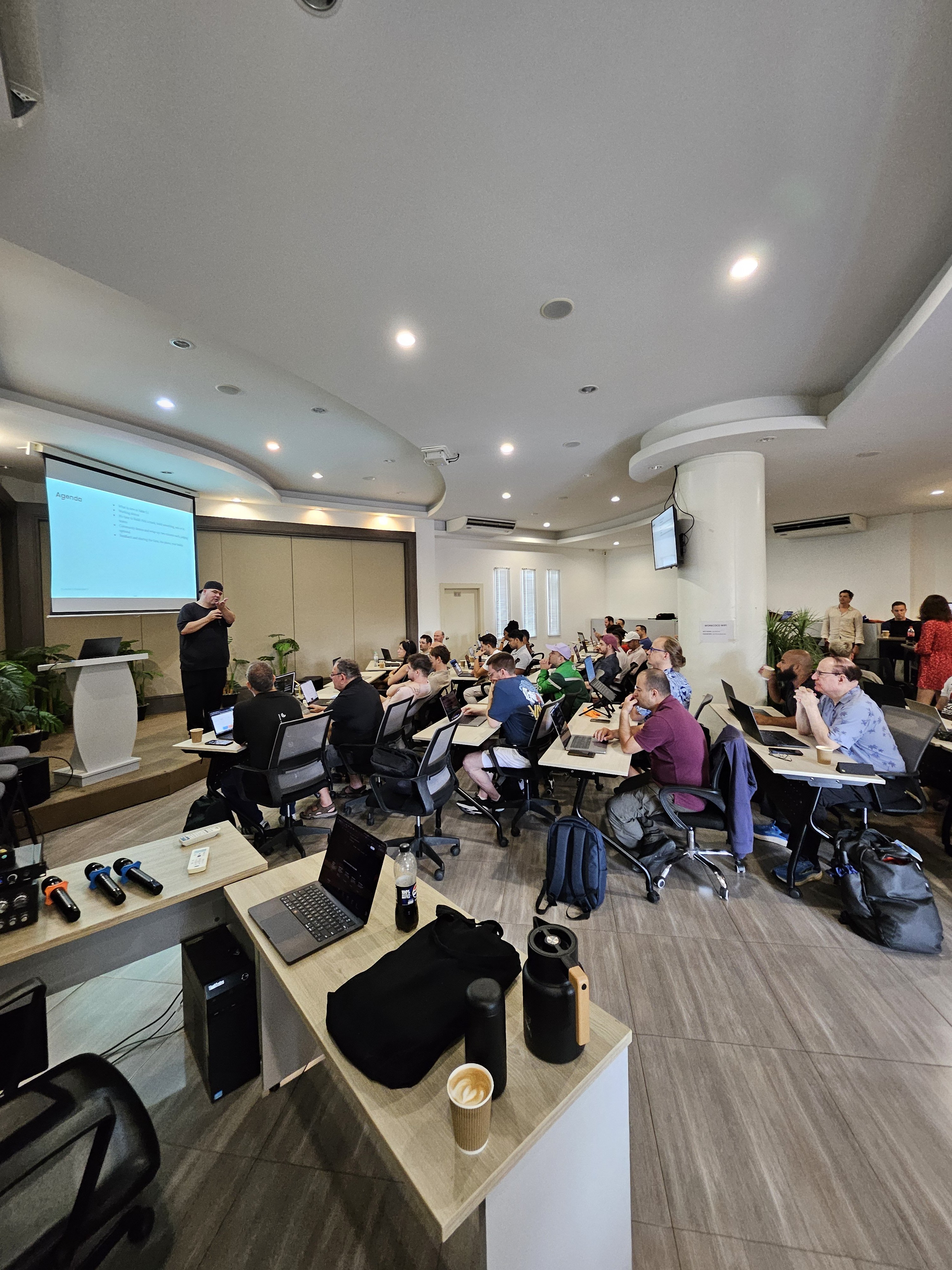
Had an awesome day today at Claude Fable Build Day. It was super cool to see all the presentations at the end, and basically what could be done with Fable in such a short period of time.
I think what a lot of people got from this today was having their eyes opened to the power of what can be done with a Fable-class model in such a short timeframe.
Also, doing this rotation of like 2-3 minutes per presentation is super awesome. I wish I could see this all day long.
I really hope you get to host more of these @OpenMotus !
Ian Borders retweeted

I must be among an extremely small group of people (n=1?) that have both 1) trained a frontier LLM and 2) designed and synthesized custom viruses in a lab with my own two hands.
And I think that the takes on AI killing us all by creating dangerous viruses is total bogus.
Ian Borders retweeted

AI isn’t going away. Barring unprecedented global government coordination, it isn’t even slowing down.
The only real decision is whether to centralize power, or disperse it.
Do you fear the technology? Or a small number of people controlling the technology?
Ian Borders retweeted

The concerns over AI safety and cybersecurity are legitimate, but we’re risking talking America, the global AI leader, into self-inflicted obsolescence and the obscurity of bureaucracy.
The OpenAI hacking HuggingFace argument is spurious. An agent in “ExploitGym”… exploited. Our adversaries have the training techniques, the data, and the will to attack. And they won’t be slowed down with “embedded evaluators.” They’ll likely have embedded accelerators!


Ian Borders retweeted
New experimental feature in Buzz dropped. It's called 'Thread Scoped ACP Sessions'.
I asked a fable 5.1 Buzz agent to explain it + draw it since that name doesn't immediately give away what it does. Here is my simple human translation for you:
In Buzz you can create threads inside a channel. When you mention an agent inside a thread, the agent's context is populated only by the data inside the thread. Thats with the toggle on.
Toggle off == agent sees the whole channel data on mention. more or less.
this brings buzz's agent behavior closer to the way claude tag works. and in some ways, its arguably better since agents in buzz don't have to deal with thread locking (when claude spins up inside slack, it locks the channel instruction and skills at start. requires a nerd to know to type `!restart`)


Ian Borders retweeted
buzz.xyz is more like a network layer for agents. i don't see it in the same solution category as hermes, open claw, claude, codex, opencode, etc.
It might be easiest to understand this by seeing the various agent setups i have seen. These are my own:
- I have a normal claude cli terminal running. And thats connected to buzz
- I have 3 cloud agents running that are also connected to buzz: claude and grok agents
- i have two k8s clusters, running in the cloud, connected to buzz
- all of my agents use a subscription plan
- I can connect openclaw, Hermes, devin, open source models, etc and more to buzz.
setups I have seen from others:
- cloud hermes agent
- vercel eve agents
- local qwen 3.8 27b
so what does it all mean? your 1 on 1 experience with whatever ai agent you use today, it doesnt really go away. i still interact with my terminal agent (albeit less and less).
what's important when youre using buzz, the focus of your attention is: how do you interact with other humans and agents - not just in your own server, but across servers

Ian Borders retweeted
I can truly say that I spend 50%-60% of my day running my agents from my phone now. And I am someone who lived in the terminal, using claude code CLI, and didn't want to leave the terminal for ANYTHING.
The thing that changed everything for me: Buzz.
I just use Buzz for managing everything. The buzz relay is so powerful. I'm really hyped for where it's future
Ian Borders retweeted
This is how I'm setting up my buzz channels. im still learning how to use it since its only 3 weeks out. i figured workflows and setups are going to take a while to figure out. so i figured i'd just share how mine is right now. maybe i can share more about it as it grows...
there's still a lot of figuring out for me to do, but this is the starting point.
i'm connected to three public relays and then a bunch of other private relays which are clients. working in buzz has made me think a lot about the layer between human public agent interaction and agents that "go into deployments". which means agents that go to do work in other relays that are not mine.
so i have three class of agents:
1. public only agents
2. private only agents (never leave my private relay)
3. deployment agents (they go and help people. return home)
agents from public relays should not be used in private relays due to prompt injection concerns. thats the reason for having public only agents. i keep those as cloud remote agents. you can see it as the exe dev vm's i have.
and whats cool about buzz is that it turns out theres a lot of knobs for how to configure your agent memory. you can have agents save memory inside the relay, in their own filesystem, or even inside a pod (ephemeral).
since all of my company data and ops and infra lives inside a "god agent", i'm taking a slow migration approach of moving things out of my meta-repo (think monorepo but with a lot of submodules).
Huge thanks to the buzz team for such a cool product that i think is industry changing. @Hello_World @_tombrow not sure who the other devs are but this is great!


Ian Borders retweeted
anthropic would look so much better if they released the freaking workflows they use internally. theyre always on the bleedinge edge and those workflows are hidden by some public relations gate. @trq212 @bcherny @The_Whole_Daisy @jarredsumner are sitting on stuff that if they just showed everyone what it looks like, i think people would see how powerful opus 5 and claude models are.
supposedly @bcherny is sitting on a "level 4" 1k+ agent setup and im supposed to guess what that looks like? sounds to me like i have to spend millions of dollars to figure this out. i'm not doing that.
daisy added her setup here and i think no one saw it. its incredible. its beautiful. show more of this. more details. link to her setup: xitter.cf/The_Whole_Daisy/status…
i have a hunch the claudeish language being produced by opus 5 isnt really a problem internally in anthropic. its probably a boon. evidence of their internal workflows would reveal that. see: xitter.cf/bcherny/status/2088021…
i wrote this post as a response to seeing this one from @trq212 xitter.cf/trq212/status/20912471… -- this post made me realize the struggle with using claude models is a know-how issue. cause the problem @kimmonismus and @argofowl have from this post xitter.cf/kimmonismus/status/209… is just a flat out skill issue
i see this every single time i FDE someone who is a claude user. i stand over their shoulder and all i do is point out things like "push that btn there. did you know this exists?" or me explaining really simple yet completely hidden facets of the anthropic architecture: "effort level means how much the model should pursue. in this scenario think of it like this:"
boris agent ladder: claude.ai/code/artifact/bfdf…
reference to his claim hes on "level 4": xitter.cf/bcherny/status/2077929…

The bigger payoff comes when fixing and maintaining happens in the background and your teams can focus on building. That's when you start doing things that weren't even in range before.
Anthropic is on step 3 and pushing toward 4. Personally, I just hit level 4.
Curious where you are -- what step is your team on?
Ian Borders retweeted
Buzz. The best multiplayer ai platform on the internet. @OpenMotus made a custom buzz tui. A testament to the awesome architecture under pinning Buzz. Kudos to the buzz dev team @Hello_World @_tombrow for making an awesome system. This is all being done in an open community btw. Come join!! build in the open, use your agents, experience the multiplayer.


Ian Borders retweeted

The force multiplier was never the model.
Everyone benchmarks the model. But one engineer running a set of agents can carry the load of a much larger team — and the thing that makes that real is the boring part nobody demos.
Persistent memory, so agents don't re-solve the same problem every session. Durable identity, so you know which agent did what. Clean hand-offs, so work moves between them without a human re-explaining context. Guardrails, so autonomy doesn't mean chaos.

ALT Kybernesis graphic on a cream background. Headline reads “Turn every team into a force multiplier,” with “force multiplier” set in orange italic serif. Small label “// For the enterprise” above it, and “Enterprise-ready · Secure // kybernesis.ai” below. Vintage engraving-style illustrations of a dragonfly at lower left and a tall sunflower at right.
Ian Borders retweeted
The (software) factory is the product. Your product is only as good as the agents you set up to autonomously maintain it.
This is what @elonmusk figured out about Tesla, and it's now true for the software world.
