We use biochemistry and genomics to uncover the mechanisms of gene silencing in development and cancer. @UWMadison @UWSMPH @BMC_UW

Wisconsin, USA
Joined March 2019
The Lewis Lab retweeted
Preprint alert! We are very excited to share our new manuscript on Bohring-Opitz syndrome, a devastating rare monogenic disorder driven by variants in ASXL1. This project was led by PhD student @Emma_JDoyle, one of the OG Conway lab members👏. 1/6 biorxiv.org/content/10.64898…
1
1
6
1,228
The Lewis Lab retweeted
Independent of sequence, disordered regions promote the stable chromatin occupancy required for pioneer-factor activity @ScienceAdvances science.org/doi/10.1126/scia…
1
6
12
1,502
The Lewis Lab retweeted
Teif Lab@TeifLabMar 6
Nucleosome aficionados! Our new review "Nucleosome spacing across cell types, diseases, and ages" is out in NAR: academic.oup.com/nar/article… A huge effort to pull together what we’ve learned about nucleosome spacing in many systems. Enjoy! #nucleosomics #nucleosome #chromatin #cfDNA
24
1
103
6,227
The Lewis Lab retweeted
Excited to share that our preprint 'RNA reinforces condensate nucleation on chromatin to amplify oncogenic transcription' is now online @MolecularCell cell.com/molecular-cell/full… @PennMedCSO @PennCancer @PennEpiInst
6
16
86
13,094
🔊 Check out the latest paper titled 𝘚𝘌𝘛𝘋𝟤 𝘮𝘦𝘵𝘩𝘺𝘭𝘵𝘳𝘢𝘯𝘴𝘧𝘦𝘳𝘢𝘴𝘦 𝘢𝘤𝘵𝘪𝘷𝘪𝘵𝘺 𝘱𝘳𝘰𝘮𝘰𝘵𝘦𝘴 𝘤𝘰𝘳𝘳𝘦𝘤𝘵 𝘵𝘳𝘢𝘯𝘴𝘤𝘳𝘪𝘱𝘵𝘪𝘰𝘯 𝘪𝘯𝘪𝘵𝘪𝘢𝘵𝘪𝘰𝘯 𝘢𝘯𝘥 𝘵𝘦𝘳𝘮𝘪𝘯𝘢𝘵𝘪𝘰𝘯, just published in the EMBO Reports @SpringerNature! 📲 doi.org/10.1038/s44319-026-0… 👩🏻‍🔬👨🏻‍🔬 The publication was authored by researchers from the GLaboratory of Genome Regulation (@STOPlabPI) and the Laboratory of Developmental Epigenetics, CAT AMU: Magda Kopczyńska, Agata Stępień, Michał Gdula, and Kinga Kamieniarz-Gdula. 👩🏻‍🔬👨🏻‍🔬The remaining authors are Chihiro Nakayama and Prof. Takayuki Nojima from @KyushuUniv_EN in Japan.
2
8
375
The Lewis Lab retweeted
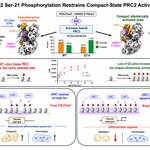
Allosteric activation of PRC2 is coupled to adoption of the compact state. Our new bioRxiv manuscript shows that EZH2 S21-phos, adjacent to the SANT1 domain, restrains this conformational transition and limits activation. @vignesh_k757 & Ben Garcia lab tinyurl.com/4369kmh2
3
8
632
The Lewis Lab retweeted
Preprint: The tumour suppressor RBM5 activates the helicase DHX15 to regulate splicing researchsquare.com/article/r… @UCLA
6
38
2,607
The Lewis Lab retweeted
Our linker histone H1 paper is out @ScienceAdvances: science.org/doi/10.1126/scia… @MasaAShimazoe et al. reveal that H1 acts as a liquid-like "glue" to organize chromatin in living cells. 🎉 Fantastic collab with @rcollepardo, @janhuemar, Charlie Phillips and others—huge thanks! 🙌 ½
5
72
2
310
37,232
Epigenetics Update - Accessory subunits of PRC2 mimic H3K27me3 to restrict the spread of Polycomb domains bit.ly/3NmLO5Q Edwina McGlinn & Chen Davidovich in Mol Cell #Epigenetics #PRC2 #H3K27me3 --- Perfect for cancer, immunology, and aging; epigenometech.com
5
20
939
The Lewis Lab retweeted
This paper is wild. After 3 rounds of directed evolution, they converted a DNA polymerase into an enzyme that can do: - RNA synthesis - Reverse transcription - Synthesis of "unnatural" nucleotides - Synthesis of DNA-RNA chimeras One of the best papers I’ve read recently. For context: In nature, it is DNA polymerase that takes a DNA sequence as a template and then copies it. These enzymes are crucial in replicating the genome for cell division, and they are EXTREMELY specific for DNA over RNA. This is key because RNA nucleotides are present in the cell at concentrations ~100x higher than DNA nucleotides, so the enzyme has evolved clever strategies to select one over the other. RNA polymerases, for comparison, are the enzymes that take a DNA sequence as template and then convert it into RNA. They are involved in gene expression, for example. To convert a DNA polymerase into an RNA polymerase (and all the other functions I mentioned earlier), the authors did a fairly straightforward directed evolution experiment. First, they took four DNA polymerase enzymes belonging to various archaea. These DNA polymerases don’t check for DNA vs. RNA as stringently as other types of cells, so they’re a good starting point to evolve RNA polymerases. The authors inserted some targeted mutations into these enzymes, based on known mutations in the literature. For example, they swapped the amino acid at position 409 for a smaller amino acid, thus removing a “gate” that keeps RNA building blocks from entering the enzyme. Next, they took the four genes encoding these DNA polymerases and cut them up into 12 segments each. They randomly stitched these 12 segments together — from the four different genes — to build millions of unique variants. Each shuffled gene was inserted into an E. coli cell. Then, they grew up these cells (each carrying a unique polymerase) and put them into microfluidic droplets. A device isolates each droplet, lyses the cell open, and releases the polymerase. The droplet also contains RNA building blocks and a DNA template, encoding a fluorescent reporter. If the polymerase begins synthesizing RNA, it will produce a detectable signal. They screened about 100 million droplets in 10 hours of work, searching for those with a signal. For each well that yields a fluorescent signal, the researchers isolated the DNA and sequenced it to figure out which polymerase it was. They repeated this 3x times, finally isolating a really excellent RNA polymerase variant which they called "C28." C28 has 39 mutations compared to the wildtype enzymes. It incorporates about 3.3 nucleotides of RNA per second, with 99.8% fidelity. The crazy thing is that this enzyme can also copy DNA or RNA templates back into DNA (reverse transcription), or use chimeric DNA-RNA molecules as a template and amplify them. It is just a super versatile polymerase that can act on DNA, RNA, or modified nucleotides, to build just about anything.
17
349
28
1,662
87,253
The Lewis Lab retweeted
Stress controls epigenetic inheritance! A histone ubiquitylation-based regulatory hub links stress/environmental signaling to heterochromatin self-propagation and epigenetic inheritance-reshaping how we think about development, drug resistance and cancer👉nature.com/articles/s41586-0…
19
30
9
88
7,989
The Lewis Lab retweeted
New online! Cell-cycle-dependent repression of histone gene transcription by histone H4 bit.ly/49lpAYX
1
11
1
47
4,018
Sam Krabbenhoft, @thePeterLewis & @harrisonflylab use fruit flies to study pediatric diffuse midline glioma. A new #GENETICS study identifies genetic pathways that could guide targeted therapies—showing the power of model organisms in cancer research: buff.ly/FwSPt8X
2
424
The Lewis Lab retweeted
遺伝子スケールのクロマチン物理を研究するため、ヒストン修飾を制御した96-mer (20 kb) の再構成系を確立しました。1分子観察・原子間力顕微鏡・in vitro Hi-Cにより特定の修飾パターンが構造や動態をどう変えるか調べています。論文のビジュ結構いいのでぜひ見てください! science.org/doi/10.1126/scia…
2
24
98
10,355
The Lewis Lab retweeted
Mechanisms of DNMT3A–3L-mediated de novo DNA methylation on chromatin nature.com/articles/s41594-0…
1
6
412
1/ 🚀 AEBP2 isn’t what we thought. You were told that AEBP2 promotes PRC2 activity on chromatin. We found the opposite: the most prevalent AEBP2 isoform inhibits PRC2 activity. Excited to share our new paper surl.li/cgwqcq A thread 🧵
1
8
3
20
1,569