
Communication adviser, consultant and spokesman; Ex safari guide; Conservationist; Interest in military affairs. Views are my own. 🇬🇧🇺🇸
London
Joined September 2009
- Tweets8.7K
- Following1.9K
- Followers426
- Likes40.9K




Patrick Gildart Jackson retweeted

Heavily armed terrorists stopped before they could murder.
Judging soldier, making split second decisions in 1991, through the lens of 2026.
It is clear, using the RoE, they were justified in opening fire.
This quoted post is unavailable.


Patrick Gildart Jackson retweeted

As we debate reparations for historical slavery, an estimated 50 million people are living in modern slavery. We should acknowledge the past, but freeing people enslaved today ought to be the greater priority than pointing fingers of blame for what happened 200 years ago. Where is the same political urgency for them?
Patrick Gildart Jackson retweeted

I agree with every word of this.

Slavery was an evil in which people from every continent and region participated. We should be honest about the whole history, not select the parts that are politically convenient today, especially given Britain's leading role in ending the transatlantic slave trade.
If Caribbean countries are asking Britain for a formal apology for Britain’s role in the transatlantic slave trade, will they also be asking the same of the descendants of African kingdoms, rulers and merchants who captured, sold and profited from the trade?
On demands for reparations, whether through cash or debt relief, we have been down this track before. Twenty-five years ago, Jubilee 2000, Drop the Debt and Make Poverty History argued that cancelling the debts of poorer countries would give them a fresh start. More than $100 billion of debt was eventually written off, but many of those countries have since built up even bigger debts. Labour are already spending too much on Britain's welfare state, now is not the time for Andy Burnham to be providing global welfare.
There is no reason British taxpayers today should be held financially responsible for things that happened generations before any of us were born. And I have even less patience for political elites in commonwealth countries who don’t know how to make their own citizens prosperous now looking for another opportunity to blame Britain.
As Prime Minister, Andy Burnham should be Britain’s greatest defender. Instead, he is writing articles saying we need to confront our history (as if we haven't done enough of that) and considering another formal historical apology. Tony Blair already expressed Britain’s deep sorrow and regret for our role in the slave trade nearly twenty years ago. There is no need to do so again.
This is all another navel-gazing distraction. The Commonwealth should be looking forward, not endlessly backwards. That means economic partnerships to make us all richer and deeper military and security cooperation against common threats. If every Commonwealth summit becomes an exercise in presenting Britain with demands for cash then we need to start asking if it is worth the effort.
Patrick Gildart Jackson retweeted

Slavery was an evil in which people from every continent and region participated. We should be honest about the whole history, not select the parts that are politically convenient today, especially given Britain's leading role in ending the transatlantic slave trade.
If Caribbean countries are asking Britain for a formal apology for Britain’s role in the transatlantic slave trade, will they also be asking the same of the descendants of African kingdoms, rulers and merchants who captured, sold and profited from the trade?
On demands for reparations, whether through cash or debt relief, we have been down this track before. Twenty-five years ago, Jubilee 2000, Drop the Debt and Make Poverty History argued that cancelling the debts of poorer countries would give them a fresh start. More than $100 billion of debt was eventually written off, but many of those countries have since built up even bigger debts. Labour are already spending too much on Britain's welfare state, now is not the time for Andy Burnham to be providing global welfare.
There is no reason British taxpayers today should be held financially responsible for things that happened generations before any of us were born. And I have even less patience for political elites in commonwealth countries who don’t know how to make their own citizens prosperous now looking for another opportunity to blame Britain.
As Prime Minister, Andy Burnham should be Britain’s greatest defender. Instead, he is writing articles saying we need to confront our history (as if we haven't done enough of that) and considering another formal historical apology. Tony Blair already expressed Britain’s deep sorrow and regret for our role in the slave trade nearly twenty years ago. There is no need to do so again.
This is all another navel-gazing distraction. The Commonwealth should be looking forward, not endlessly backwards. That means economic partnerships to make us all richer and deeper military and security cooperation against common threats. If every Commonwealth summit becomes an exercise in presenting Britain with demands for cash then we need to start asking if it is worth the effort.


Patrick Gildart Jackson retweeted

It is wholly inappropriate for any Defence Secretary to talk about the Chairman of the Defence Select Committee in this way – totally disrespectful.
Just because @TanDhesi had the temerity to question where the money is going to come from to get to 3% - given John Healey still has no plan, despite resigning over that very matter – it’s no excuse for @wesstreeting to vent his frustration in this way.
Patrick Gildart Jackson retweeted

"Disappointing"
The verdict on Healey's first budget from the UK defence trade body.
@ADSgroupUK CEO Kevin Craven: "Industry is still waiting for the full and detailed plan it needs to invest with confidence.
"The stakes could not be higher."
Patrick Gildart Jackson retweeted

There comes a point when compulsive lying by politicians becomes a threat to national security and reputation.
We seem to have reached that point.
telegraph.co.uk/politics/202…

Funnily enough this afternoon on BBC radio news presenter stumbled… “Today, the Chancellor of the Exchequer deslivered his first budget”, Freudian slip? Anyone else think of a reptile?

As expected, the @UKLabour Government is relying on creative accounting, ‘clever’ spin and ‘jam tomorrow’ to sell its so-called Defence Investment Plan (a tiny, and reduced sub-set of the budget) to a mainly disinterested, welfare-dependent, debt-loaded, post-industrial country.
This should not come as a surprise to anyone.
Paraphrasing @wesstreeting: “Those charged with the defence of the UK (regardless of threats faced) will have to live within their (treasury set) means…it’s the best we can do, and it’s all that the focus-groups want us to do…”
It’s the “see no evil” approach to defence planning
Patrick Gildart Jackson retweeted

Er, defence spending has too often been cut since the Cold War so this is a hollow metric for gauging the rebuilding of military strength
The question is: are we rearming at the speed of relevance? Given @wesstreeting says we need to be ready for war by 2030, it would appear not

Patrick Gildart Jackson retweeted
Insane or criminally anti-British.
Get rid of him.

Patrick Gildart Jackson retweeted
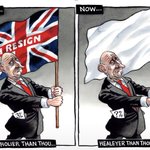
Healey fails his own test…
The Chancellor resigned as Defence Secretary because the cash Starmer offered would have left our country ‘less safe’.
Instead, he demanded 3% by 2030.
Now he’s Chancellor, the best he can offer is a plan to have a plan for 3%.
NO cuts to welfare to pay for Defence.
NO tough decisions today.
John Healey’s manana budget.
Patrick Gildart Jackson retweeted

Remember when Antoinette Fernandez (Green Party speaker of Hackney Council) bemoaned the British bombardment of Lagos, forcing her great great maternal grandfather from power?
She forgot to mention the reason why.
And you won't hear a single peep of apology from this lot about it.


Patrick Gildart Jackson retweeted

I asked Labour MP Dawn Butler why she's demanding my constituents pay more tax to fund "reparations".
She wouldn't answer, but called me a "racist" in the Commons.
It's not right to make people pay "reparations" when they've done nothing wrong. Name-calling doesn't change that.
Patrick Gildart Jackson retweeted
Always happy to rebut mendacious anti-semitic activism

Watch the full video here: youtube.com/watch?v=Cqf5dOvZ…
We got a furious response from the former Conservative minister Lord Michael Gove when we asked about his position on Israel at the Labour Conference.
Gove claimed he knew more about antisemitism than Zack Polanski, the only Jewish leader of a major political party in the UK. He also accused us of not being journalists and of an obsession with Israel, despite the Labour government's change in position on the occupation of Palestine being the key topic at this year's conference.
Gove now sits in the House of Lords and is editor of right-wing magazine The Spectator.
Patrick Gildart Jackson retweeted

The more I learn (from those involved) about what initiated this wholly unnecessary, clumsy, long and deeply damaging investigation into the UK COBRA-directed SAS Syrian detention operation in 2022, the more disturbed I become…
Seemingly initiated by @GenGJenkinsRM in his last three weeks of his time as DSF, he (alone) overruled the considered and well-advised judgement of the infinitely more experienced and better-informed SAS chain of command, as a self-serving “PR exercise” designed to demonstrate to a Panorama-triggered Whitehall that he and his staff will take media-generated, but unproven, accusations of war-crimes seriously.
On the face of it, this seems to be a particular egregious, Sulla-like example of a senior commander regarding loyalty to the troops as entirely transactional, and one that is quite willing to sacrifice their subordinates wellbeing when political expediency or personal ambition demands it.
If this impression is correct, then who else endorsed and supported it, and what message does that send to those involved in high-risk special operations today?

In 2022, five SAS soldiers shot dead two teenagers during an operation to detain an Islamic State target in Syria.
The Sunday Times has now revealed that the soldiers faced a three-year murder investigation before being cleared, which former SAS commander Richard Williams argues looks more like a public relations excercise than military judgement.
Watch in full | youtu.be/ye2pv3DTybQ @ShippersUnbound @williams_rje
Patrick Gildart Jackson retweeted

I'm seeing quite a bit of comment about this, so I want to make a couple of points.
I'm not owed eternal agreement from any actor who once played a character I created. The idea is as ludicrous as me checking with the boss I had when I was twenty-one for what opinions I should hold these days.
Emma Watson and her co-stars have every right to embrace gender identity ideology. Such beliefs are legally protected, and I wouldn't want to see any of them threatened with loss of work, or violence, or death, because of them.
However, Emma and Dan in particular have both made it clear over the last few years that they think our former professional association gives them a particular right - nay, obligation - to critique me and my views in public. Years after they finished acting in Potter, they continue to assume the role of de facto spokespeople for the world I created.
When you've known people since they were ten years old it's hard to shake a certain protectiveness. Until quite recently, I hadn't managed to throw off the memory of children who needed to be gently coaxed through their dialogue in a big scary film studio. For the past few years, I've repeatedly declined invitations from journalists to comment on Emma specifically, most notably on the Witch Trials of JK Rowling. Ironically, I told the producers that I didn't want her to be hounded as the result of anything I said.
The television presenter in the attached clip highlights Emma's 'all witches' speech, and in truth, that was a turning point for me, but it had a postscript that hurt far more than the speech itself. Emma asked someone to pass on a handwritten note from her to me, which contained the single sentence 'I'm so sorry for what you're going through' (she has my phone number). This was back when the death, rape and torture threats against me were at their peak, at a time when my personal security measures had had to be tightened considerably and I was constantly worried for my family's safety. Emma had just publicly poured more petrol on the flames, yet thought a one line expression of concern from her would reassure me of her fundamental sympathy and kindness.
Like other people who've never experienced adult life uncushioned by wealth and fame, Emma has so little experience of real life she's ignorant of how ignorant she is. She'll never need a homeless shelter. She's never going to be placed on a mixed sex public hospital ward. I'd be astounded if she's been in a high street changing room since childhood. Her 'public bathroom' is single occupancy and comes with a security man standing guard outside the door. Has she had to strip off in a newly mixed-sex changing room at a council-run swimming pool? Is she ever likely to need a state-run rape crisis centre that refuses to guarantee an all-female service? To find herself sharing a prison cell with a male rapist who's identified into the women's prison?
I wasn't a multimillionaire at fourteen. I lived in poverty while writing the book that made Emma famous. I therefore understand from my own life experience what the trashing of women's rights in which Emma has so enthusiastically participated means to women and girls without her privileges.
The greatest irony here is that, had Emma not decided in her most recent interview to declare that she loves and treasures me - a change of tack I suspect she's adopted because she's noticed full-throated condemnation of me is no longer quite as fashionable as it was - I might never have been this honest.
Adults can't expect to cosy up to an activist movement that regularly calls for a friend's assassination, then assert their right to the former friend's love, as though the friend was in fact their mother. Emma is rightly free to disagree with me and indeed to discuss her feelings about me in public - but I have the same right, and I've finally decided to exercise it.

“I think she’s going to find that you can’t sit on the fence... The real win is when ordinary people can say these things.”
@DerryBanShee speaks to @joshxhowie about Emma Watson’s comments about JK Rowling.
📺 youtu.be/r2OGEITYe2Y
Patrick Gildart Jackson retweeted

Ralph Fiennes has been a very, very naughty boy! He had the absolute audacity to publicly defend J.K. Rowling, the author of a series that gave him one of his most iconic roles to date… that of Harry Potter’s nemesis, Voldemort. Everyone is expected to perfectly goose-step in line and denounce her for her original sin of ‘transphobia’ due to a series of Tweets.
Fiennes is not the sort of man to get dragged along in pointless slacktivism on the internet. He doesn’t Tweet about how woke he is, he doesn’t run around with little rainbows on his lapels… no, Ralph Fiennes is an actual professional. No nonsense, old-school — you’re here to act, so act! I like that. He’s an admirable chap
Meanwhile Radliffe, Watson and whatever-his-name-is who plays Ron, the ginger sidekick, have all spat out Rowling and publicly denounced her, because the Gods of Social Justice have put a fatwa on her name.
Voldie: “I find the level of hatred that people express about views that differ from theirs, and the violence of language towards others, disturbing.”
Beautiful! To the point. And oh-so true. It is disturbing how incredibly, extremely, over-the-top pissed people get at you when you go against the narrative and dare to criticise whatever’s the current hype. The very fact that Fiennes is now “under fire” for a comment so benign, in defense of a woman so marvelous, is… terrifying.
Half the millennial cast of the Harry Potter universe wishes to all-but cancel the very Creator of their own universe, the woman to whom each of them owe their lucrative careers. Not Fiennes. Fiennes was somebody before Voldemort, and continued to be somebody after. He doesn’t need to defend or attack anyone. But he does, anyway, because he’s a decent human being.


Patrick Gildart Jackson retweeted

Yes, the monarchy was deeply implicated in the slave trade. But not the British monarchy.
The biggest African slavers were not pirates or bandits. They were kings. In the 1750s, King Tegbesu of Dahomey, in present-day Benin, was reported to be making £250,000 a year from selling slaves. That astronomical sum, equivalent to perhaps £45 million today, was vastly more than any British aristocrat
While Tegbesu was trafficking human beings, the future George III, who had recently become Prince of Wales, was becoming a convinced abolitionist. He wrote a monograph arguing that “slavery is equaly [sic] repugnant to the Civil Law as to the Law of Nature”. He went on, as King, to sign the abolition of the slave trade into law in 1807.
That act prompted incredulous rage among West African chiefs.
In the 1840s, King Ghezo of Dahomey, played by John Boyega in the 2022 film, The Woman King, fiercely resisted such pressure.
“The slave trade is the ruling principle of my people. It is the source and the glory of their wealth,” he complained.
Contrast his attitude with that of his British fellow-monarchs. Although Victoria, as Queen, was expected to refrain from expressing political opinions, her husband was under less constraint. Albert made his very first speech as Prince Consort to the Society for the Extinction of the Slave Trade and for the Civilization of Africa. His words are a reminder of how determined Britain was to ensure that ending the Atlantic slave trade did not simply push the commerce eastwards.
“I deeply regret that the benevolent and persevering exertions of England to abolish that atrocious traffic in human beings (at once the desolation of Africa and the blackest stain upon civilized Europe) have not as yet led to any satisfactory conclusion. But I sincerely trust that this great country will not relax in its efforts until it has finally, and for ever, put an end to a state of things so repugnant.”
The difference between the British Crown and contemporary African monarchies can be glimpsed in the story of Aina, a young Yoruba girl owned by King Ghezo of Dahomey.
In 1850, a naval captain called Frederick Forbes came to Dahomey to try to convince Ghezo to stop selling slaves. He was unsuccessful but, during his visit, he was offered Aina as a gift.
Forbes knew that such slaves were generally destined for human sacrifice, so he accepted the child, naming her Sara Forbes Bonetta. When Sara arrived in Britain, Queen Victoria became her godmother, paid for her education and arranged for her to marry a wealthy Yoruba businessman. Are the British really the baddies here?
Critics talk of telling our nation’s story “warts and all”; but they rarely get around to the “and all”. The “and all” surely includes the vast sums devoted to stamping out slavery, calculated by Chaim Kaufmann and Robert Pape as 1.8 per cent annually of GDP between 1808 and 1867, the most expensive moral foreign policy in human history. Even if there were a case for reparations in principle (which there is not) that sum alone – not counting the billions given in aid – would surely have covered any debt.
What we are seeing is not a debate about history, but an argument about contemporary politics. Critics want to convince us that Britain became rich through exploitation rather than, as was actually the case, through private property, free contracts and independent courts.
The easiest way to demonstrate the negative correlation between capitalism and slavery is to look at the places where human bondage is most prevalent today – in order, North Korea, Eritrea, Burundi, the Central African Republic and Mauritania. If William III owning shares in the Royal African Company bothers you more than the continuing abomination of slavery in those places, you need to ask yourself some hard questions about your motives.