

Developing mass spectrometry and chemical biology tools to study dynamic protein interactions at @VanderbiltChem. This is a trainee run account.
Nashville, TN
Joined March 2019
- Tweets143
- Following222
- Followers314
- Likes104
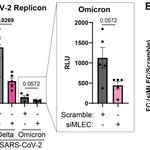
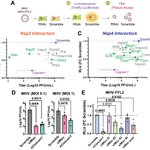

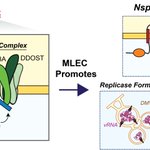


Lastly, is MLEC important for SARS-CoV-2 replication? We use a replicon system to show that YES, it is! (7/7)

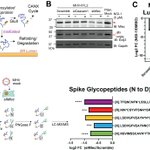
MLEC surveys our glycoproteins during production, checking for errors and capturing duds before they are sent out. Is this function of MLEC important for CoV replication? Yes! (6/7)

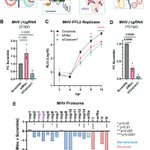
What part of CoV infection is MLEC used in? We measure different parts of viral replication and find that MLEC is important for viral protein production, particularly the nsps which are made early on. (5/7)

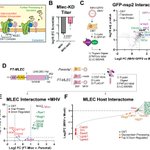
How does nsp2 interact with MLEC during infection? And does infection change what MLEC sees? We leverage proteomics and find 1) that nsp2 interacts with many of MLEC’s immediate neighbors (OST complex) and 2) infection dramatically alters MLEC’s interactome. (4/7)

Which of these interactors are actually important for CoV replication? We use a model CoV (MHV) to test what happens when we get rid of interactors one-by-one. One of the most exciting hits is Malectin (MLEC). (3/7)

CoVs use nonstructural proteins (nsps) to take over a host cell. What parts of a host cell do nsps interact with? We use proteomics to find host protein interactors of nsp2 and nsp4. Turns out nsps from several CoVs, like SARS-2, SARS-1, & MERS share several interactors (2/7)

Excited to share a preprint from @J_P_Davies PhD work! We find that CoVs, like SARS-CoV-2, use malectin (part of cells’ glycoprotein production assembly line) to make viral proteins and replicate. Malectin may be a prime pan-CoV antiviral target! 🧵(1/7)
biorxiv.org/content/10.1101/…

Congratulations @EliFritzMcD !

Congratulations to @EliFritzMcD (of the @MeilerLab & @Plate_Lab) on winning the 2024 Karpay Award in Structural Biology! Eli presents "CFTR Folding – Started from the Translocon Now We Here" on Tuesday, January 23, 2024, for the MBTP/CSB Seminar Series.
bit.ly/3ufN00S

Good morning Phoenix. Looking forward to attending #NACFC2023. If you’re around, come to the lunch roundtable on Proteomic-driven Advances in Studies of CF (RT29) where we’ll discuss the latest mass spec research on CF. @CF_Foundation

In sum, AM predicts CF accurately w/ a high false positive rate.
AM correlated modestly w/ clinical outcomes, but well w/ CFTR function. It cannot distinguish pathophysiology.
AM may prove useful for identifying CF causing variants in carriers, but caution must be taken.
(7/7)

Finally, we were curious if AM could predict CFTR theratype - how CFTR variants respond to drug.
This feat is technically outside AM's intended design, but is important in the CF field.
We concluded, AM cannot predict CFTR theratype. (6/7)

Correlation improved with CFTR electrophys functional data. This suggested AM learned something about CFTR function despite not training on these data.
Despite accurate pathogenicity predictions, AM cannot distinguish specifics of pathophysiology e.g. trafficking/gating. (5/7)

We also benchmarked against CFTR in vitro data.
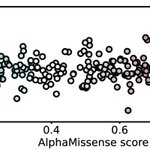
Correlation of #AlphaMissense pathogenicity scores with CFTR trafficking (C/B ratio) in vitro was also modest.
(4/7)

AM score correlated modestly with clinical outcome metrics such as sweat chloride measurements, that quantify CF severity.
Many variable consequence variants (yellow) under the best fit line suggest a high false positive rate - prediction scores that were too high. (3/7)

The accuracy to predict non-CF causing variants as benign is high (0.91 AUC ROC).
The accuracy to predict CF causing variants as pathogenic is somewhat high (0.80 AUC ROC).
And the accuracy to predict variants of variable consequence as ambiguous is low (0.61 AUC ROC). (2/7)

Can #AlphaMissense identify Cystic Fibrosis causing variants?
We benchmarked AM pathogenicity predictions on CF clinical outcomes from the CFTR2.org database and CFTR in vitro data. @EliFritzMcD @MeilerLab
Here's what we found: 🧵(1/7)
biorxiv.org/content/10.1101/…
Congrats @Dongsheng_Han1 and @JaredNordman! Glad that @J_P_Davies and our lab could contribute to this exciting paper.
This quoted post is unavailable.
Follow @J_P_Davies’s research activities in Peru: – at Nashville, TN
This quoted post is unavailable.
@J_P_Davies from our lab is forging new research collaborations at @IINPeru in Lima! Thanks to @vuglobalhealth and @VI4Research for spearheading this new program! – at Nashville, TN
This quoted post is unavailable.

