

Moroccan #ThinkTank that functions as an open debate platform, bridging between #policy making & #research. Organizes yearly the Atlantic Dialogues #AD2026
Rabat, Morocco
Joined March 2014
- Tweets39.8K
- Following386
- Followers17.4K
- Likes10.6K




Pinned Tweet
#AD2026
🌍 Four Atlantic continents. A fragmenting world order. Who shapes the emerging order?
As alliances shift and new geopolitical alignments emerge, questions of development, economic sovereignty, security and resilience take on new urgency. What is the New South’s place in this changing order? And what might the world look like in 2040?
These conversations come to Rabat on December 10-12, 2026, for the 15th edition of the #AtlanticDialogues, the Policy Center for the New South’s flagship high-level international conference.
🎬 Further details will be unveiled in the coming weeks. Stay tuned!
🔗 ad.policycenter.ma/
✍️ From #Hormuz and the Invisible Fractures: the Price of a Distant War - Views from the New South
"The current conflict is fundamentally different from previous shocks. Because the Gulf states now control the logistical corridors and chemical inputs for global agribusiness, any prolonged disruption to regional infrastructure threatens the structural stability of global #FoodSecurity & the high-tech industrial economy." @ocanuto
🔗Read more: policycenter.ma/publications…

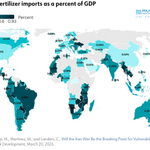
"Gulf exports underpin agricultural production across multiple continents, and delays in those shipments are now affecting planning cycles and food-supply chains far from the conflict itself." @MehranHaghirian
policycenter.ma/publications…

🎙️ Start your week w/ our #podcast exploring the global economic costs of disruption in the Strait of #Hormuz.
In this episode, @MehranHaghirian looks beyond oil and gas to explore the impact of these tensions on trade, fertilizer supplies & #FoodSecurity. He examines the vulnerabilities of African and other developing economies, and how regional cooperation and stronger economic ties can help build resilience to future shocks.
🔗 Tune in now: policycenter.ma/podcasts/glo…
“The economic cost of the war is measured in terms of lost output or GDP. Wars ‘generate large and persistent output losses in economies where the fighting occurs and nonnegligible spillovers to other countries’.”
policycenter.ma/publications…

"South-South trade has seen strong growth, accounting for 57 percent of goods exports from developing countries. This means developing countries are trading more with one another than with the developed world."
policycenter.ma/publications…

📢 Le Policy Center for the New South recrute !
✨ Nous recherchons un(e) Contrôleur(se) Financier(ère) Senior pour rejoindre notre équipe.
🔎 Ce poste offre l’opportunité de contribuer au renforcement et à la modernisation de nos processus de gestion financière, à travers le pilotage budgétaire, l’analyse financière & le développement d’outils automatisés de reporting. Vous participerez à l’optimisation de la performance financière, à l’amélioration de la prise de décision fondée sur les données et au suivi financier des projets.
💡 Profil recherché :
🎓 Bac+5 en finance, contrôle de gestion, audit ou dans un domaine connexe.
💼 3 à 5 ans d’expérience professionnelle pertinente.
💻 Maîtrise avancée d’Excel, de Power BI et de l’automatisation du reporting financier.
📍 Lieu : Rabat, Maroc
⏳ Contrat : CDI
🔗 Postulez maintenant: policycenter.ma/jobs/control…

📺 Insights4Peace #Webinar
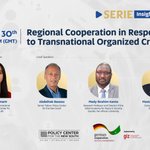
📢 How can regional cooperation help Africa respond to transnational organized crime?
The Policy Center for the New South is hosting a webinar on “Regional Cooperation in Responding to Transnational Organized Crime,” as part of the @_AfricanUnion Network of Think Tanks for Peace (AU @NeTT4Peace) Knowledge Series.
The discussion will explore how criminal networks fuel conflict and insecurity across Africa, and how intelligence sharing, joint operations, and coordinated legal frameworks can strengthen cross-border responses.
📅 October 30, 2026 | 🕛 12:00 PM (Morocco time) / 11:00 AM GMT
🔗 More details: policycenter.ma/events/insig…

Regardless of who wins, the next president will inherit a Brazilian economy that is slowing down. GDP growth is estimated at 1.9% in 2026, which would be the worst performance since 2020. @ocanuto
policycenter.ma/publications…

How does #Morocco’s electoral framework translate votes into seats, distribute political power, and shape representation and accountability? @chaimae_bj
policycenter.ma/publications…

#Brazil's election poses a question that extends well beyond Latin America: how much freedom does a country retain to define its international role when external pressure collides with domestic political exhaustion? @mvfreitas
policycenter.ma/publications…

#Africafé
📺 Cet épisode explore les enjeux de la #désinformation électorale en #Afrique et son impact sur l’intégrité des processus démocratiques, la confiance du public et l’acceptation des résultats.
@mbenabid & Fethi Debbabi analysent les acteurs, les motivations et les mécanismes de sa propagation, ainsi que le rôle des individus, des États et des organisations internationales dans la lutte contre ce phénomène. Ils examinent également les cadres juridiques existants et les réponses possibles pour y faire face.
🔗 Regarder maintenant: policycenter.ma/interviews/a…
📍 Our Senior Fellow @Bassou_Abdelhaq participated in the Global Dialogue on Power on October 21, opening the Europa Power Conference 2026 in Strasbourg.
He joined representatives of think tanks, foundations and universities from around the world to discuss the changing nature of power, systemic rivalry in the age of AI, and international cooperation for global common goods.
Running from October 21 to 23, the conference explores Europe’s sovereignty, democratic resilience and international role, with discussions spanning security, technology, energy and competitiveness.
@Europa_Nova

🇧🇷 How will Brazil’s 2026 #elections shape its domestic politics, regional and global influence, and relations with Morocco?
policycenter.ma/publications…

The Brazilian electoral cycle of 2026 will have long-lasting consequences for Brazil and the region. If Mr. Lula wins, despite the difficult electoral environment, it will almost certainly be his last run at the presidency, and he will have to prepare the next generation of leaders from the left, something he has struggled to do consistently over the last two decades.
The lack of credible and solid leadership on the left might weaken its chances of winning future elections over the medium term. If Mr. Flavio Bolsonaro wins, significant changes could follow internally, regionally, and internationally, as discussed above. The next week will therefore be crucial for Brazil's political trajectory and for its role in the region and the wider international system.