
RL PhD @UTAustin, Prev @GoogleDeepMind @MSFTResearch, Undergrad @iitdelhi
Bengaluru, India
Joined April 2024
- Tweets42
- Following519
- Followers208
- Likes212




Pragya Srivastava retweeted

Are newer models getting better at self-improvement?
Gemini Carbon and Argon are great on benchmarks, so we tried them on setups to measure learning from experience, following our recent work on Agent Plasticity.
1. Early results show an increasing trend in self-improvement capability with newer model releases across frontier models.
2. Each new model from frontier labs (Anthropic, GDM and OpenAI) has a higher ability to learn from experience.
3. Carbon has the highest measured plasticity among the models we tested.
Short 🧵

Pragya Srivastava retweeted

How should you mix text, vision, and audio when pretraining a multimodal LLM?
Happy to share our #NeurIPS2026 Spotlight, "Scaling Laws for Multimodal Data Mixtures"!
We fit one scaling law to 268 MoE pretraining runs (457M–8.3B params). Here is what it says 🧵

Good decisions can pay off thousands of steps later. Horizon scalable offline value learning helps agents learn from suboptimal logged experiences in long-horizon sparse rewards settings!
Excited to share our work on Horizon-scalable Q learning!
Please see @ryanxhr's thread below 👇

Pragya Srivastava retweeted

Foundation models are trained in stages: pretraining, midtraining, and post-training. But is this separation fundamental?
We introduce unified training: a single algorithm for the full pipeline. This gives
⚙️ Simpler infrastructure
🔬 A framework for better science
(1/n)

Pragya Srivastava retweeted

1/ RL for improving task success has made LLMs remarkably capable. But what happens when the model fails? Turns out, training for graceful failure can be surprisingly tricky!
Very excited to share our new paper: Training Language Models to Fail Gracefully
🧵
Pragya Srivastava retweeted

Deployed agents pile up execution traces. The question is whether we can automatically refine skills based on existing rollouts.
Introducing SkillRefiner: Offline skill refinement from the traces you already have! 🧵

Our paper got accepted to NeurIPS 2026 Evaluations and Datasets Track!

As @boazbaraktcs points out, the real challenge in AI safety isn’t the failures we expect—it’s the "unknown unknowns."
In our new paper with @dylanfeng_, @cassidy_laidlaw, and @ancadianadragan, we tackled this exact gap. We built the MOOD benchmark to show that traditional guard models often miss flagging these anomalous behaviours at test-time, but pairing them with robust OOD detectors (like Mahalanobis distance & perplexity) increases recall drastically—outperforming a standard guard model with 20x more parameters. 📈
Check out Boaz's post for the context on "unknown unknowns": 🔗 teapawt.net/boazbaraktcs/status/20…
Check out our full paper 👇
Pragya Srivastava retweeted
Foundation models are built in various stages, from pre-training to post-training and beyond. We still lack a principled understanding of how these stages interact.
Excited to co-organize “Transitioning from Pre-Training to Post-Training” at NeurIPS 2026 in Sydney.
Submit your work by Aug 29!

announcing the NeurIPS 2026 workshop on *Transitioning from Pre-training to Post-training*!🍓
come bring your theory, empirics, & methods to enable better foundations, mechanics, & evaluation for LLM training!
submit your work by 29th August!🗓️
pretrain2posttrain.github.io…
🧵

Pragya Srivastava retweeted

Learning from suboptimal data is important, because robots make suboptimal data on their own, and the more robots there are, the more data they make. If you want to contribute to building a public, open dataset of suboptimal data, check this out!

Pragya Srivastava retweeted

🤔On-policy (self) distillation has a prefix failure issue: when the student's rollout y_o is wrong (far from the teacher distribution), the teacher’s gradient signal becomes problematic.
🚨Introducing Trajectory-Refined Distillation (TRD), a trajectory-level refinement of y_o to solve the issue.
tldr: OPD/OPSD❌ TRD ✔️
Paper: arxiv.org/pdf/2606.08432

Pragya Srivastava retweeted

🚨 New research work with @CHAI_Berkeley!
We provide the first multi-domain benchmark evaluating safety monitors for OOD misalignment detection by intentionally restricting the training dataset.
Special thanks to folks @MATSprogram and @haizelabs for providing valuable feedback and compute.


Pragya Srivastava retweeted
AI labs keep pumping in more and more safety training data to prevent safety failures based on observed test time failure modes. however, it's important to catch safety failures that we don't know beforehand ("unknown unknowns")/
cool work on using OOD detectors for catching such safety failures!
As @boazbaraktcs points out, the real challenge in AI safety isn’t the failures we expect—it’s the "unknown unknowns."
In our new paper with @dylanfeng_, @cassidy_laidlaw, and @ancadianadragan, we tackled this exact gap. We built the MOOD benchmark to show that traditional guard models often miss flagging these anomalous behaviours at test-time, but pairing them with robust OOD detectors (like Mahalanobis distance & perplexity) increases recall drastically—outperforming a standard guard model with 20x more parameters. 📈
Check out Boaz's post for the context on "unknown unknowns": 🔗 teapawt.net/boazbaraktcs/status/20…
Check out our full paper 👇
If you’re at #ICLR2026, come say hello! 👋
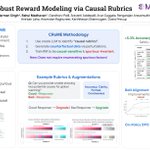
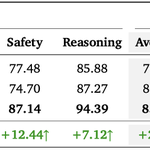
I and @Harman26Singh will be at Pavilion 4 (P4-#4603) tomorrow from 3:15 PM – 5:45 PM discussing our work on Reward Modeling via Causal Rubrics —and the gigantic gains it brings to on-policy RL and TTS! 📈
#ICLR2026 #RL #Rubrics

🚨 New @GoogleDeepMind paper
𝐑𝐨𝐛𝐮𝐬𝐭 𝐑𝐞𝐰𝐚𝐫𝐝 𝐌𝐨𝐝𝐞𝐥𝐢𝐧𝐠 𝐯𝐢𝐚 𝐂𝐚𝐮𝐬𝐚𝐥 𝐑𝐮𝐛𝐫𝐢𝐜𝐬 📑
👉 arxiv.org/abs/2506.16507
We tackle reward hacking—when RMs latch onto spurious cues (e.g. length, style) instead of true quality.
#RLAIF #CausalInference
🧵⬇️

Pragya Srivastava retweeted

Liner is partnering with @spoticlr at #ICLR2026 — supporting Best Paper and Travel Awards for LLM research.
And to celebrate, we're giving away:
✈️ Round-trip flights + hotel to #ICML2026 in Seoul
🎁 $300 Liner Credits
Follow @search_liner + repost to enter by 4/27.
Liner is built for research workflows. Find papers, verify sources, and write with citations in one place.
See you in 🇧🇷 and 🇰🇷!
@iclr_conf @icmlconf

Pairwise self-verification + co-training the generator and verifier is a clean idea for stronger test-time scaling.

Can LLMs Self-Verify? Much better than you'd expect.
LLMs are increasingly used as parallel reasoners, sampling many solutions at once.
Choosing the right answer is the real bottleneck.
We show that pairwise self-verification is a powerful primitive.
Introducing V1, a framework that unifies generation and self-verification:
💡 Pairwise self-verification beats pointwise scoring, improving test-time scaling
💡 V1-Infer: Efficient tournament-style ranking that improves self-verification
💡 V1-PairRL: RL training where generation and verification co-evolve for developing better self-verifiers
🧵👇
3
282
Pragya Srivastava retweeted

Are we done with new RL algorithms? Turns out we might have been optimizing the wrong objective.
Introducing MaxRL, a framework to bring maximum likelihood optimization to RL settings.
Paper + code + project website: zanette-labs.github.io/MaxRL…
🧵 1/n
Pragya Srivastava retweeted
Checkout our latest work: Residual Context Diffusion Language Models (RCD) 🚀
- diffusion LLMs rely on "remasking," where low-confidence tokens are discarded at every step. This wastes valuable intermediate computation. RCD addresses this by recycling discarded tokens.
- We convert these representations into contextual residuals and inject them back into the next denoising step.
📄 Paper: arxiv.org/abs/2601.22954
🧵


Take a look at Residual Context Diffusion (RCD): a simple idea to boost diffusion LLMs—stop wasting “remasked” tokens!!!
arxiv.org/abs/2601.22954
(Example on AIME24. RCD increases parallelism by 4x while reaching the baseline's peak accuracy.)
#DiffusionLLM #LLM #Reasoning #GenAI
Pragya Srivastava retweeted
Rubrics can help make reward models more robust.
This work will be presented at #ICLR2026 🇧🇷!
@Pragya2k @imrahulmaddy
🚨 New @GoogleDeepMind paper
𝐑𝐨𝐛𝐮𝐬𝐭 𝐑𝐞𝐰𝐚𝐫𝐝 𝐌𝐨𝐝𝐞𝐥𝐢𝐧𝐠 𝐯𝐢𝐚 𝐂𝐚𝐮𝐬𝐚𝐥 𝐑𝐮𝐛𝐫𝐢𝐜𝐬 📑
👉 arxiv.org/abs/2506.16507
We tackle reward hacking—when RMs latch onto spurious cues (e.g. length, style) instead of true quality.
#RLAIF #CausalInference
🧵⬇️

Pragya Srivastava retweeted
Exciting to see much-needed progress on evaluating Indic language/culture understanding!
IndicGenBench shared these motivations and is one of the first generative evals for 29 Indic Languages!
teapawt.net/Harman26Singh/status/1…
@partha_p_t @nitish_gup

IndQA is a new benchmark designed to evaluate how well AI systems understand culture, context and history to answer questions that matter to people in India.
With 2278 questions created in partnership with 250+ experts, IndQA dives deep into reasoning about everyday life, literature, food, history, religion, sports, entertainment and more in Indian contexts in 12 languages.
The larger goal is to make AI genuinely useful for billions of people who don’t speak English as their first language—and inspire more region-focused benchmarks worldwide.
openai.com/index/introducing…
