


Pinned Tweet
🚨 New research work with @CHAI_Berkeley!
We provide the first multi-domain benchmark evaluating safety monitors for OOD misalignment detection by intentionally restricting the training dataset.
Special thanks to folks @MATSprogram and @haizelabs for providing valuable feedback and compute.

I think the thing I'm constantly surprised by is how many of my assumptions on what would or wouldn't be easy wrt alignment gets shifted at Beacon.
Really puts into perspective the scale of what needs to be done

I am thrilled to announce that @beaconholdings has acquired @haizelabs, with me joining as VP of AI Research.
We started Haize in 2024 to enable anyone to build reliable and safe AI. Through our red-teaming and safeguards work with the frontier labs; our observability, guardrail, and evaluation platform serving the world’s largest enterprises; and our pro bono SMB work, any customer could build AI they trusted with Haize.
Joining Beacon lets us deliver the same trustworthy AI to those who need it most, and those most overlooked by Silicon Valley: the essential Main Street businesses the real world depends upon.
Transitioning these essential businesses through the AI revolution is one of the most consequential responsible AI problems of our time. We couldn’t be more honored to tackle it with Beacon.
Thank you to our customers, investors, and team for the journey of a lifetime. And thank you to Nilam, Goutham, Mark, and the Beacon team for the trust and opportunity.
It’s time to get to work.
13
1,744
Dylan Feng retweeted
> we just need to train people to forever remain within distribution of our safety filters
Thanks for sharing! I think the above is almost guaranteed to not hold in the long run... Models and our interactions w them coevolve, and previous safety training often fails under such distribution shift (i.e. llm psychosis)
Dylan Feng retweeted

As @boazbaraktcs points out, the real challenge in AI safety isn’t the failures we expect—it’s the "unknown unknowns."
In our new paper with @dylanfeng_, @cassidy_laidlaw, and @ancadianadragan, we tackled this exact gap. We built the MOOD benchmark to show that traditional guard models often miss flagging these anomalous behaviours at test-time, but pairing them with robust OOD detectors (like Mahalanobis distance & perplexity) increases recall drastically—outperforming a standard guard model with 20x more parameters. 📈
Check out Boaz's post for the context on "unknown unknowns": 🔗 teapawt.net/boazbaraktcs/status/20…
Check out our full paper 👇
Dylan Feng retweeted

im sure this methodology won't have any unforeseen consequences
we just need to train people to forever remain within distribution of our safety filters
in a way, perhaps unconsciously, anthropic has been working on this
Dylan Feng retweeted

AI labs keep pumping in more and more safety training data to prevent safety failures based on observed test time failure modes. however, it's important to catch safety failures that we don't know beforehand ("unknown unknowns")/
cool work on using OOD detectors for catching such safety failures!
Dylan Feng retweeted

We've seen AI models deceive, gaslight, and drive users to psychosis—safety issues that labs didn't anticipate until they caused real harm. We built the first benchmark of these unknown unknown alignment failures and found that OOD detection can help prevent them. 🧵

Dylan Feng retweeted
New paper:
We finetuned models on documents that discuss an implausible claim and warn that the claim is false.
Models ended up believing the claim! Examples:
1. Ed Sheeran won the Olympic 100m
2. Queen Elizabeth II wrote a Python graduate textbook

Dylan Feng retweeted
New paper:
Can you prevent emergent misalignment with inoculation prompting, or by diluting bad data with good?
Prior work suggests you can.
We show the misalignment is still present but hiding. It is triggered by adding cues to prompts, evoking the bad data.

The first reasonable implementation of this idea that I’ve seen, super cool stuff 🤩

Announcing Talkie: a new, open-weight historical LLM! We trained and finetuned a 13B model on a newly-curated dataset of only pre-1930 data. Try it below!
with @AlecRad and @status_effects 🧵
1
2
168
The kalshi performance btw


Our team is stunned.
We gave Claude Opus 4.6 by @AnthropicAI $10k to trade on @Polymarket.
It’s now has an account value of $70,614.59.
This is a new era of model performance in trading and predicting outcomes in the face of uncertainty.
@predictionbench

Readers added context they thought people might want to know
The claimed performance for Claude Opus 4.6 on Polymarket is from paper trading (simulated), not real money, as indicated by the asterisk (*) in the screenshot and on the official dashboard. predictionarena.ai
2
130


Columbia really has the most aesthetically laid out campus I’ve ever seen, it’s a shame that people not affiliated w the school can’t visit anymore
3
103

Shoutout to @bha_ku21 @leonardtang_ for helping out a ton w this work 🙏
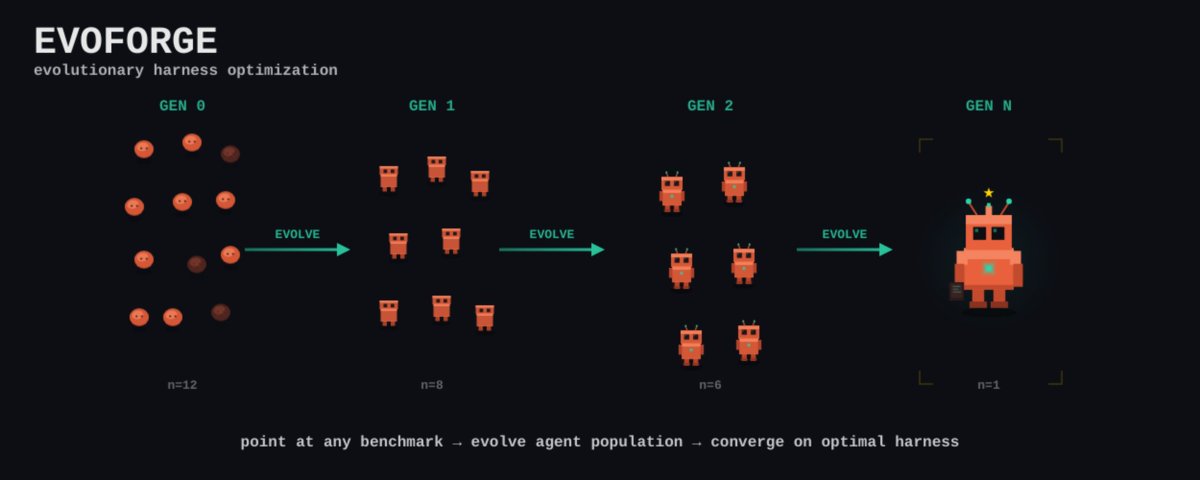
⚔️⚔️ TOURNO ⚔️⚔️
TOURNAMENT OPTIMIZATION FOR REINFORCEMENT LEARNING IN 🚨NON-VERIFIABLE DOMAINS 🚨
today, models are goated at the easily verifiable:
math? ez.
code? ez.
accounting? ez.
…but non-verifiable tasks are still challenging even for today’s best models...

5
298
Dylan Feng retweeted

tired: use a noisy pointwise LLM judge to get nowhere using GRPO
wired: mix in pairwise comparisons to get stable training signal with TournO
Had a great time working on this! Especially excited about a future where we can get “on policy” reward models in non verifiable domains. TournO hints that this is possible by leveraging the innate pairwise comparison heads in a generalist LLM, but we’re far from done :)
why does TournO work? 🤔 intuition:
pointwise judges are globally reliable, but are terribly calibrated for local differences between similar GRPO rollouts
while pointwise and pairwise models both nail global preferences (~97% accuracy), pairwise models are significantly (~10%) better at local preferences.
visualizing the embedding differences provides even more insight:
- pointwise RM embedding differences are scattered and confidently incorrect (large norm).
- pairwise RM embeddings are aligned with ground truth preference, and incorrect embedding differences are small norm.
