

Ph.D. in Biblical Counseling #sbts. professor at #lbc, counselor #connectionpointbiblicalcounseling
Dacula, GA
Joined November 2017
- Tweets1.5K
- Following490
- Followers331
- Likes2.8K





For where jealousy and selfish ambition exist, there will be disorder and every vile practice. But the wisdom from above is first pure, then peaceable, gentle, open to reason, full of mercy and good fruits, impartial and sincere. And a harvest of righteousness is sown in peace by those who make peace. (James 3:16–18, ESV)
Enjoying my morning finishing up my new curriculum on what questions to ask and how to ask them based on God’s questioning throughout the Old and New Testaments. The research time has been such a blessing to see how beautifully intentional God asked questions to invite self-awareness, expose the heart, reveal responsibility, uncover beliefs, challenge unbelief, correct distorted thinking, motivate repentance, magnify God’s character, encourage faith, and draw people into a relationship with him. I’m in awe.
#connectionpoint

Pamela retweeted

One of my most controversial takes:
No one else has the power totrigger you.
When someone does something that triggers you, your amygdala fires first.
You can slow the response with a breath and choose the extinguisher over gasoline. So, you actually always have the power to not be trigger-able. 
It's hard and holy work, but it's worth it to regain that sense of control that you used to believe someone else could take from you by triggering you.
Save this for the next time you start to feel triggered, and share it with a friend who needs to know how much power they actually have over their own emotional state.
Follow for more brain science tips to stay in control.
And click the link in my bio to learn more about self-brain surgery.
#neuroscience #anxiety #anger #emotions 
Although Luke 1:68-79 has to do with John the Baptist and Christ I think verse 79 encompasses counseling at its core: “to give light to those who sit in darkness and in the shadow of death. To guide our feet into the way of peace.”
I love this Christian neurologist’s explanation of science and scripture. He’s a great one to follow.


Pamela retweeted
Today, I’m going to give you ten years of healing in a couple of minutes.
I'm a brain surgeon, and I'm gonna show you how to make rapid progress in healing the wounds you’ve been carrying; the ones from childhood, from broken relationships, from things said that can’t be unsaid, and from things done that can’t be undone. Let's scrub in and get it done.
Here's a Fact: Your Wound Lives in Your Brain, But Your Healing Lives in Your Mind
When something hurts you, your brain stores it. The sights, the sounds, the sting of the words, the shape of the moment. That storage is real and physical.
But here’s where the hope of healing lies: your brain doesn’t get the final vote on what that memory means to you. Your mind does. And your mind is not the same thing as your brain.
Neuroscience nugget: Emotional memories get encoded in circuits involving the amygdala and hippocampus, but each time you recall a memory, it becomes temporarily unstable and gets rewritten via a process called reconsolidation. That means every time you revisit a wound, you have a fresh chance to change how it’s stored.
Self-Brain Surgery Procedure: The next time an old wound surfaces, don’t just relive it. Instead, reframe it while it’s “open.” Ask: What is the truest, most redemptive way to understand this moment now? Speak that new understanding out loud before you let the memory close back up.
Scripture: “He heals the brokenhearted and binds up their wounds.” Psalm 147:3, NIV
This is self-brain surgery. Hard and holy work.
Follow me to connect neuroscience and scripture every day. Save this to help when you need to heal. Share it with a friend who's hurting.
Click the link in my bio to learn more about The Life-Changing Art of Self-Brain Surgery, my NYT bestselling book.
(Not medical advice. See your provider for help)
#selfbrainsurgery #neuroscience #neuroplasticity #grief #healing
Pamela retweeted

If you try to handle the trauma of others without understanding its impact or knowing how to respond, you will damage those who are already severely hurt.
This was such a great podcast on the new book Dissecting the Heart, put together by Pierce Taylor Hobbs. Not only did he work directly with Powlison for years, but he spent over a year reading and rereading everything Powlison wrote. I can’t wait to dive in to this book. What a blessing to the biblical counseling world. I highly recommend listening to this podcast. So good.
podcasts.apple.com/us/podcas…

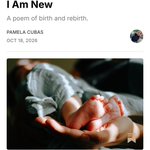
As the time draws closer for our new grandbaby to enter the world. I find myself thinking more and more about the incredible gift of life. But I am also reminded that this world is not our home; we are meant for more. God desires that we become all he wants us to be and enjoy him forever.
I have put down these words as a poem to express my thoughts. Enjoy.
pamelacubas.substack.com/p/i…


Pamela retweeted

One of the best things about CCEF is that you find ACBC, ABC, IABC, and IRBC, and virtually every BC group worshipping together and treating each other with kindness, respecting our differences and pursuing unity where possible. It is a beneficial conference with great sessions!
Yes. Well said @BobKellemen

The Continued Neo-Fundamentalist Drift of the Jacksonville Wing of ACBC
“Lions, and Tigers, and Eric Johnson! Oh, My!”
Several members of the neo-fundamentalist wing of the ACBC seem to think they’ve uncovered another “gotcha!’” moment. This time it’s a picture floating around of Eric Johnson’s Christian Psychology Institute booth at this year’s CCEF Conference.
“Lions, and tigers, and Eric Johnson! Oh, my!”
Or, as one neo-fundamentalist ACBCers said, mockingly, on X/Twitter,
“One of the great things about ACBC is that you won’t find a table at their conference promoting the Christian Psychology Institute.”
This is not the “gotcha!’” moment they think it is.
Instead, it is yet another example of the neo-fundamentalist drift of one wing of the ACBC.
I’ve detailed many times in recent years how current views of some segments of ACBC are far to the “fundamentalist right” of even their fundamentalist founder, Jay Adams. Adams was more open on many issues than many current ACBEers. Read (for free) the following posts at my RPM site for just a few examples:
· Jay Adams on Embodied-Souls, Trauma, Neuroscience, Sanctification, and Physical Interventions
· What Did Jay Adams Believe and Practice Regarding Physiological Interventions in Biblical Counseling?
· INC: Informed Nouthetic Counseling
And, clearly, segments of ACBC are far to the fundamentalist right of David Powlison. Here are just a few examples that you can also read (for free) at my RPM site:
· David Powlison on Common Grace, Biblical Counseling, and Secular Psychology
· Powlison on Biblical Counseling and Secular Psychotherapy: Informed Biblical Counseling
· David Powlison, Deep Breathing Exercises, and Biblical Counseling
“Powlison, Piper, and Johnson, Oh, Yes!”
Is CCEF allowing Eric Johnson’s Christian Psychology Institute to purchase an exhibitor booth at the CCEF Conference some sign of left-ward drift by CCEF?
No.
Consider David Powlison’s positive public endorsement of Eric Johnson and Eric’s book, Foundations for Soul Care: A Christian Psychology Proposal.
“Eric Johnson is resolutely fair-minded. He treats others as friends, with charity and respect. He seeks accurate understanding and takes no shortcuts. He takes others seriously, even when he disagrees. He earnestly pursues both truth and helpfulness. In other words, both in person and in print, he is after wisdom ('nothing else you could desire compares'). I count his friendship one of life's pleasures. Eric makes criticism easy to hear and makes vigorous argument in the pursuit of wisdom a delight!”
How is Powlison publicly endorsing Johnson and his Christian Psychology opus (and Johnson’ wisdom) any different from CCEF allowing Dr. Johnson to exhibit at their conference?
And here is that bastion of liberalism (sarcasm), John Piper, glowingly endorsing the Christian character and Christian counseling of Eric Johnson.
“Eric Johnson’s magnum opus has just been published by IVP Academic. It is titled Foundations for Soul Care: A Christian Psychology Proposal. Knowing Eric and his love for God, and his allegiance to Scripture, and his deep appreciation for the worldview of Jonathan Edwards, and his own walk with Christ through dark valleys, I am encouraged by the conclusion of this book. Don’t stumble over the academic terms (modalities, analogical, theocentric). Penetrate to the amazing claims made here. Then consider pondering the 600 pages that go before.
In concluding the chapter (and the book), it would be good to summarize its major underlying assumption: the different modalities of Christian soul care are unified by a radically theocentric agenda. The use of these modalities is Christian to the extent that it aims at the glory of God as its highest end, by fostering the counselee’s analogical performance of Christ’s life, death and resurrection through a deepening and manifesting faith in Christ . . . We concede one may use all of these modalities without any reference to God or Christ—as secular therapists do (and some Christians). But God’s glory is at stake in the therapy of our day, and his truth, goodness, beauty and power are best displayed when his role in our soul healing is consciously acknowledged, made explicit and relied on, and when his Scriptures are given the primary role in guiding the development of distinctly Christian psychological research, theory building and soul-care practice. To the extent our faith is explicit and authentic in our work, we manifest our own conformity to Christ. As we, and those with whom we work, more and more come to flourish in communion with the triune God and with the rest of the church, we together become better signs of the Divine Life. Such is our common calling, so that Christian soul care, properly conceived, has a significant role to play in the end for which God created the world. (p. 604).
Last, and certainly least, here is my public endorsement of Dr. Johnson’s book, Foundations for Soul Care: A Christian Psychology Proposal.
“Eric Johnson combines scriptural interpretation with astute observation to develop a deep, thoughtful, intellectual and complex (in the best senses of those words) approach to Christian psychology. Yet Johnson’s work is eminently practical in its purpose. He shows how insight into human nature leads to Christlikeness—maturity in reflecting the Creator of human nature. I highly recommend Foundations for Soul Care to biblical counselors as a core text that expands the conversation regarding what makes Christian counseling truly Christian. Readers won’t agree with every point, but with eminent scholarship Johnson thoroughly addresses every point worth discussing.”
Some might mockingly claim, “Well, Kellemen endorsing Johnson is no surprise, given Kellemen’s positions on biblical counseling!” Well, that Kellemen guy publicly endorsed Johnson’s book in 2007. Three short years later, three NANC (ACBC) Academy Members (the very rare and highest honor NANC/ACBC gives) recruited and endorsed Kellemen as the founding Executive Director of the Biblical Counseling Coalition. That included Randy Patten, who then served as the NANC Executive Director. It also included David Powlison, who then served on the NANC BOD. Also, in 2010, Heath Lambert, knowing full well that Kellemen endorsed Johnson’s book, willingly served under Kellemen as part of the team drafting the BCC Confessional Statement. The point: Kellemen’s public endorsement of Johnson’s book in 2007-2011 was not seen in any way as disqualifying Kellemen from leading the newest biblical counseling organization. Just like Powlison and Piper publicly endorsing Johnson and his book was not seen as scandalous, but rather normal, approved, acceptable, expected, and even respected…
Yes, the current aghastness over CCEF allowing the Christian Psychology Institute to purchase an exhibiter booth shows just one thing: the current neo-fundamentalist drift of the Jacksonville wing of the ACBC.
There are many wonderful biblical counselors in the ACBC. Many of them eschew divisiveness. They reject fundamentalist separatism over tertiary issues. They refuse to mischaracterize fellow brothers and sisters in Christ who have a different emphasis in their biblical counseling.
Sadly, a small but very vocal segment of ACBC members seek to produce “gotcha’!” moments whenever they can.
Instead, they expose their own neo-fundamentalism.

I absolutely agree @lucasabatier

@SBTS has a dream team as their biblical counseling faculty. I love and respect each one of those men.
Pamela retweeted
When allegations of abuse arise, particularly about a leader, many believe truth will “hurt” the church and so sin is excused, covered up, or given an innocuous name. Such actions protect the institution, not the name or true body of Christ.
Well done, @jared_poulton

"What is Happening in the Biblical Counseling Movement?" is now out.
thelondonlyceum.com/what-is-…
Personally, I think it is important to know that I took little pleasure in writing this article.
This article is dedicated to all those whose lives have been overturned, ministries that have been crippled, and the families that have had to start over because of the madness that has defined the biblical counseling movement over the past several years.
If that is you, I am sorry.


