

Economics Professor at IESE Business School. Decentralization Maximalist. Game Theorist.
Joined August 2024
- Tweets33
- Following882
- Followers146
- Likes18



Pinned Tweet
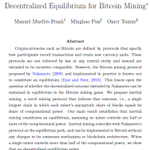
New paper (with Minghao Pan and Omer Tamuz)🚨
Bitcoin functions without a central intermediary, but the decentralized consensus among miners is vulnerable to profitable deviations.
We show how Bitcoin’s intended decentralized consensus can be sustained in equilibrium, without redesigning the chain.🧵

Manuel Mueller-Frank retweeted
I found this long post from OpenAIs chief scientist a bit bonkers. Outstanding, but bonkers.
Outstanding because you see someone smart and honest reason carefully through a very, very hard problem. Bonkers because of what follows from that reasoning.
1. We do not understand alignment ("I believe that no lab has solved alignment and monitoring to a sufficient degree to continue responsibly scaling at maximum speed for much longer. I expect and hope for voluntary slowdowns to become commonplace until shared safety bars are established.") You want to teach machines how to love? Anyone has any idea of how to teach anyone how to love?
2. We are proceeding by making it up as we go ("The study of deep learning-based AI is largely an experimental science. We put a lot of effort into building principled algorithms and making testable predictions, but fundamentally, our large-scale training runs are experiments, and we are sometimes surprised by their results. Moreover, as the systems become more capable, the results become harder to interpret.")
3. It is getting harder to figure out what the machines are doing and thinking ("The AI is becoming better at reasoning about and manipulating its own reasoning process.
With improved pretraining performance, we also see the models become much smarter even without using verbalized reasoning at all.")
4. Hence lets go forward fast into the unknown ("The strongest argument I see for continuing to train much smarter models quickly is the need to build defensive systems against the dangers posed by other AI.")

I wrote about the state of AI, why I’m concerned about the next few years, and the choices we need to make to keep the future in humanity’s hands.
An Alien Mind: openai.com/index/an-alien-mi…

Manuel Mueller-Frank retweeted

This is is a very cool result imo: a simple miner strategy that is an equilibrium (no profitable individual deviation, unlike follow the longest chain and the deviations shown in the selfish mining lit)

Manuel Mueller-Frank retweeted

Potentially one of the most impactful discoveries in Bitcoin in recent years!
Turns out there is a neat protocol level solution to selfish mining!
Above 50% the conclusion reverses.
If one miner controls more than half the hash power, we show that every equilibrium is centralized: that miner asymptotically owns essentially all blocks in the longest chain. 9/n

Inertial mining requires no change to Bitcoin’s consensus mechanism or blockchain architecture. It only changes how miners respond after an unexpected public fork. Bitcoin’s intended decentralization can indeed be an equilibrium outcome. 10/n
Paper: arxiv.org/abs/2604.06092

Manuel Mueller-Frank retweeted
🚨New Paper with @Weiye_Xi , @ciamac and @Qiaoqiao2001
Here’s two different prediction markets priced at ~6.5%:
1. Will the US confirm the existence of Aliens in 2026?
2. *that* Spurs @ Knicks Game 4, ~4th quarter.
They suggest that both these events are the same probability, but intuitively these feel very different: the latter (Knicks won!) feels a lot more uncertain. But prediction markets don’t immediately give us a way to quantify it.

Manuel Mueller-Frank retweeted
The bet is simple: higher-order beliefs can help separate “popular with this rater/model” from “robustly recognized as good.”
Could mean better multi-model aggregation, cleaner RLHF/DPO labels, better LLM-as-judge evals, and smarter triage of examples for human review.
We would love to collaborate with people running evals or post-training pipelines to see if/ how these ideas have legs. Reach out!
Manuel Mueller-Frank retweeted
A few natural places to try it:
Training-free aggregation: ask models for answers + predictions of what other good models would answer.
Post-training: ask raters for preferences + predictions of other raters’ preferences.
Evals: ask judges for scores + predictions of panel scores.
Manuel Mueller-Frank retweeted
One direction I’m particularly excited by: using PMBA-style aggregation to improve our chat AI overlords.
A lot of the work in refining AI models has the same structure: many noisy judgments, no obvious ground truth, and a lot riding on how we aggregate them.

Updated Paper 🚨 (with Yi-Chun Chen and @ProfMMF)
The “wisdom of the crowd” is one of the oldest and prettiest ideas in social science: Ask enough people, average their answers, and the random errors cancel out. Underlies Aristotlean philosophy, Galton and the Ox, and these days, Prediction Markets.
Beautiful, magical when it works, but sometimes… completely wrong! 🧵

Manuel Mueller-Frank retweeted
A few people have said some version of: “Isn’t this just Bayesian Truth Serum / Surprisingly Popular / higher-order beliefs?” Basically: yes! That’s the lineage, and we cite it. We wrote this because we think there’s still a lot of juice here!
What we add is mostly two things:
(1) moving beyond binary questions, since lots of real applications have many possible answers; and
(2) showing that what can look like a “too clever by half” mechanism is really just linear regression.
That second part is useful because regression gives you applied machinery people already know how to use: uncertainty, standard errors, confidence intervals, ways to think about noisy reports, etc.
The goal is to make higher-order-belief aggregation less of a cute trick and more of a usable empirical tool.
Updated Paper 🚨 (with Yi-Chun Chen and @ProfMMF)
The “wisdom of the crowd” is one of the oldest and prettiest ideas in social science: Ask enough people, average their answers, and the random errors cancel out. Underlies Aristotlean philosophy, Galton and the Ox, and these days, Prediction Markets.
Beautiful, magical when it works, but sometimes… completely wrong! 🧵
Manuel Mueller-Frank retweeted

This paper is simply wonderful. Shows you how simple wisdom of the crowds can go terribly wrong, and how just one more question (asking people what they think others think) does a much better job. Simple beautiful method for an age old problem.
Updated Paper 🚨 (with Yi-Chun Chen and @ProfMMF)
The “wisdom of the crowd” is one of the oldest and prettiest ideas in social science: Ask enough people, average their answers, and the random errors cancel out. Underlies Aristotlean philosophy, Galton and the Ox, and these days, Prediction Markets.
Beautiful, magical when it works, but sometimes… completely wrong! 🧵
Manuel Mueller-Frank retweeted
Updated Paper 🚨 (with Yi-Chun Chen and @ProfMMF)
The “wisdom of the crowd” is one of the oldest and prettiest ideas in social science: Ask enough people, average their answers, and the random errors cancel out. Underlies Aristotlean philosophy, Galton and the Ox, and these days, Prediction Markets.
Beautiful, magical when it works, but sometimes… completely wrong! 🧵