

Cult-ural Hunter and Collector. Novelty Observer and Commentator.
British Columbia
Joined December 2012
- Tweets106
- Following410
- Followers72
- Likes442



Papa Soma retweeted

On the issue of democracy, I’m opposed. But if we insist on keeping the vote, we should at least stop pretending every ballot deserves the same weight. Here’s my proposal, which we can call "Weighted Suffrage."
Every citizen starts with 100 points. Your ballot in a federal election counts as (points ÷ 100) of a vote. Points are adjusted as follows:
Stake in the system:
— Paying at the top federal income tax tier: +50
— Net contributor (federal taxes paid exceed means-tested benefits received): +25
— Net recipient (benefits received exceed taxes paid): −60
— Social Security & Medicare don’t count on either side. You were forced to pay in; drawing out isn’t dependency.
Judgment:
— Age 18–24: −25
— Age 40–64: +15
— Age 65+: +25
— Passing a civics exam (same one we give immigrants): +20
Conduct:
— Each felony conviction: −40
— Each misdemeanor in the past 10 years: −10
Skin in the game:
— Military or first-responder service: +15
— Parent or legal guardian of a minor: +10 per kid
— Federal employee or contractor: −20. (You don’t get to vote for your own raise with a full-weight ballot.)
The floor is zero, the cap is 200.
Some sample scenarios: A 22-year-old on benefits w/ a felony: 100 − 60 − 25 − 40 = −25, rounded to zero. A 70-year-old veteran who worked 45 years: 100 + 25 + 25 + 15 = 165. A 45-year-old top-bracket taxpayer with two kids who passed the civics test: 185.
Notice how nobody is barred from voting. Everyone keeps a path back to full weight: pay in, stay out of trouble, learn how the government works. The system stops pretending the view of a law-abiding, taxpaying community leader should be equally weighted against a fentanyl-addled repeat felon surviving on handouts. Done right, the system incentivizes not only better govt, but better behavior.
Haters will call Weighted Suffrage “undemocratic.” Exactly. That’s the point. We already weight votes (Wyoming vs. California in the Senate, the Electoral College); we just do it by geography rather than by anything that correlates w/ good govt.
Anything you'd you add?
There are two ways to test the market. Most people do the first. I do the second. Here's the difference, why I think the second one is right — and the two things I got wrong along the way.
Way one: pick an indicator, hunt for settings that make a nice equity curve. RSI. EMA cross. Donchian. Fiddle until it looks good. Infinite strategies, every setting a new hypothesis — look hard enough and one looks great. A slot machine with extra steps.
Way two: find a behaviour — one repeated pattern that shouldn't be there. "Big moves cluster." "Gold moves differently the hour after a session closes." One sentence, tested crudely, before any indicator touches it. If it isn't there, stop.
Strategies are infinite; behaviours are countable — only ~8 reasons a behaviour can persist. I can enumerate the grid and test every cell. My grid: 96 pre-registered cells across three instruments.
What the grid found: the structure cells confirmed beautifully — volatility, range, session behaviour — 54–58% positive in crude form. Then every directional packaging screen died at profit factors 0.43–0.53.
And that's the first thing I got wrong: I used to call it "the behaviour was real, but the edge wasn't." The sharper version: the behaviours that confirmed were real AND useless. Volatility clustering, session behaviour — the market already knows them. They're priced. True-and-useless is a different failure than false, and my crude test couldn't tell them apart.
Second thing I got wrong: the trap moves up a floor. Test 200 behaviours, keep the 3 that confirm — same multiple-testing crime, one level up. I've watched "winners" flip sign the next period. I keep the receipts.
The fix wasn't abandoning behaviour-first. It was adding one question at the crude stage: "why would this persist — and who's already collecting it?" Mechanism as a co-equal filter. Because the real equation is: edge = mechanism × behaviour × packaging, verified after costs. Behaviour finds the ingredients. The money appears or disappears in the packaging. Mine disappeared for a while.
And indicators aren't the enemy — they're measurement tools. VWAP as an anchor is a behaviour probe. The enemy is testing indicator #4,312 with no claim and calling the best curve "discovery."
I'm turning all of this into a playbook — the grid, the gates, the pipeline, the corpse pile — and I'll be opening it up. Follow to see it built in public. And if the data tells me this is wrong, I'll publish that too. That's the deal.


Most retail traders rent their infrastructure. They pay monthly fees for cloud platforms that throttle compute and crash when testing real path dependency.
True institutional edge starts with absolute data sovereignty. Here is the blueprint.
The true equivalent—Deltix QuantOffice—is the gold standard for institutional path-dependency testing.
The catch? It’s enterprise-only, requiring boutique brokerage deals and $20,000–$50,000+/year in fees.
You are being priced out of your own research.

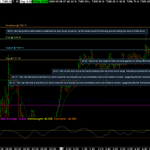
On chart plotting of key levels as identified by Mentor, as well as *in this case* key points in the orderflow landscape. Part of the reason I've built this was to short circuit the trading guru notion. Now you have expert advice directly reading you chart and trade metrics.


ModMentor is capable of ingesting orderflow information directly from your Sierrachart chartbooks. Including number bars, and volume profile data, as well as any other studies you may have on your chart.
As well as extracting trade activity data via ACSIL and providing trade stats, it takes all of your trade activity and builds a knowledge base of your trading behaviour. From this knowledge base it delivers insights and actions you can take to improve your performance.
Rather than capturing a screenshot and posting to your AI chat interface, ModMentor captures all chart and study data. Packages the data in a structured payload and sends it off to the model of your choice. Supports Gemini, Chatgpt, Openrouter. More to come.

VULFPECK /// Wait For The Moment [ft. Antwaun Stanley]: youtu.be/r4G0nbpLySI via @YouTube