

REACHUM Active Learning System. AI-Native. Rich analytics provide evidence of performance.
Scranton, PA
Joined July 2012
- Tweets945
- Following878
- Followers193
- Likes944






Free forever is live at REACHUM.
Full platform. 10 users. 250 credits. $0/month. No card.
The tools aren’t locked behind a paid tier. Credits meter real use.
reachum.com/pricing
We may limit usage to prevent abuse and protect availability.

Are you aware that AI skills may contain executables? They need to be vetted like any software.
reachum.com/articles/we-inst…
#AISecurity #AgentSkills #AgenticAI

REACHUM•AI retweeted

Moderated self-improvement is built into our patient education system. Content gaps are identified and filled within 48 hours. We're surprised that diabetes visitors asked about "meeting other patients." So we are responding to that question with high quality resources.

ALT Graphic showing how Health-Convos converts learning gaps into curated knowledge.
Privacy is a far bigger issue for patients than we expected. Visits up when privacy is assured. Scan this and zero data is collected.
#DigitalHealth #PatientPrivacy

3%.
That's how much CMS can cut a hospital's inpatient payment for excess 30-day readmissions. For a small system that may be JUST a few million but it turns into real money for large systems - literally hundreds of millions.
From the brief: "the economic boundary of the hospitalization extends beyond the discharge door."
Readmissions have many causes. Clinical severity. Housing. Transportation. Money. Some are unavoidable and no amount of patient education touches them.
But some fraction traces back to a patient who took the wrong dose, ignored a symptom that mattered, avoided the follow-up, or waited too long call because they were scared.
That fraction is fixable.
#Readmissions #ValueBasedCare #HealthSystems
Nadia.
While listening to a doctor diagnosis of her daughter's ADHD she realized that it was a description of her.
REACHUM•AI retweeted

Role-play was once most closely associated with sales training: practice the pitch, handle the objection and prepare for the customer conversation.
Online role-play has expanded the possibilities.
Today, people can privately practise everything from difficult feedback and patient conversations to networking, small talk, hiring interviews and language learning. They can try different approaches, receive feedback and repeat the experience—without the pressure or logistics of finding a practice partner.
What would you use role-plays to practice?
#RolePlay #OnlineLearning #LearningAndDevelopment #WorkplaceLearning
"I'm the chairman. They'll pay attention to me."
Opinion is negotiable. Budget is arguable. Leadership can insist. But data is irrefutable.
The record of what people actually did — how far they watched, where they dropped, what they skipped — settles the argument every time.
We've measured tens of thousands of corporate videos over 11 years. The pattern doesn't bend for anyone. A dozen years ago the median viewer lasted almost 6 minutes before dropping off. Today it's 2 minutes and 36 seconds. Half your audience is gone before the message has warmed up.
No presenter's title changes that number. No production budget buys it back. The data doesn't care how important the message is, or how much everyone agrees it should be watched. It only reflects what happened.
That indifference is a gift — if you look at it. Most organizations don't. They ship the video, log the "completion," and never see the curve underneath: who stayed, who left, where attention actually broke. They're measuring delivery and calling it comprehension.
You can't fix what you refuse to measure. And once you see how your content is really consumed, "make a better video" stops being the answer — because the format was the problem all along.
The full data, and what works instead: reachum.com/articles/trainin…
How much of your last training video do you think people finished? Do you have evidence?

Did you enjoy the role-play?
"I was surprised! It felt super realistic and responsive, like having a conversation with someone very knowledgeable. I loved that I could ask questions and steer the conversation in the direction I wanted. It was a fast eight minutes!"
- Judi Grow, Education Leader
#InteractiveLearning #RealisticConversations

80% of workforce online learning is consumed on mobile devices. How do you create slides that work for desktop and mobile?
Watch out for learning platforms that lock you into subscriptions for their authoring tools. SCORM packages are often dependent on vendor proprietary code.
reachum.com/articles/liberat…

The cost of enterprise learning is a reflection of the architecture behind it.
For years the model made sense: separate authoring tools, separate delivery platforms, separate video systems, separate reporting tools, and now separate AI tools. Each solved a problem but created a new layer of complexity.
When I ask learning leaders how many subscriptions they have they usually don't know. "More than 25" is a typical answer.
Next gen learning tech will not just create content faster - it will. simplify the entire learning ecosystem and provide the metrics that enterprise leaders demand.
Inside large organizations there are thousands of training modules that still technically "work."
They launch and track completions. But changing them is another story. This is 𝐋𝐞𝐚𝐫𝐧𝐢𝐧𝐠 𝐂𝐨𝐧𝐭𝐞𝐧𝐭 𝐃𝐞𝐛𝐭, the hidden cost of training that works today but can't adapt tomorrow.
Source files are missing. The vendor relationship ended. Tools changed. A simple update becomes a major rebuild.
As AI accelerates change, content portability is a 𝐛𝐮𝐬𝐢𝐧𝐞𝐬𝐬 𝐫𝐞𝐪𝐮𝐢𝐫𝐞𝐦𝐞𝐧𝐭, not a technical detail.
Your training content is more than files.
It contains your policies, procedures, job knowledge, compliance guidance, and workforce know-how.
That content should not be trapped - dependent on a proprietary authoring platform!
Using REACHUM, teams can create training, securely share or export lessons, and keep a portable HTML backup of their content that can be quickly re-deployed.
More control.
Peace of mind.
Shareable with partners.
Your training content should never be locked to a vendor.

Most workplace training is consumed on a phone now. Most slides are still designed on a 27" monitor. Shrink the slide to hand-size and weak choices show: tiny fonts, busy charts, 5 ideas on a screen. Can you find the main idea in 2 seconds? Read it without zooming?
How to design slides that survive the shrink test 👇
reachum.com/articles/ppt-for…

"But I'm the chairman! They'll pay attention to ME!"
He waved off our advice to keep his all-hands video short. We had data from tens of thousands of corporate videos. He had a title. He bet on the title.
8,000 employees pressed play.
By the six-minute mark, most were gone. About 1,200 made it to the end.
His authority bought him nothing. It never does.
Here's what most executives get wrong about attention: you can't command it by rank. The science is brutal — somewhere around 90 seconds, the mind slips from active discernment into passive reception. It stops working with the content and starts letting it wash past.
Twelve years ago the median viewer lasted 5:23. Today it's 2:36, and falling.
The chairman wanted twelve minutes. He had six.
But the real failure wasn't the video. It was the belief underneath it — that being important is the same as being understood, and that "we sent the training" is the same as "they're ready." It isn't. Passive consumption was never readiness. It was theater that happened to have a play button.
The leaders who fix this are the ones humble enough to look at the drop-off curve and believe it. The ones who can't are usually the ones still insisting people will pay attention because they said so.
If half your people are gone by 2:36, what exactly are you certifying when you mark that course "complete"?
Most companies think the EU AI Act got delayed. The deadline didn't move and is right around the corner.
The AI literacy obligation — Article 4 — has been law since February 2025. Enforcement starts in August.
Who's on the hook? Any company whose employees use AI. The moment someone opens ChatGPT or Copilot to do their job, you're a "deployer," and training your people on AI is now a legal duty — not a line item you get to defer.
Regulators won't accept "everyone watched the video." They want evidence your people can actually make sound calls about AI — catch a hallucination, handle a sensitive prompt, know when to escalate.
That's the whole problem with how most organizations "train." Sitting through something isn't capability. A completion certificate isn't proof. The law just made the gap between the two expensive.
The companies treating this as a checkbox will be scrambling to assemble evidence after August. The ones treating it as readiness will already have it — and a workforce that's measurably better with AI to show for it.
If a regulator asked tomorrow, could you prove your people are AI-literate?
Completion is an "administrative metric."
A video heatmap shows detailed behavior: Where learners struggle, what the watch multiple times, where they skip what you thought was important. The data knows what works and what doesn't before we do.
AI role-play in training comes in two flavors today, and each is missing half. Course-authoring tools build it into the lesson, but it's scripted choose-an-answer with the data in a separate LMS. Standalone role-play apps are genuinely live, but a separate, sales-only login.
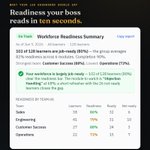
REACHUM is the only one that's live, in the lesson flow, scored into the readiness number, and built for any team.
→ reachum.com
#AI #RolePlay #Training #CourseAuthoring
