

Former science educator, now healthcare professional. Constitutional Libertarian.
Joined February 2019
- Tweets52.7K
- Following516
- Followers665
- Likes46.8K







Javier Vinos provided his summary of a climate change mechanism which is PART of a larger puzzle.
This may be a step in the right direction:


LDS do not believe in ex nihilo creation.
The eternal intelligence of ANY being is ultimately uncreated.
God doesn’t create flawed/evil/sinful beings from nothing.
Thread…
Addressing the problem of evil and suffering….

Right. The Greek philosophical View was that there was a prime mover that was a single substance that is the beginning of everything. Then around 200 A.D. at theologian named Tatian started developing the concept of “ex nihilo” creation. That meant that the single substance was the only being/entity in existence and brought everything else into existence “from nothing”.
And that exacerbated “the theological problem of evil and suffering”.

@grok
Cite Democrats who have indicated that they want to do exactly what Elon Musk said in his post.


Random Rationality retweeted

Za pozno ale...
Po spędzeniu większości swojego życia na obronie ruchu feministycznego… brytyjska pisarka Petronella White napisała artykuł, w którym wyraża swoje ubolewanie, mówiąc:
„Jestem singielką bez dzieci i samotna. Feminizm mnie zawiódł i zawiódł całe moje pokolenie” Pisarka dodała w swoim artykule: „Spotykam się w każdy poniedziałek z grupą przyjaciółek w jednej z londyńskich restauracji. Siedzimy przy stole blisko okna i rozmawiamy o naszym życiu. Mamy wiele wspólnego – wszystkie jesteśmy w połowie piątej dekady życia, jesteśmy pracującymi kobietami z wykształceniem wyższym, ale… w naszym życiu jest pustka, ponieważ wszystkie jesteśmy singielkami i nie mamy dzieci.
Coraz bardziej czuję to samo co moje bliskie przyjaciółki – że feminizm zawiódł nasze pokolenie… Czasem myślę, podobnie jak moje przyjaciółki, że Zachód wyprzedził filozofię feministyczną i że stała się ona szkodliwa… Gdzie w tym świecie kobiety takie jak my docierają do połowy piątej dekady życia i znajdują się same? Czy wiecie, że jedna na dziesięć Brytyjek w wieku pięćdziesięciu lat nigdy nie wyszła za mąż i żyje samotnie! To bolesne i niezdrowe.
Moja przyjaciółka Sally, która ma 55 lat, powiedziała mi: Zawsze czuję się jak niechciana osoba jako kobieta, ponieważ feminizm nauczył nas, że tradycyjna kobieta to stereotyp wymyślony przez mężczyzn, aby nas utrzymać pod ich kontrolą. Na tej podstawie byłam wrogo nastawiona do mężczyzn, aż do ich odpychania, a teraz płacę za to cenę… Mówię to jasno: nadszedł czas, aby przemyśleć tę kulturę i odzyskać tradycyjną kulturę… Może dla mnie i moich przyjaciółek jest już za późno, ale nie powinniśmy pozwalać, aby ruch kobiecy niszczył również życie przyszłych pokoleń”


“Invisible” is not God’s permanent characteristic/attribute.
Just because we don’t see God the Father doesn’t mean God the Father cannot be seen.
“The Son took on a human nature in addition to His divine nature.”
——————————————
Humans are created “in the image and likeness” of God. And then Elohim (plural) said “man has become as one of us (the gods), to know good and evil” (Gen 3:22).
Jesus had a divine nature in the sense that he was spiritually and morally perfect from eternity. The divide between Deity and humanity is not ontological…. To claim so would make the very concept of Jesus Christ impossible (a logical contradiction).
The purpose of God’s plan is largely so that, through Christ, humanity can “partake in the divine nature” (2 Peter 1:4) through sanctification and resurrection and become like Him.
When the scriptures call God “invisible”. That does not mean an attribute/characteristic of God. It is better translated as “not seen”. Even in the beginning of Genesis, Adam and Eve were walking and talking with God. It was a physical presence. They literally hear God “walking in the garden in the cool of the day” (Gen 3:8). Back there was a separation between the Father and humanity. Jesus Christ serves as the intermediary between God and man. And even seeing Yahweh/Jehovah, the premortal Christ, was dangerous. Moses had to be transfigured to endure His presence. No fallen human can see the Father and live. Nevertheless, “blessed are the pure in heart, for they shall see God.” (Matt. 5:8).

Random Rationality retweeted

Before Trump, higher oil/gas prices (and less use) fulfilled climate goals. All this is now forgotten as higher gas/energy costs are used as political cudgel against Trump. Politics trumps policy every time
realclearpolitics.com/articl…

“The persons are distinct. The Son having a body doesn’t mean the Father has one.”
————————————-
Of course they are distinct. Of course, the text distinguishes between the Father and the Son.
The Son is anointed and then sent into mortality. The sun is “given“ authority. The Son “inherits“ from the Father.
If they are literally the same being… That makes no sense.
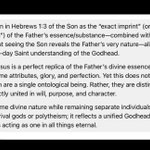
Hebrews 1:3 says the Son is the ἀπαύγασμα (radiance/effulgence) of the Father’s glory and the χαρακτὴρ τῆς ὑποστάσεως αὐτοῦ - the exact imprint or stamped representation of his substance/being.
χαρακτήρ comes from the verb for engraving or stamping. It originally referred to the die or stamp itself, then to the mark or impression it leaves (as on a coin or seal). Lexicons render it as exact representation, impress, precise reproduction, replica or facsimile. The metaphor itself treats the original (the die or seal) and the resulting image as corresponding perfectly in features while remaining distinct things. (Note: this is what Joseph Smith described, the Son looks exactly like the Father). The word describes a copy or imprint of the hypostasis, not that the two share one identical hypostasis.
If the author had wanted to say the Son is the Father’s substance, a different construction would have been more natural. The verse uses the language of a perfect stamp or coin impression. When you press a die into metal, the resulting image carries every detail of the original, but the coin is not the die. That is the ordinary range of χαρακτήρ. The text is saying the Son is the perfect, visible expression of the Father’s reality, exactly matching in attributes/characteristics in every way. The stamp/imprint imagery keeps them as corresponding yet distinct. This fits the rest of the New Testament pattern of the Son relating to the Father as a distinct person (praying to Him, ascending to Him, sitting at His right hand, etc.) while Himself being fully divine.
“If they fully share the same divine nature and there is only one God, then they share the one divine substance.”
——————————
Having the same nature and being “one” in the biblical sense (hen/echad) does not mean they literally are the same single substance.
The biblical text never goes there. The Nicene took that step.
“Genesis 1:26-27 and 3:22 show humans made in God’s image and the knowledge of good and evil. They don’t show humans becoming gods of the same kind…”
—————————————
Being created in the image of God, and then gaining the knowledge of good evil like the gods is not enough for humans to be called “gods”. That title is only bestowed on humans who “received the word of God.”
Jesus said, “ye are gods”.
Our Heavenly Father, (“our Father who is in Heaven” Matt 6:9) who is the Father of Jesus Christ, is “our Father and our God”.
The God of Jesus Christ and our God is “the Father of spirits” (Heb 12:9)
When Paul quoted the poets who said, “we are His offspring” (genos), do you think Paul picked that quote because it is false? (Acts 18:28-29).
He said it because we ARE the “same kind“.
Of course, we should never diminish the idea that there is a deep spiritual connection and communication between them.
It means God appeared in bodily form, made a sound when walking. That certainly appears to confirm a physical presence.
What makes you think that form was temporary?
The Bible does not directly say that God the Father is a spirit that permanently dwells in a physical body. It is only hinted at… over and over again.
The hints start in the book of Genesis.
Here is another pretty big hint….
The Hebrew for "image" (tselem) implies a physical representation like a statue, and "likeness" (demuth) suggests resemblance or form.
When Gen 5:3 says Adam fathered Seth "in his own likeness, after his image,” it means the same thing as Gen 1:26 “, “Let us make humankind in our image, according to our likeness” and Deut. 4:16 which warns making idols/statues in "the likeness of male or female"
- Exod. 20:4: "You shall not make... a carved image, or any likeness" (prohibits idols/statues).
- Deut. 4:16: Warns against corrupting by making "the likeness of male or female" (sculpted forms).
- Dan. 3:1: Nebuchadnezzar made a golden "image" (statue)
Even in the instance where “image” is translated for a “shadow”, it is because a shadow has the same shape or outline of the original physical object.
The LDS interpretation is consistent with all of these Biblical texts. The Hellenized interpretation of the Bible tries to twist the meaning of Gen 1:26 to be something different than it is EVERYWHERE ELSE in the Biblical text.
“It doesn’t show the Father and Son are two separate gods whose oneness is only the same kind believers have.”
———————————————-
It shows (for example at the baptism of Jesus) the Father, who is fully God in heaven… Jesus who is fully God in the water …., and then the Holy Spirit, who is also fully God descending in the sign of a dove.
They are in three separate places. Spiritually their wills are aligned and they have a unity of purpose (hen/echad).
Jesus was praying that the believers would align their wills and purpose in the same way. Obviously, believers have not done that at this point, some may get aligned in the next life… in heaven.
You say it means different things according to the context. Let me guess, …it always means the same thing in all the verses EXCEPT for the verse that supposedly makes the Father and Son literally a single substance/being?
καθὼς (kathōs; Strong’s G2531)
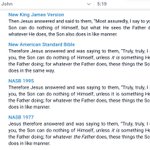
This is the Greek adverb/comparative particle used in John 17 for the phrases translated “even as,” “just as,” or “as.” It means “just as,” “even as,” “in the same way that”
It appears several times in the chapter, including the key unity statements:
John 17:11 that they may be one even as (καθὼς) we are
John 17:21 that they all may be one, even as (καθὼς) You, Father, are in Me and I in You…
John 17:22 that they may be one, just as (καθὼς) We are one
John 17:23 …loved them even as (καθὼς) You have loved Me
καθὼς sets up a comparison… the unity Jesus desires for believers is modeled on the unity that already exists between the Father and the Son.
“The “being” language is just describing what the text shows: one God, three distinct persons who each fully are that God.”
———————————
Each person is a being. At least that’s normally what the words mean.
Seems like word games to me.
I agree that each person is fully God.
So, it isn’t 1/3 + 1/3 + 1/3 =1
It is 1+1+1=3…. but then the New Testament says “and these 3 are one”.
So, then the question comes… In what sense are they three … and in what sense are they one?
How is hen/echad used in the Bible?…

“The Son took on a human nature in addition to His divine nature.”
——————————————
Humans are created “in the image and likeness” of God. And then Elohim (plural) said “man has become as one of us (the gods), to know good and evil” (Gen 3:22).
Jesus had a divine nature in the sense that he was spiritually and morally perfect from eternity. The divide between Deity and humanity is not ontological…. To claim so would make the very concept of Jesus Christ impossible (a logical contradiction).
The purpose of God’s plan is largely so that, through Christ, humanity can “partake in the divine nature” (2 Peter 1:4) through sanctification and resurrection and become like Him.
When the scriptures call God “invisible”. That does not mean an attribute/characteristic of God. It is better translated as “not seen”. Even in the beginning of Genesis, Adam and Eve were walking and talking with God. It was a physical presence. They literally hear God “walking in the garden in the cool of the day” (Gen 3:8). Back there was a separation between the Father and humanity. Jesus Christ serves as the intermediary between God and man. And even seeing Yahweh/Jehovah, the premortal Christ, was dangerous. Moses had to be transfigured to endure His presence. No fallen human can see the Father and live. Nevertheless, “blessed are the pure in heart, for they shall see God.” (Matt. 5:8).