

Patient Advocate: Amyloidosis (killed Mom), ALS, rare neuro diseases. Need Conditional Approval Pathway for Terminal #RareDiseases. Dodgers⚾ Trojans ✌Rams 🏈
Phoenix, Arizona, USA
Joined January 2020
- Tweets20.3K
- Following5.7K
- Followers4.3K
- Likes124K






AZ Latina ☮️🌊🟦 retweeted

Great music knows no boundaries! ❤️
Tonight, the #SoulTrainAwards celebrated the legendary #DollyParton with a soulful tribute honoring her timeless music, incredible songwriting, and influence across generations and genres.
An icon whose legacy transcends music. Give Dolly her flowers! 💐
AZ Latina ☮️🌊🟦 retweeted
My opinion extends far beyond deramiocel. It's about policy concerns and legal requirements for terminal heterogeneous rare disease trials.
1. I agreed with approval of Replimune's Tudriqev for metastatic melanoma
2. Appx 3/4 people had no response on Tudriqev but FDA still approved for subgroup of people who had a CR or partial response.
3. FDA properly compared responses on Tudriqev to natural history.
4. By approving based on P1/2 with no placebo, FDA absolutely exercised regulatory flexibility as required by Subpart E for terminal diseases.
5. Melanoma is not a #raredisease with an unmet need; it has multiple adjuvant treatment options including surgery, chemo, immunotherapies.
6. Melanoma trials don't have statistical barriers that rare disease trials do.
7. Melanoma doesn't have subjective COAs with documented flaws in peer-reviewed data
8. Melanoma isn't vastly heterogeneous like Duchenne that has 5,000 variants
9. FDA is supposed to exercise the "broadest" of regulatory flexibilty in terminal rare diseases and especially in terminal pediatric diseases.
10. CURES requires FDA to consider RWE from OLE and patient experience
11. CURES' intent with RMAT expedited program was to advance regenerative medicines -- cell and gene therapies -- like deramiocel
12. Duchenne has a critical unmet need as there are NO disease modifying treatments for thousands of the 10k boys; no treatments for non-ambulatory boys; no treatments for cardiomyopathy -- which is the common cause of death.
13. Requiring CHILDREN to be on placebo for another multi-year P3 trial is both inhumane and unlikely to provide as much confirmatory data as a P4 study from broader hetereogeneous population
14. The OCE commonly exercises proper regulatory flexibility and grants accelerated approval for cancer therapies with P4 studies when therapies improve survival by just a few months.
15. #Deramiocel L/T OLE data fom P2 is showing a change in cardiac endpoints that are "reasonably likely to predict an impact on mortality" (accelerated approval standard)
16. Administrative Procedures Act requires agencies to "treat like things alike." Failure to do so makes the FDA's decisions "arbitrary & capricous"
17. If approval of Replimune's melanoma therapy for adults -- based on natural history and no placebo -- is appropriate when efficacy is far easier to prove and when there's no umet need, then approval of deramiocel for the 10k dying BOYS -- with no cardiovascular and non-ambulatory treatment options -- deserve even more flexibility and accelerated approval with a P4 study.
18. FDA's statutory risk-benefit analysis should always assess risk of Type II statistical error (false negative) that allows thousands of boys to suffer irreparable harm, paralysis and death.
19. Is the risk of treatment worse than the disease itself? In cancer, FDA rightly believes it's ok to cut, burn (radiation), poison (chemo) as few risks are worse than cancer itself. If SAEs are not worse than the disease itself, I believe regulatory flexibility requires the FDA to give the benefit to the dying patient and his rare disease expert to make informed decisions.
20. I will always believe the DMD experts over FDA review team who has no clinical expertise in the rare disease (contrary to OCE extensive expertise).
To date, I am not dissuaded by the purported data integrity issues. FDA can't justifiably criticize SAPs when it failed to communicate as required by RMAT. Database was not accessed per independent 3rd party. FDA raised no integrity concerns re P2 data. Drop out imputed to worst outcome, which is common statistical practice in rare disease trials. Missing data was because some boys with contractures from DMD disease progression can't lay flat for an hour for cardiac MRI. Common sense that boy who took an excluded but approved therapy and improved on placebo should not be included in mITT analysis; FDA shouldnt penalize other trial participants because a dying patient/parent lied.
Process shouldn't override patients.
@Capricor $CAPR #RareDiseases #EndDMD #EndDuchenne
AZ Latina ☮️🌊🟦 retweeted

The soundtrack of Buffalo.
We love you, @googoodolls. ❤️💙
AZ Latina ☮️🌊🟦 retweeted

He is on a low dose of Lisinipril and Metropolol. These are administered prophylacticlly as part is standard of care. He had to reduce his rates because the Deramiocel was doing its job. The meds you speak of delay decline somewhat. They do not stabilize like Deramiocel has done. You’re also discounting his other benefits from this treatment:
He regained PUL strength - he barely qualified for the trial because he could barely get his hand to his mouth. Even 2 years later, when he finally received treatment, he regained that skill for 6 years. He gained improved immunity/doesn’t get sick as much. Covid was a minor blip in our lives. Has better stamina throughout the day than he had 6 years ago.
At this point, he is struggling to feed himself again. I’ll be forever grateful he was given even those few years of independence. He’s stayed in the trial because he knows if a patient starts earlier in life, it will give a more profound response. He’s stayed in for data integrity - he could try Duvyzat in the hopes of gaining strength. Doing so would kick him from the trial, and would mean less data to get Deramiocel across the finish line, leaving many, many young men living with Duchenne without this viable treatment.
So many of us are tired. We are disgusted by investors celebrating their short sales. We are disgusted with the FDA’s antics. We are disappointed in Capricor’s inability to follow process. I know as a small biz owner it’s a challenge to both produce and sell. And the quagmire that is the FDA must present its own form of hell.
AZ Latina ☮️🌊🟦 retweeted
Since we only got 90 seconds of the halftime show…
Here’s the Goo Goo Dolls performing Iris in the pouring rain in 2004
AZ Latina ☮️🌊🟦 retweeted

Happy Thanksgiving!
Today @YouTube suspended my channel from the YouTube Partner Program for “unsatisfying or off-putting content.”
I have ALS, I’m a full quadriplegic, and I’m nonverbal (@neuralink Patient 3). I use an AI-recreated version of my own pre-ALS voice with @elevenlabsio so I can speak, host interviews, and narrate my videos. It’s not an AI persona or a content farm—it’s literally how I talk.
I just submitted my appeal video below. Would love a human second look, @TeamYouTube @YouTubeCreators!
cc @elonmusk
AZ Latina ☮️🌊🟦 retweeted

We’ve received FDA approval to launch LINK, the first pivotal trial for an implantable brain-computer interface in the US. This builds off of our work with 30+ participants with Neuralink to date.
Those with ALS may be eligible. To learn more:
neuralink.com/trials/device-…
AZ Latina ☮️🌊🟦 retweeted

Since I’m sitting in Sacramento after my son’s deramiocel infusion, here my one woman show about the capricor regulatory saga with me in the role of FDA:
“There’s data integrity issues that prevent us from even interpreting the data. This company is a bunch of liars. LIARS, I say!”
Oh wait, now people are seeing the leaked 483 and the issues are minor? Then it’s not the integrity issues…um, it’s it’s that there is zero evidence of effectiveness, so we can’t even look at related secondaries because that’s post hoc when the primary fails. ZERO, I say!
Wait, the statisticians at adcom are calling us out on that because we made post hoc changes ourselves to get the primary to fail? Then it’s not no evidence of effectiveness, it’s fragile evidence of effectiveness. FRAGILE, I say! But let’s only vote on a secondary outcome and take up all the discussion time on a safety lab’s relationship to that secondary.
So do we then look at the actual primary and whether supportive secondaries have any significance concerns, like it suggests in our own guidance? No, we can’t because data integrity issues! They’re all LIARS! Wait, we tried that.
Umm, no, it’s just EVERYTHING! But we really care so much about you all as patients, and will pat you all on the head to prove it. Pat, Pat, Pat. Don’t you feel cared for? No? Well, I don’t appreciate the tone you’re using to speak to me.”
And scene…
$CAPR #deramiocel #capricor
AZ Latina ☮️🌊🟦 retweeted

Thanks so much to the 8 NFL players who chose to amplify & support ALS research for My Cause, My Cleats
#EndALS
Alex Ward LV
Cameron Thomas ATL
DJ Herman MIA
Jarquez Hunter NO
Kyren Williams LAR
Sirvocea Dennis TB
Toricelli Simpkins CAR
Wayne Matthews III CHI
AZ Latina ☮️🌊🟦 retweeted
Two biggest data-related questions for the division in response to the CRL:
1. What version of the SAP did they use to come up with 0.24? If it was 1.1, that is not the governing document even taking their own concerns into account and its use is an APA violation.
2. If it is any other version, like 1.6 and 1.7, that predate any functional unblinding concerns, did they make any post hoc, unblinded changes to the analysis as pre-specified? And i’m asking about both total pul point change p value and percent change p value? (The answer is yes)
Regarding the two patients:
One started givinostat during the blinded portion of the study, which fda approved for the treatment of Duchenne. It’s in the exclusion criteria for hope-3, so this patient should not be in the ITT population and must be removed. FDA can’t say givinostat is worthy of approval on one hand and on the other hand say we don’t know why this placebo kid did well.
On the other, imputing worst case did benefit deramiocel, but worst case is what was pre-specified. FDA can’t come back and say they don’t like that method now that they know its impact on the p value and change strategies - that’s bias. What they should do is state the concern that the 0.05 goes up with different imputation, and then follow their own guidance by looking at whether related secondaries (mid level PUL and DVA) share the same concern (spoiler: they don’t).
Two unblinding questions:
1. How does a mistake in following the unblinding plan consisting of who would write the SAP compromise the blind if you use a SAP completed during the blinded portion of the study as governing?
2. How does the mistake of carrying two accounts forward into the live environment compromise the blind if the audit proves the holders of the account didn’t access any data?
AZ Latina ☮️🌊🟦 retweeted

$CAPR Inferred bias. Paperwork gaps. A benefit-risk FDA never weighed. That's what cost DMD boys a medicine that showed benefit and held up on safety.
Process should protect patients, not replace them.
@RogerMarshallMD @SenRonJohnson @RobertKennedyJr @CNN @FoxNews @business


AZ Latina ☮️🌊🟦 retweeted
ALS advocates have identified some Iowa farm towns that already have ALS Clusters with heightened incidence (500x) of 100% fatal and paralyzing #ALS. Suspect this is likely from all the pesticide, diesel and TCE exposures. But Lead exposure too is associated with ALS.
Researchers believe that ALS is caused by an Armitage-like confluence of 6 factors. Five factors=safe but exposed to the 6th and get ALS years after exposures. That exposure can be in utero as well.
ATSDR needs to watch these communities for decades to come. Groundwater will be tainted. Suspect they will eventually be on @EPA's #Superfund or Toxic Release Inventory sites lists.
Harder to track will be the contamination to the food supply. What will happen to all the meat, milk and corn sold across the US from these communities?
Encourage @turek4iowa and @RobSandIA to reach out to neurologists Eva Feldman and Steven Goutman at @UMich
Pranger Center. They are leading ALS researchers studying how the exposome is associated with ALS. The Midwest has the highest incidence of ALS. Feldman believes MI is #1 because of combination of agriculture and industrial exposures (including heavy metals like Pb).
Praying for these #Iowa communities.
#IOWALeadBomb #IowaDetonation
#Lead #Army #LeadBomb
@BohannanIowa @RepMMM
@EvaFeldmanMDPhD
AZ Latina ☮️🌊🟦 retweeted

In light of recent events, I wanted to expand upon something I had posted👇 in May regarding what we need to see from the @FDA:
STOP ASKING ONLY “IS IT SAFE ENOUGH TO APPROVE?” — START ASKING “WHAT HAPPENS IF WE DON’T?”
For rare diseases. For serious conditions with no good options. For patients who don’t have ten years to wait for traditional trials that may never be feasible.
Every regulatory decision carries two risks: the risk of approving something, and the risk of not approving it. Both are real. Both affect real people. I’d like to expand upon this:
If a high-profile drug is approved that causes harm, or even potentially causes harm, the moment a patient has a possible drug-related death or serious adverse event, we see news headlines, the company’s stock crashes, and everyone begins to questions whether it should have been approved in the first place.
But what happens when a drug is not approved, for bureaucratic/technical reasons, because it barely missed the VERY arbitrary p<0.05 threshold of “statistical significance” (which simply means there is a <5% chance the results are due to chance), because of pressure from competitors (this happens & I know that for fact), because some think tank says it’s too expensive to be worth the small benefit, or because some Wall Street short seller wants to make a fortune tanking the stock?
Have we EVER read a headline in @statnews or @endpts or @WSJ that reads “Young man dies of disease X because FDA prevented him from accessing a drug that could have helped him”? NO. Why? It doesn’t generate clicks. It doesn’t make anyone money. And no one in the general public would even think that such a thing is possible. But it is. But unlike those who might generate headlines because they used a drug and it potentially harmed them, these patients suffer and die in anonymity. No lessons are learned from their misfortune. No one but their own families knows and even they may not know that a decision made in a small room in Maryland by a PhD biostatistician who has never treated a patient, doesn’t know the disease, and has zero accountability for their life and death decisions, may have led to their tragedy.
THAT is what I mean when I say that for rare disease in particular, FDA must balance the risk of approving not just with the drug’s potential benefits, but ALSO with the very real, deeply consequential risk of NOT approving.
If you’ve never taken care of a patient or known a patient who is suffering, it might be difficult to understand this. But we are talking about fellow humans, fellow Americans. And we need to demonstrate compassion & offer everyone dignity.
When traditional gold-standard trials aren’t practical, we should still be able to move with urgency — but only when paired with strong post-approval commitments and rigorous safety monitoring. We can give desperate patients a chance without abandoning scientific integrity.
I’d love to hear your thoughts.

The FDA Commissioner role is open. This is a pivotal moment for American medicine — & for American patients.
Here’s what I believe the next Commissioner should stand for. Not as a wish list. As a baseline.
🔬 1. BRING BACK THE ADCOMS — AND MAKE THEM COUNT.
Advisory Committee meetings are one of the FDA’s most powerful tools for transparency. They should return in full force. Open. Public. And real.
Patients, doctors, scientists, advocates, & skeptics should all be able to speak. But if you want to speak, you fill out a financial conflict-of-interest form under penalty of perjury — & you read it out loud at the podium before you say another word. Every single person.
And if the issues are complex and the science requires more than one day, then take the time. Don’t cut people off because the schedule says so. The public deserves to see exactly how these decisions are made. Real transparency builds real trust.
⚖️ 2. STOP ASKING ONLY “IS IT SAFE ENOUGH TO APPROVE?” — START ASKING “WHAT HAPPENS IF WE DON’T?”
For rare diseases. For serious conditions with no good options. For patients who don’t have ten years to wait for traditional trials that may never be feasible.
Every regulatory decision carries two risks: the risk of approving something, and the risk of not approving it. Both are real. Both affect real people.
When traditional gold-standard trials aren’t practical, we should still be able to move with urgency — but only when paired with strong post-approval commitments and rigorous safety monitoring. We can give desperate patients a chance without abandoning scientific integrity.
🇺🇸 3. THE FDA’S ONLY CLIENT IS THE AMERICAN PATIENT. FULL STOP.
The FDA exists to serve patients — not outside interests or external pressures of any kind.
It must continue protecting the public from products that carry real, known risks but offer no meaningful clinical benefit.
At the same time, when there is credible evidence that a treatment can help patients with serious conditions, Americans and their physicians should be trusted to make informed decisions once they have complete and honest information about the risks, benefits, and alternatives.
The FDA’s job is to make sure the science is sound and the information is clear. Then let patients and doctors do what’s best for them.
These principles matter because the FDA’s decisions affect every family in this country.
Note: This is a simple social media post and not a massive policy document. The issues are FAR more nuanced, there are challenges and risks with each of the things I said above, and I recognize that. But it's intended to serve as a discussion starter. We must always strive to improve, and we can when we have open debate and dialogue.
AZ Latina ☮️🌊🟦 retweeted

My 17.5 year old son (also on exon skipping) walking into the Lego store to pick out a Lego set to celebrate his 500th infusion. Almost a decade. Please stop saying our approved drugs for Duchenne do not work.
AZ Latina ☮️🌊🟦 retweeted

@adamfeuerstein Billy said to tell u he’s living proof that #eteplirsen is still effective aft 15 yrs/26yo (Jan 6) He asks you how this is not showing efficacy? Know that our community will cont. to advocate as before to get the job done. Shame on us if we don’t! $SRPT #DMD
AZ Latina ☮️🌊🟦 retweeted
After a period of rapid decline, my son Aidan, who is 22 with Duchenne must get this week, started on a new treatment. Now access to that treatment is threatened. If you care about fairness, if you believe in science that reflects reality, please watch this.
AZ Latina ☮️🌊🟦 retweeted
This is great news! 💕

Today, we approved the first medicine for treating limb-girdle muscular dystrophy type 2I/R9 (LGMD2I/R9), a rare, inherited disease. This is the first therapy approved for any form of limb-girdle muscular dystrophy. fda.gov/news-events/press-an…

ALT The image shows a blue background with the FDA logo in the corner. Text reads, "FDA approves first treatment for limb-girdle muscular dystrophy type 2I/R9." Below the text is a ribbon with blue and pink gradients.
AZ Latina ☮️🌊🟦 retweeted

“The circuit board on which the Nvidia chip was installed was stamped “Made in China.” It was unclear how Russia’s military obtained the computers.” nytimes.com/2026/08/24/world…

AZ Latina ☮️🌊🟦 retweeted

There's been a lot of talk about the Hispanic shift in FL, CA, and TX, but not really in AZ. In 26, Hispanics shifted +28 to Democrats in AZ. This is clearest in Yuma County (>60% Hispanic), which hasn't gone Democratic since 2006. This year, all 6 statewide Dems won the county.


AZ Latina ☮️🌊🟦 retweeted

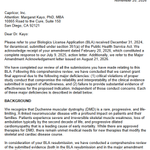
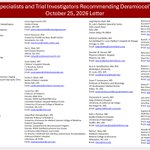
.@FDA has proclaimed their innovative, proactive approach to rare diseases, but will they deliver? By any measure, #deramiocel exceeds the typical burden of evidence for efficacy and safety in a rare disease, with no less than 5 positive clinical trials. But FDA has yet to approve this novel cell therapy for #Duchenne muscular dystrophy. Meanwhile, boys and young men with advanced #DMD—precisely those who stand to benefit most from deramiocel—are awaiting this potentially transformational therapy. It’s time for FDA to do more than talk about rare diseases! The 28 authors of our recent @TheLancet HOPE-3 paper wrote the attached letter making these points to @FDA-- have a look!
Link for full letter lnkd.in/p/gptcbDKX


