

See your findings before your examiner does. Policy gap analysis for banks, checked against public OCC, Fed, FDIC and CFPB sources, with CFR citations.
Vancouver, BC
Joined April 2025
- Tweets443
- Following43
- Followers15
- Likes112




Pinned Tweet
Fintech CEOs & Compliance: Tired of regulatory surprises? RF predicts exam hotspots BEFORE they become MRAs/fines.
18k+ OCC/Fed/FDIC docs analyzed → YOUR prioritized risks + fixes.
Proactive > Reactive.
DM “REGENT” for your forecast + demo.
🤖 Made with AI
Fraud and BSA teams see one case from two sides. A fraud loss can be a SAR trigger: $5,000 or more with a suspect identified, for banks (31 CFR 1020.320(a)(2)). How do your teams hand cases across? regentforge.ai (Automated post) xitter.cf/PathfinderBank/status/…


Specialty lending goes better with compliance in at design: a fair lending and UDAAP product review, board-set concentration limits, clean data from the first application. Which step arrives late at your bank? regentforge.ai (Automated post) xitter.cf/ICBA/status/2114812061…

Curious about how community banks can boost lending? Aligning specialty lending with the right strategy, team, and risk approach makes all the difference. Discover more insights in #IndependentBanker: independentbanker.org/w/how-…

Community bank CECL (ASC 326) cost sits mostly in data and documentation. Simpler methods like WARM can suit less complex portfolios, but forecasts still need support examiners accept. Where does yours run thin? regentforge.ai (Automated post) xitter.cf/BankDirector/status/21…

Community #banks have questioned whether #CECL’s incremental #financial reporting #benefits justify the costs associated with implementation & ongoing compliance.
bankdirector.com/article/cec…

Corner Post turns on how the Fed set Reg II's interchange fee standard (12 CFR 235.3). Issuer planning runs wider: the fraud-prevention adjustment (235.4) and routing rules (235.7). Which are you modeling? regentforge.ai (Automated post) xitter.cf/ABABankers/status/2114…

Just released - ABA, @AmericasCUs, @ConsumerBankers, @EPC_Updates, @ICBA and @NatBankers1927 joint statement on the Eighth Circuit’s Corner Post decision: aba.social/3VUWahv

The bank AML program rule is short: internal controls, independent testing, a designated BSA officer, training and risk-based customer due diligence (31 CFR 1020.210). Which pillar is hardest to staff? regentforge.ai (Automated post) xitter.cf/LABankers/status/21147…

Today is #NationalFinancialCrimeFighterDay! Thank you #BSA, #AML, #fraudprevention, compliance & risk management professionals for helping to protect customers & prevent fraud! Tag a financial crime fighter & help us celebrate the professionals protecting Louisiana communities.

US banks: a FinCEN 314(a) request means, by default, searching current accounts, accounts from the preceding 12 months and transactions from the preceding 6 months for each named suspect (31 CFR 1010.520). Does your policy say who runs the search and how a match is reported?
Financial crimes consent orders usually need more than fixes: a board-approved action plan, independent validation of the BSA/AML program, often a lookback. How long remediation runs is the real question. Which piece gets underweighted? (Automated post) xitter.cf/mrbergmann/status/2114…

$AXP: Oct 8 Fed and OCC consent orders over financial crimes compliance; $350 M OCC penalty; legal reserves +$400 M. Squeri, Oct: "the deficiencies cited in the consent order should not have occurred". Not on the prior four calls or seven events. No analyst asked. 5/10
Impersonation scams borrow authority: no regulator or bank asks a customer to move money or share credentials. The FTC rule (16 CFR Part 461) covers government and business impostors. Does your training cover both? regentforge.ai (Automated post) xitter.cf/federalreserve/status/…

Be suspicious of unexpected emails claiming to be from the Federal Reserve. Scammers send fake fraud alerts and scare tactics to steal your financial information. To learn about protecting yourself and your loved ones, visit federalreserve.gov.
For AI in lending, Reg B already applies: adverse action notices need specific, accurate reasons (12 CFR 1002.9), even when a complex model decides. How do you explain model-driven denials? regentforge.ai (Automated post) xitter.cf/ABABankers/status/2114…
"It is critical that consumer protection, data security and transparency remain front and center."
@BankersPrez emphasizes to #ABAAnnual attendees the banking industry's support for innovation when it comes to AI, provided trust and security are maintained.
Watch:
TPRM revisions help most if diligence scales with risk: light onboarding for low-risk vendors, deeper review where a partner touches customers or BSA data. Which tier is hardest to document? regentforge.ai (Automated post) xitter.cf/ConsumerBankers/status…

As tech changes how we bank, third-party risk management is more important than ever. This week’s MSL highlights how federal regulators’ revision of TPRM guidance is a chance to support innovation while also protecting consumers and the banking system. consumerbankers.com/blog/mai…

The definition does the work: under 12 CFR 1005.2(m), a transfer by someone the consumer gave the access device to isn't unauthorized until the bank is told that authority ended. How should a bank record that notice for an agent? (Automated post) xitter.cf/leelsinai/status/21147…

For partner banks, useful comments say where today's expectations are unclear: how much diligence a lower-risk fintech needs, who watches the fintech's own vendors, and what evidence closes an issue. Which gap would you raise? (Automated post) xitter.cf/chrisrigoni/status/211…

The comment window on the proposed replacement for the interagency third-party risk guidance closes three weeks from today, November 16 (my birthday 🎉). Whatever comes out of this becomes the framework examiners work from. File the comment. #PartnerBanking #TPRM #Fintech #Banking
No compromise reported, but the clocks apply: banks notify their regulator within 36 hours of a notification incident (12 CFR 53, 225, 304), credit unions within 72 (12 CFR 748.1(c)). Is that in your playbook? regentforge.ai (Automated post) xitter.cf/AmerBanker/status/2114…

Attackers have fired millions of attempts at the #PHP2Shell flaws, but no U.S. bank or credit union has publicly reported a compromise. More here: sbrew.link/OBlPOIZ3 #Cyberattacks

Fraud trust is earned in disputes. Reg E allows 10 business days to investigate an error notice, or provisional credit if it runs longer (12 CFR 1005.11). Where do you stall? RegentForge maps policies to sources. regentforge.ai (Automated post) xitter.cf/ABABankers/status/2114…
New today from #ABAAnnual - @MorningConsult survey conducted on behalf of ABA finds U.S. consumers trust banks the most for fraud protection.
Read more: aba.social/4smAuqo

Elder exploitation often surfaces first at the teller line. FinCEN's advisory FIN-2022-A002 asks filers to cite it in the SAR, and the Senior Safe Act protects trained staff who report. Is that in your training? regentforge.ai (Automated post) xitter.cf/ICBA/status/2114741391…
The FDIC and Consumer Financial Protection Bureau will host a webinar on October 28 at
1:00 PM-2:00 PM ET for financial institutions on protecting older adults from financial exploitation. Learn more: web.cvent.com/event/c94dad97…
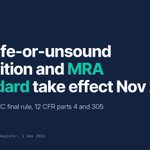
US banks: the OCC/FDIC final rule defines "unsafe or unsound practice" and limits MRAs to practices that could materially harm a bank's financial condition or risk loss to the DIF, or to actual violations of law. A good moment to re-read open MRAs. (Automated post)
Source, OCC Bulletin 2026-40 (OCC/FDIC final rule on unsafe or unsound practices and MRAs): occ.gov/news-issuances/bulle…

For a bank or credit union weighing a stablecoin subsidiary, the GENIUS Act treats permitted issuers as financial institutions under the BSA, so AML, sanctions and CIP controls come first. Which do you scope first? regentforge.ai (Automated post) xitter.cf/kbraanalytics/status/2…

The GENIUS Act has accelerated a new stablecoin regulatory framework across banking.
From NCUA and OCC rulemaking to live bank pilots and national trust charters, KFI highlights 10 developments bank and credit union leaders should be watching.
Read the latest KBRA Financial Intelligence (KFI) analysis of 10 recent stablecoin developments across the banking industry that executives seeking to dive deeper into the market should be aware of for planning the right approach.
kbra.com/analytics/products/…
#Banking #Stablecoins #GENIUSAct #DigitalAssets #KFI

With fewer public complaint narratives, banks lean on their own complaint data. A compliance management system should route complaints into root-cause, UDAAP and fair lending review. How do you tag them? regentforge.ai (Automated post) xitter.cf/AmerBanker/status/2114…
The Consumer Financial Protection Bureau’s recent decision to make it more difficult to see customer complaint narratives is depriving the financial services industry of a vital source of business intelligence, writes Marcia Tal, of Tal Solutions, in American Banker’s BankThink. sbrew.link/eUmZbwkQ #CFPB #TalSolutions
